Abstract
The article examines the perception of an artistic work by younger schoolchildren using a comparative analysis of a literary text. The Federal State Educational Standard for Primary General Education sets one of the requirements for the literary development of younger students: the mastery of universal educational communicative actions. In order for a student to engage in active communicative activity with the text being studied in the classroom, it is necessary to use analytical techniques that will help the student to approach the text, feel it, and become interested in it. This will then lead to a dialogue between the reader and the writer. These tasks are not easy to accomplish. To solve them, it is important to create an environment where the process of analyzing a literary text becomes natural for the young reader. Using comparative analysis will help create such conditions. The purpose of this work is to identify the methodological conditions for using comparative analysis as a means of improving the perception of younger students when working with literary texts. The level of perception of an artistic work among third grade students is revealed. The relevance of this research is driven by the need to develop a series of lessons where comparative analysis techniques will organize perception at different stages of working with it. These techniques will be aimed at fostering in primary school students the ability to compare a literary text (specifically a short story) with other literary texts and its interpretation across various art forms.
Keywords
Perception, Fiction, Story, Comparative Analysis
1. Introduction
The first step in the reader's interaction with a literary text is the perception stage. This stage forms the basis for further analysis, and the next step leads to the creative process of interpretation. Students tend to have a more fragmented perception, as they focus on the objects with the most prominent features and details, regardless of their significance. This makes it challenging to select an episode or character for in-depth analysis and interpretation to reveal their unique characteristics.
| [12] | Benesh N., Papina M., Pozdeeva S. To the problem of developing children's interest in reading: search for effective working techniques // Ped. Rev.. 2021. |
[12]
According to M. A. Rybnikova, the perception of a work is a process that involves purposeful observation of life phenomena and their expression in speech, as well as comparison with similar observations made by the writer. Personal experience, combined with the author's experience, enriches the student's inner world, making their perception more sensitive and contributing to the comprehensive development and education of their personality. M. A. Rybnikova emphasizes that "empathy" is an integral part of this process, as it activates students and motivates them to engage in further reflection and reasoning
| [4] | Rybnikova, M. Essays on the methodology of literary reading. — 3rd ed. — M.: Uchpedgiz, 1963. — 313, p., 1 l. portr. — Temat. Decree: pp. 309-311. |
[4]
.
T. V. Ryzhkova describes the perception of a work of art as "a complex mental and psychological process, a special form of activity that involves various aspects of the psyche"
| [5] | Ryzhkova T. Theoretical foundations and technologies of primary literary education: a textbook for students. higher. academic year. Institutions/ T. V. Ryzhkova. - M.: Publishing center "Academy" 2013- 416 p. |
[5]
.
T. G. Brazhe shares the opinion of T. V. Ryzhkova, believing that students need a stage in the lesson related to the primary perception of what they have read, as “when analyzing a literary work in the classroom, it is necessary to proceed from the students’ initial ideas about it”
| [3] | Brazhe, T. On the variability of analysis // The art of analyzing a work of art: a manual for teachers / comp. T. G. Brazhe. M.: Prosveshchenie, 1971. pp. 37-54. |
[3]
. These words confirm what was said above that perception is based not only on information received through the senses in the present, but also on each person’s personal experience.
Research by N. D. Moldavskaya, M. P. Voyushina, and other Russian researchers is considered to be one of the most important works, which identify the levels of perception of literary works, showing the understanding and evaluation of images by readers, as well as the features of perception of complex literary works. The deepening of students' perception of a literary work can be achieved through the use of various methods, technologies, and artistic means, which, when combined with the teacher's teaching process, will yield results.
| [1] | Voyushina, M., Kislinskaya S., Lebedeva E. and others. Methods of teaching literature in elementary school: a textbook for students. higher. studies. M.: Publishing Center "Academy", 2010. 288 p. |
| [2] | Voyushina, M. Methodological Foundations of Literary Development of Primary School Students: Methodological Foundations of Language Education and Literary Development of Primary School Students: A Guide for Students of Primary Education Faculties and Primary School Teachers / Edited by T. G. Ramzaeva. St. Petersburg: Special Literature, 1997. 168 p. |
| [6] | Literary development of schoolchildren in the learning process [Text] / N. D. Moldavskaya; Scientific research. in-t content. and methods of teaching APN USSR. Moscow: Pedagogika Publ., 1976. 224 p. |
| [7] | Lyubeznova, Y. The relevance of comparative analysis of literary works in schools / Yu. V. Lyubeznova. — Text: direct // Pedagogical Mastery: materials of the XLII International Scientific Conference (Kazan, January 2023). — Kazan: Young Scientist, 2023. |
| [8] | Comparative analysis of texts as a means of developing a reading culture and critical thinking: a teaching and methodological guide / G. Ivanenko. – Chelyabinsk: A. Miller Library, 2023. – 59 p. |
[1, 2, 6-8]
The methodology of literary education includes a large number of methods and tools aimed at solving problems and achieving results in accordance with the Federal State Educational Standard for Primary General Education
| [15] | Federal State educational standard of primary general education [Electronic resource]. |
[15]
. One type of such tool is comparative analysis.
Comparative analysis is based on the operation of "comparison." A. M. Novikov describes comparison as a cognitive operation that underlies judgments about the similarity or difference of objects
| [14] | Novikov A. M., Novikov D. A. Methodology, Moscow: SIN-TAG, 668 p. |
[14]
.
Comparison, as a logical operation, is a vital skill. In the context of education, comparison is a meta-subject result that is also important for solving the challenges of literary education.
| [13] | Bardakova V. Comparative analysis of literary works in primary school literary reading lessons // Izvestiya VGPU. 2022. |
[13]
The ability to compare different components of a literary work based on predetermined criteria for identifying similarities or differences contributes to the development of analytical thinking and creativity in students, which is essential for their full appreciation of art.
It should be noted that the School of Russia school textbooks contain a small number of tasks aimed at comparative analysis. Most often, these tasks involve comparing an episode from a fairy tale (either literary or Russian folk) with a work of art. However, there are few tasks related to the short story as a literary genre. There is a lack of such tasks and activities that focus on comparing not only the characters within a single work, but аlso the works themselves across different genres to identify their distinctive features.
| [11] | Zhelnova, K. How Modern Junior Schoolchildren Perceive Artistic Subtext / K. A. Zhelnova. — Text: direct // Young Scientist. — 2016. — No. 29 (133). — Pp. 570-574. |
[11]
The use of various types of juxtaposition in the classroom helps to solve the following tasks:
1) A deeper analysis of the work, identifying cause-and-effect relationships and interactions between characters, in order to understand the work. Juxtaposition helps students to gain a deeper understanding of the content of the work, identifying its main ideas, themes, and symbolism.
2) The development of critical thinking. Juxtaposition of texts can lead to discussions among students, which can result in a deeper analysis of the work and the identification of more details. The development of students' critical thinking helps them to gain a more comprehensive understanding of a literary work and its author, as well as to compare and evaluate information.
3) The difference between literary genres. Comparing different literary works allows students to identify the characteristics of different styles and genres, as well as to evaluate their features and expressive means.
In our article, we are discussing the genre of short stories. A short story is a short piece of fiction that tells a story or event. Short stories are typically short in length and have a simple structure, making them accessible to beginner readers. They can range in content and form, from humorous and entertaining to sad and captivating. In elementary school, short stories are used to develop imagination, language skills, and an understanding of fiction and its different genres.
A comparative analysis allows the student to see parallels and contrasts between different texts, authors, characters, or plots. To deepen the understanding of a story through a comparative analysis in a literature class, students should be encouraged to compare the story with other works that share similar themes, plots, or characteristics, or with other works of art such as paintings, drawings, or audio and video clips. During the analysis process, you can pay attention to the following aspects:
1) Comparing the style and language of the authors. What artistic techniques are used in both works? What storytelling techniques are employed to create imagery and atmosphere?
2) Analyzing the characters. What are the similarities and differences between the characters in the stories? What motivations and internal conflicts do the characters have?
3) Examining the themes. What themes and ideas are present in both works? How do the authors approach the discussion of these themes?
4) Examining the plot. How does the plot develop in the stories? Are there any parallels in the narrative structure, or is the plot different?
When comparing stories from the same author's cycle, it is important to pay attention to the following criteria, which we have derived from the analysis of methodological literature:
Theme and plot. It is necessary to identify the themes, plots, and motifs present in the stories. Pay attention to recurring motifs, characters, events, and settings.
Style and language. The techniques used by the author may vary from story to story in order to convey the author's perspective on the characters or events.
Characterization of the characters. Studying the characters and their motivations, as well as their development and interactions in different stories, is essential for comparison purposes.
Artistic ideas and messages. Identifying the ideas and values that the author is trying to convey through their stories helps us understand the author's intention.
We decided to identify the level of reading comprehension of a literary text among primary school students.
2. Materials and Methods
The experimental study was conducted at Gymnasium No. 433 in the Kurortny District of St. Petersburg. The experiment involved 22 students from the 3A grade. Based on the literature studied, the following methods were chosen to determine the level of perception in younger students:
Method 1. "Diagnosis of Perception of a Literary Work" by M. P. Voyushina - answers to questions | [1] | Voyushina, M., Kislinskaya S., Lebedeva E. and others. Methods of teaching literature in elementary school: a textbook for students. higher. studies. M.: Publishing Center "Academy", 2010. 288 p. |
| [10] | Modernization of Literary Education and Development of Primary School Students: A Monograph / M. P. Voyushina. - Saint Petersburg: Sudarynya, 2007. - 318 p. |
Students are asked to read the text "You Can't Avoid Trouble" by R. Pogodin and complete a questionnaire consisting of 8 tasks. The tasks are aimed at identifying the development of criteria for perception and understanding of a literary text.
| [9] | Brick Islands [Text]: Stories about Keshka and his friends / Rady Pogodin; illus. by N. Salienko. — Moscow; St. Petersburg: Rech, 2015. — 140. |
[9]
M. Voyushina identified the criteria for perceiving and understanding the text of a literary work:
1) the ability to express one's opinion about what has been read;
2) the ability to determine the dynamics of emotions and the change of moods of the characters in the work;
3) the ability to determine the motives of the characters' actions in the text;
4) the ability to distinguish and determine the author's position;
5) understanding the artistic idea of the text.
The questions on Radiy Pogodin's story "You Won't Get Out of Trouble" from the collection "Brick Islands" for the ascertaining experiment focus on areas such as emotions, imagination, and thinking.
1) Did you like the story? Why? (2 points)
2) Do you feel sympathy for any of the characters in the story? Why? (2 points)
3) Why did Lyudmilla get angry with Keshka? (3 points)
4) Why do you think the author uses the expression "white flies"? (3 points)
5) The author uses a lot of ellipses in the story. Why do you think that is? (1 point)
6) How do you understand the expression "You can't avoid trouble"? (3 points)
7) Create two color scales. Show how Kesha's mood changed and how Lyudmilka's mood changed during their meeting. (2 points)
8) Draw an illustration for this story and justify your choice of the episode to illustrate. (2 points)
Table 1. Levels of perception of an artistic work.
Perception level | Points for answering the questions |
Idea level | 15 - 18 points |
Hero level (analytical) | 12 - 14 points |
Statement level | 8 - 11 points |
Fragmentary level | Up to 8 points |
Method 2. "Diagnosis of the zone of the nearest and actual level of development of younger schoolchildren's literary work" by M. P. Voyushina - to compose questions for classmates.
Each child was given the text of Radiy Pogodin from the collection "Brick Islands" - "Just a Story". The students were tasked with formulating questions for the work. The questions should not only be of a reproductive nature, but also aimed at a deep understanding of the content and the artistic idea. The criteria used were the same:
a) the ability to express one's opinion about what has been read;
b) the ability to determine the dynamics of emotions, the change of moods;
c) the ability to determine the motives of the characters' actions in the text;
d) the ability to distinguish and determine the author's position;
e) understanding the artistic idea of the text.
3. Results
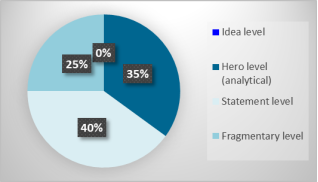
Based on the collected and analyzed data from the first diagnostic, the level of students' perception was determined. The percentage of the levels of perception of a literary work is presented in
Figure 1.
Table 2. Levels of perception of an artistic work.
Perception level | Points for answering the questions |
Idea level | 0 |
Hero level (analytical) | 7 |
Statement level | 8 |
Fragmentary level | 5 |
Total | 20 |
Figure 1. Level of Perception of a Work by 3rd Grade Students.
The analysis of the results of the methodology showed that out of the 20 respondents participating in the study, there are no students in the class with the "idea" level, which is normal, as it is only by the fourth grade that children should be close to this level.
7 children, or 35% of the respondents, are at the "hero" level. This level of perception is characterized by the ability of children to see the dynamics of the characters' emotions and relate them to their own feelings caused by certain actions or events. The students described their feelings and were able to explain them, accurately identifying the motive behind Lyudmilka's actions and providing explanations for her behavior. In their answers, some of the children used quotes from the text: "She had such a bad temper." 15% of the students (3 students) are at a transitional level, as their answers go beyond a specific character.
8 people - 40% of the respondents - have a descriptive level. 10% of children (2 students) move from the descriptive level to the level of a hero, which was evident in their detailed responses. At the descriptive level, children can identify changes in the emotional state of the characters and follow their dynamics, but they struggle to express their emotional reactions to the characters, their actions, and the overall story. The children were unable to fully explain the author's use of artistic expression.
A quarter of the respondents (25%) - 4 people - have a fragmentary level, which is the lowest of all. The children do not have a holistic perception of the work, and they focus only on individual events or characters. When answering the questions, the students used one-word, unраспространенные предложения «Yes/No/I don't know». They were unable to convey feelings and emotions, or to argue their opinions, but they were able to show the dynamics of the characters' emotions - Keshka and Lyudmilla - using a color scale. The children did not use the text of the work when answering the questions, and they relied solely on their memory. Imagination is poorly developed, which was evident in the task of illustrating the episode. This is below the norm for a third-grade student.
Most of the students had difficulty answering the question "Why does the author use a large number of ellipses in the story?" The most common answers were based on the children's personal experiences in Russian language classes, where ellipses are used to indicate missing letters or words. However, some students believed that ellipses were necessary to shorten the text or sentence and avoid writing a large number of words. These responses demonstrate a lack of understanding of the role of ellipses in sentences and the overall structure of the story. Another question that none of the children were able to answer in detail was "How do you understand the expression 'you can't avoid trouble'?" Many children drew on their personal experiences and provided specific examples to illustrate when this expression might be used, while some children simply explained it as "a lot of problems" without delving into its meaning.
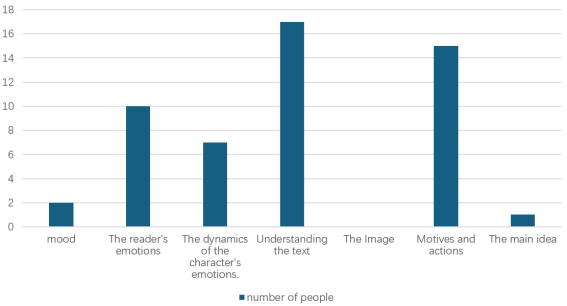
During the second diagnostic, which involved creating questions for their classmates, the results are shown in
Figure 2 and
Table 3.
Table 3. Characteristics of the questions asked by students based on Radiy Pogodin's story "Just a Story" from the collection "Brick Islands".
Characteristics of the questions asked by the students | Number of questions | Percentage ratio |
Definition of emotional mood | 2 questions | 1, 22% |
Identifying the reader's emotions | 11 questions | 6, 71% |
Identifying the characters' emotions (changing their moods) | 13 questions | 7, 93% |
Questions about understanding the text | 111 questions | 67, 68% |
Questions about imagination | 0 questions | 0% |
Questions about understanding the motives of the characters' actions | 26 questions | 15, 85% |
Figure 2. Characteristics of the questions asked by students.
The stating study showed that out of 18 people, not a single child asked a question about imagination, so the percentage for this criterion was 0%. At the same time, the first place is occupied by questions on the understanding of the text - 67, 68%. These questions are of a reproductive nature. In the works of students, there could be from 5 to 10 questions related to the content: the sequence of events, who the characters are, what they look like. Such questions show a superficial understanding of the work, however, they are necessary for the initial perception in order to understand the main plot. (Examples of questions: "What was the hero's name?", "Where did the ribbon go?", "Who was drowning?", "What was the smell like?", and so on). These types of questions do not require deep thought, delving into the idea of the work, or addressing the underlying issues.
Deeper perception included issues related to the actions and emotions of the characters. The criterion of "character motives" is in second place - 15, 85%. Almost all the respondents paid attention to the actions of the heroes, using the questions "Why was Lyudmila teasing/ Why did the neighbors come out to save?) Such questions help readers form their own opinions and attitudes towards the characters. Younger students can analytically put themselves in the characters' shoes in order to evaluate their actions, motives for such behavior, and convey emotions. Therefore, there were enough questions in the diagnosis: "What would you do in such a situation?", "What would you do if you were in Tolik's place?", "What would you do when you saved Keshka?". Motives of actions are closely related to the emotions of the characters (7.93%) and the emotions of readers (6.71%). The students focused not only on the readers' emotions - "Did you like the story and why?", but also asked questions that could reveal the character of the hero and their behavior. The main characters of the work take center stage in the questions asked by younger students, but these questions are not primarily aimed at creating a complete image of the character, including not only their appearance and actions, but also their personality, emotions, and motivations. This is still difficult for them to comprehend.
4. Discussion
To determine the level of perception, students were asked to use M. Voyushina's methods, which involve working with questions based on the text to check understanding of the content and creating questions based on the story. The results of the first and second methods showed the following findings. At the hero level, 35% of students performed well. This level is characterized by the enumeration of the main events, characters, and details identified. Recreating the character's image requires specific details, so the younger student lists all the details mentioned in the text. They primarily focus on the events and the sequence of actions in the story. It is difficult to establish cause-and-effect relationships between events, as well as to understand the emotions and experiences of the characters, as this does not evoke an emotional response in the child.
40% of students are at the ascertaining level of perception, which is characterized by the fact that the child can determine the motives of the characters, evaluate their actions, and express their own point of view. The students have a developed emotional attitude towards the entire work, which allows them to describe the characters in a vivid manner based on the author's details. It is worth noting that the students' accurate determination of the characters' motives helps them in evaluating and justifying their opinions, but it can be challenging to understand the author's intentions.
The second method showed that students tend to analyze works superficially, without going beyond a specific image; they pay attention to their emotions as readers and to the dynamics of the characters' emotions. Students find it difficult to understand the use of author's means and to determine the artistic intention.
The results indicate that students do not always have the ability to communicate with the text of a work and find answers to their questions within the text itself. Students' responses are not always emotional and tend to be brief, lacking details and deep reflection. Additionally, few students pay attention to the artistic details created by the author, and not all students are able to identify the author's intention.
Based on these findings, it is evident that there is a need for a series of lessons aimed at deepening students' understanding of the text through comparative analysis.
5. Conclusion
The conclusion section should precisely articulate the main findings of the article, emphasizing its significance and relevance. The perception of literary text in primary school students is below the age norm. This indicates a lack of development in the components of perception, as most fourth-grade students are at the descriptive level of perception, while the age norm for literary development is the analytical level. Therefore, it is necessary to create and conduct a series of lessons using the artistic tool of comparative analysis, which not only deepens understanding of the text but also develops critical thinking. Comparing different stories helps students to establish cause-and-effect relationships between events, characters, and themes that may be shared among the stories. This work develops students' analytical skills, allowing them to evaluate literary works from different perspectives. The dynamic atmosphere of the lesson using this method enables students to think independently and draw conclusions through a dialogue between students and the teacher.
Thus, it is necessary to develop a methodology using comparative analysis as a means of perceiving a literary work using the short story genre as an example.
Abbreviations
St. Petersburg | Saint Petersburg |
Author Contributions
Svetlana Belorussova: Writing – review & editing
Arina Mayorova: Writing – original draft
Data Availability Statement
The data that support the findings of this study can be found at: https://doi.org/10.12737/2500-3305-2025-10-1-44-51
Conflicts of Interest
The authors declare no conflicts of interest.
References
| [1] |
Voyushina, M., Kislinskaya S., Lebedeva E. and others. Methods of teaching literature in elementary school: a textbook for students. higher. studies. M.: Publishing Center "Academy", 2010. 288 p.
|
| [2] |
Voyushina, M. Methodological Foundations of Literary Development of Primary School Students: Methodological Foundations of Language Education and Literary Development of Primary School Students: A Guide for Students of Primary Education Faculties and Primary School Teachers / Edited by T. G. Ramzaeva. St. Petersburg: Special Literature, 1997. 168 p.
|
| [3] |
Brazhe, T. On the variability of analysis // The art of analyzing a work of art: a manual for teachers / comp. T. G. Brazhe. M.: Prosveshchenie, 1971. pp. 37-54.
|
| [4] |
Rybnikova, M. Essays on the methodology of literary reading. — 3rd ed. — M.: Uchpedgiz, 1963. — 313, p., 1 l. portr. — Temat. Decree: pp. 309-311.
|
| [5] |
Ryzhkova T. Theoretical foundations and technologies of primary literary education: a textbook for students. higher. academic year. Institutions/ T. V. Ryzhkova. - M.: Publishing center "Academy" 2013- 416 p.
|
| [6] |
Literary development of schoolchildren in the learning process [Text] / N. D. Moldavskaya; Scientific research. in-t content. and methods of teaching APN USSR. Moscow: Pedagogika Publ., 1976. 224 p.
|
| [7] |
Lyubeznova, Y. The relevance of comparative analysis of literary works in schools / Yu. V. Lyubeznova. — Text: direct // Pedagogical Mastery: materials of the XLII International Scientific Conference (Kazan, January 2023). — Kazan: Young Scientist, 2023.
|
| [8] |
Comparative analysis of texts as a means of developing a reading culture and critical thinking: a teaching and methodological guide / G. Ivanenko. – Chelyabinsk: A. Miller Library, 2023. – 59 p.
|
| [9] |
Brick Islands [Text]: Stories about Keshka and his friends / Rady Pogodin; illus. by N. Salienko. — Moscow; St. Petersburg: Rech, 2015. — 140.
|
| [10] |
Modernization of Literary Education and Development of Primary School Students: A Monograph / M. P. Voyushina. - Saint Petersburg: Sudarynya, 2007. - 318 p.
|
| [11] |
Zhelnova, K. How Modern Junior Schoolchildren Perceive Artistic Subtext / K. A. Zhelnova. — Text: direct // Young Scientist. — 2016. — No. 29 (133). — Pp. 570-574.
|
| [12] |
Benesh N., Papina M., Pozdeeva S. To the problem of developing children's interest in reading: search for effective working techniques // Ped. Rev.. 2021.
|
| [13] |
Bardakova V. Comparative analysis of literary works in primary school literary reading lessons // Izvestiya VGPU. 2022.
|
| [14] |
Novikov A. M., Novikov D. A. Methodology, Moscow: SIN-TAG, 668 p.
|
| [15] |
Federal State educational standard of primary general education [Electronic resource].
|
Cite This Article
-
APA Style
Belorussova, S., Mayorova, A. (2026). Comparative Analysis as a Means of Perception of an Artistic Work (Using the Example of a Short Story). International Journal of Science and Qualitative Analysis, 12(1), 15-21. https://doi.org/10.11648/j.ijsqa.20261201.12
 Copy
|
Copy
|
 Download
ACS Style
Belorussova, S.; Mayorova, A. Comparative Analysis as a Means of Perception of an Artistic Work (Using the Example of a Short Story). Int. J. Sci. Qual. Anal. 2026, 12(1), 15-21. doi: 10.11648/j.ijsqa.20261201.12
Copy
|
Download
AMA Style
Belorussova S, Mayorova A. Comparative Analysis as a Means of Perception of an Artistic Work (Using the Example of a Short Story). Int J Sci Qual Anal. 2026;12(1):15-21. doi: 10.11648/j.ijsqa.20261201.12
Copy
|
Download
-
@article{10.11648/j.ijsqa.20261201.12,
  author = {Svetlana Belorussova and Arina Mayorova},
  title = {Comparative Analysis as a Means of Perception of an Artistic Work (Using the Example of a Short Story)},
  journal = {International Journal of Science and Qualitative Analysis},
  volume = {12},
  number = {1},
  pages = {15-21},
  doi = {10.11648/j.ijsqa.20261201.12},
  url = {https://doi.org/10.11648/j.ijsqa.20261201.12},
  eprint = {https://article.sciencepublishinggroup.com/pdf/10.11648.j.ijsqa.20261201.12},
  abstract = {The article examines the perception of an artistic work by younger schoolchildren using a comparative analysis of a literary text. The Federal State Educational Standard for Primary General Education sets one of the requirements for the literary development of younger students: the mastery of universal educational communicative actions. In order for a student to engage in active communicative activity with the text being studied in the classroom, it is necessary to use analytical techniques that will help the student to approach the text, feel it, and become interested in it. This will then lead to a dialogue between the reader and the writer. These tasks are not easy to accomplish. To solve them, it is important to create an environment where the process of analyzing a literary text becomes natural for the young reader. Using comparative analysis will help create such conditions. The purpose of this work is to identify the methodological conditions for using comparative analysis as a means of improving the perception of younger students when working with literary texts. The level of perception of an artistic work among third grade students is revealed. The relevance of this research is driven by the need to develop a series of lessons where comparative analysis techniques will organize perception at different stages of working with it. These techniques will be aimed at fostering in primary school students the ability to compare a literary text (specifically a short story) with other literary texts and its interpretation across various art forms.},
 year = {2026}
}
Copy
|
Download
-
TY  - JOUR
T1  - Comparative Analysis as a Means of Perception of an Artistic Work (Using the Example of a Short Story)
AU  - Svetlana Belorussova
AU  - Arina Mayorova
Y1  - 2026/08/22
PY  - 2026
N1  - https://doi.org/10.11648/j.ijsqa.20261201.12
DO  - 10.11648/j.ijsqa.20261201.12
T2  - International Journal of Science and Qualitative Analysis
JF  - International Journal of Science and Qualitative Analysis
JO  - International Journal of Science and Qualitative Analysis
SP  - 15
EP  - 21
PB  - Science Publishing Group
SN  - 2469-8164
UR  - https://doi.org/10.11648/j.ijsqa.20261201.12
AB  - The article examines the perception of an artistic work by younger schoolchildren using a comparative analysis of a literary text. The Federal State Educational Standard for Primary General Education sets one of the requirements for the literary development of younger students: the mastery of universal educational communicative actions. In order for a student to engage in active communicative activity with the text being studied in the classroom, it is necessary to use analytical techniques that will help the student to approach the text, feel it, and become interested in it. This will then lead to a dialogue between the reader and the writer. These tasks are not easy to accomplish. To solve them, it is important to create an environment where the process of analyzing a literary text becomes natural for the young reader. Using comparative analysis will help create such conditions. The purpose of this work is to identify the methodological conditions for using comparative analysis as a means of improving the perception of younger students when working with literary texts. The level of perception of an artistic work among third grade students is revealed. The relevance of this research is driven by the need to develop a series of lessons where comparative analysis techniques will organize perception at different stages of working with it. These techniques will be aimed at fostering in primary school students the ability to compare a literary text (specifically a short story) with other literary texts and its interpretation across various art forms.
VL  - 12
IS  - 1
ER  -
Copy
|
Download








 Share This Article
 Twitter
 Linked In
 Facebook