Abstract
This analysis presents a comprehensive, end-to-end operational model for a railway system without Travelling Ticket Examiners (TTEs), arguing that a simple technology replacement for ticket checking is fundamentally flawed. An operational deconstruction reveals the TTE's primary functions are not enforcement but the management of on-board safety, security, and passenger service, which cannot be automated. Consequently, a successful solution must be an integrated, four-part socio-technical system. The first phase, Automated Perimeter Control, establishes station-level access using a matrix of validation technologies from NFC smartcards to biometric gateways. Still, this model fails in open networks with unstaffed platforms. To address this, the second phase introduces the 'Intelligent Carriage', a layer of in-transit monitoring using service-specific technology: IoT-based seat sensor grids with passenger-facing "traffic light" indicators for reserved-seating trains, and privacy-compliant, anonymous AI-driven Automated Passenger Counting for unreserved commuter cars. The third phase is the 'Central Nervous System', a high-concurrency, real-time data architecture modelled on China’s Passenger Service Record (PSR) system. This "brain" fuses live sensor feeds with the ticketing database to create an automated exception-handling system, flagging discrepancies like an "occupied but unbooked" seat. The final, critical phase addresses the non-automatable human element. It proposes that the TTE-less train is not unstaffed; instead, the enforcement-focused TTE is replaced by a service-and-safety-focused 'Passenger Welcome Host'. This new role does not proactively check tickets but responds only to system-generated alerts, while primarily focusing on high-value tasks such as passenger assistance, accessibility services, conflict de-escalation, and emergency response. This framework mandates robust solutions to bridge the digital divide for unbanked or non-smartphone users through cash-accepting kiosks. The business case shifts from labour savings to achieving near-total revenue protection, enhanced operational efficiency through rich data streams, and improved passenger throughput.
Keywords
TTE-less Railway Framework, Intelligent Carriage, Passenger Welcome Host, Central Nervous System (Data Fusion),
TTE Role Analysis (Safety & Service)
1. Executive Summary
This report delivers a comprehensive, end-to-end solution for a "TTE-less" railway system, one that automates passenger ticket verification. The central finding is that a simple technology replacement cannot achieve this objective. The query's focus on "checking tickets" fundamentally mistakes a single
task for the entirety of the
role. An operational analysis of the Travelling Ticket Examiner (TTE) reveals that their primary function is not enforcement, but the management of on-board safety, security, and passenger service.
.
Consequently, a "complete solution" must be a holistic, four-part socio-technical system that successfully replaces all functions of the TTE, not just ticket validation.
1) Phase 1: Automated Perimeter Control. The first layer involves implementing "gated" or "verified" access at the station level. This requires a matrix of validation technologies, ranging from established, low-friction Near-Field Communication (NFC) smartcards
and low-cost QR codes
to high-efficiency biometric gateways that use facial recognition.
This approach is highly effective for "closed" networks (e.g., metros, high-speed rail terminals) but fails in "open" networks (e.g., unstaffed regional platforms).
2) Phase 2: The 'Intelligent Carriage'. The second layer provides in-transit monitoring to address the failure of a perimeter-only model. This "Intelligent Carriage" utilises a service-specific matrix of technologies: for reserved-seating trains, this includes IoT-based seat sensor grids (as pioneered by operators like LNER)
and Bluetooth beacons.
For unreserved commuter cars, this involves privacy-compliant, anonymous AI-driven Automated Passenger Counting (APC) systems.
.
3) Phase 3: The Central Nervous System. This is the data architecture that functions as the system's "brain." It is a high-concurrency, real-time database, modelled on China's Passenger Service Record (PSR) system.
| [47] | Shan, X., Zhang, Z., Ning, F., Li, S., & Dai, L. (2023, April 28). Application and realization of key technologies in China railway e-ticketing system. Retrieved November 19, 2025, from
https://www.emerald.com/rs/article/2/1/140/335498/Application-and-realization-of-key-technologies-in |
[47]
This "Central Nervous System" fuses the ticketing/reservation database with the live sensor feeds from the "Intelligent Carriage" to create an automated exception-handling system, flagging discrepancies (e.g., "occupied but unbooked seat") in real time.
4) Phase 4: The New Human Element. The TTE-less train is not an
unstaffed train. The critical safety, security, and service functions of the TTE cannot be automated. This model proposes replacing the enforcement-focused TTE with a service-and-safety-focused 'Passenger Welcome Host'.
This new role is trained in advanced de-escalation and emergency response.
They do not proactively check tickets; they respond
only to the exceptions flagged by the automated system, while focusing primarily on high-value passenger service.
Figure 1. A holistic TTE-less railway model illustrating how automated access control, in-carriage intelligence, real-time data fusion, and a redefined human role combine to replace ticket enforcement without removing on-board staff.
This transition fundamentally shifts the business case. The solution does not offer significant labour cost savings, as the 'Host' role is essential for safety and service. Instead, the return on investment is found in near-total revenue protection, enhanced operational efficiency through rich new data streams
, and improved passenger throughput. This framework also mandates robust solutions to address the "digital divide" for unbanked or non-smartphone users
| [20] | Golub, A., MacArthur, J., Brown, A., & Brakewood, C. (2021, May 1). Applying an Equity Lens to Automated Payment Solutions for Public Transportation. Retrieved November 19, 2025, from
https://pdxscholar.library.pdx.edu/cgi/viewcontent.cgi?params=/context/trec_reports/article/1226/&path_info=Applying_an_Equity_Lens_to_Automated_Payment_Solutions_for_Public_Transportation.pdf |
[20]
and to ensure full accessibility for passengers with disabilities.
.
2. Deconstructing the Conductor: The True Operational Scope of On-board Staff
The premise of eliminating Travelling Ticket Examiners (TTEs) is almost exclusively based on their most visible function: "checking tickets." However, this perception misrepresents their operational and legal value. An analysis of railway operational manuals and job descriptions reveals that ticket verification is a minor subset of a TTE's responsibilities. These duties are critical to safety, service, and revenue, and any automated solution must provide a viable replacement for every function.
3. Core Non-ticketing Duties of TTEs
The role of a TTE, or conductor, is fundamentally one of on-board governance. This role is comprised of four distinct, non-ticketing functions:
1) Safety and Emergency Management: The TTE is the primary on-board authority and "Person In-Charge" in the event of an incident.
This includes "Emergency Handling" and executing "safety procedures."
In a crisis, such as a fire or derailment, the TTE is responsible for coordinating passenger evacuation, assisting emergency services, and communicating with the train operator and control centre.
This is a safety-critical, often legally mandated, human presence.
2) Passenger Assistance and Care: TTEs are mandated to "Assist passengers and address their concerns"
and "Attend to the comfort of all passengers, especially women and children."
This role serves as the human interface for all passenger needs. This is particularly crucial for passengers with disabilities or reduced mobility, who rely on the TTE for boarding assistance, securing accessible seating, and receiving information. This human element is the delivery mechanism for accessibility mandates like the 'Passenger Assist' program.
.
3) Security and Conflict Resolution: The TTE is the sole authority responsible for "Maintain[ing] the decorum" of the carriage.
This involves managing passenger-to-passenger conflicts (e.g., disputes over seats, noise, or luggage) and being the first line of defence against anti-social behaviour.
Their presence acts as a deterrent and a mediator, preventing minor issues from escalating.
4) Dynamic Revenue and Operations Management: TTEs perform real-time revenue and yield management. This includes the duty to "Allocate vacant berths to passengers on the waitlist"
and "ensure that vacant seats/berths should be allocated to waitlisted passengers on first come first serve basis."
This function is vital for managing perishable revenue; a TTE can identify an empty, reserved "no-show" seat, locate a waitlisted passenger in another car, and facilitate the upgrade, capturing revenue that would otherwise be permanently lost. They also handle on-board ticket sales and upgrades for passengers who change their plans mid-journey.
Figure 2. A functional decomposition of the traditional conductor role, demonstrating that safety, service, conflict resolution, and dynamic revenue management dominate over ticket checking and must be preserved in any automation strategy.
The attempt to automate "checking tickets" is therefore a red herring. The true challenge is not automating verification; it is replacing the TTE's role as the train's autonomous, mobile, human-in-the-loop decision-maker. Their functions—situational awareness in an emergency, human judgment in a conflict, and dynamic management of perishable revenue—cannot be replaced by a simple sensor.
Therefore, any proposed "TTE-less" solution must provide a robust, alternative system for every one of these non-ticketing functions. This reframes the entire problem from one of simple technology replacement to one of complex socio-technical systems design. The automation of verification is merely the trigger that necessitates the complete re-engineering of on-board safety, service, and revenue management.
4. Phase 1: Automated Access Control at the Perimeter
The first component of a TTE-less framework is the creation of a "secure perimeter" at the station. This layer of technology aims to validate passengers before or as they board, shifting the point of verification from in-transit to the point of origin. This model is highly effective in "closed" systems (such as subways or dedicated high-speed rail terminals) where all passenger flow can be funnelled through access gates.
4.1. Gated Access and Smart Turnstile Integration
The physical backbone of perimeter control is the modern turnstile system. These are no longer simple mechanical barriers but integrated electronic access points.
Smart turnstiles connect to a central access control system
and are designed to be "media-agnostic," capable of supporting multiple validation methods simultaneously, including RFID, NFC, QR codes, and biometrics.
While this infrastructure is a highly effective enforcement mechanism, it represents a significant capital expenditure. It is operationally unsuitable for "open" rail networks (e.g., regional lines with unstaffed, platform-only stops).
4.2. The Validation Media Matrix
The effectiveness of a smart turnstile
is dependent on the validation medium it reads. There is a direct trade-off between speed, cost, and security.
1) NFC / Contactless Smartcards: This is the dominant, proven technology for high-throughput, high-frequency transit.
a)
Global Examples: This model was perfected by systems like Japan's Suica card, Hong Kong's Octopus card, London's Oyster card, and Paris' Navigo card.
b)
Technology and Speed: These cards use Near-Field Communication (NFC) or a similar Radio-Frequency Identification (RFID) technology.
Their success lies in their transaction speed; a tap-to-validate transaction can occur in as little as 35 milliseconds.
This speed is essential for processing large crowds during rush hours. These systems also successfully integrate e-money, allowing the card to be used for both transit and at-station retail.
2)
QR Codes: This medium has become a popular "asset-light" alternative, as it leverages the passenger's own smartphone, eliminating the need for the railway to issue physical cards.
.
a)
Benefits: QR codes are exceptionally easy and inexpensive to produce and distribute digitally.
b)
Drawbacks: Operationally, QR codes introduce significant friction. Unlike a simple NFC tap, the passenger must unlock their phone, open the correct app, find the specific ticket, and then correctly align the screen with a scanner. This process is slow and failure-prone, leading to bottlenecks. This friction "creates an extra cost to transport operators/authorities as traveller assistance is regularly required to get through turnstiles."
The unreliability and slowness of QR codes have become so problematic that "some major train operators are already formulating plans to migrate from QR codes."
4.3. The Biometric Gateway: Facial Recognition as the "Ultimate" Ticket
The most technologically advanced—and operationally "seamless"—perimeter solution is the biometric gateway. In this model, the passenger's face becomes their ticket. Passengers book tickets online, and their biometric data is linked to their reservation. This allows for a completely "hassle-free boarding" experience where passengers simply walk through a gate, identified by a camera.
.
1)
Implementation: These systems use advanced algorithms and AI-powered machine learning models to map facial landmarks (e.g., distance between eyes, shape of the nose).
This facial map is then compared to a secure database to confirm identity and validate the ticket
2) Case Studies:
a) India (RRTS): A high-speed regional rail network is implementing an AI-based, ticketless travel system using facial recognition. Critically, this system was designed to "operate on-premises without internet or cloud support," providing maximum security and privacy to commuters and allowing it to function even in variable lighting conditions.
b) India (General): Facial recognition is also being deployed in busy railway stations for security, using AI to "identify people who try to travel without buying tickets" and "apprehend the blacklisted person."
This demonstrates the dual use of the technology for both ticketing and law enforcement.
c) China: The national e-ticketing system is explicitly designed to link with "face recognition clusters" as part of its core architecture, enabling a fully integrated, high-speed validation process.
| [47] | Shan, X., Zhang, Z., Ning, F., Li, S., & Dai, L. (2023, April 28). Application and realization of key technologies in China railway e-ticketing system. Retrieved November 19, 2025, from
https://www.emerald.com/rs/article/2/1/140/335498/Application-and-realization-of-key-technologies-in |
[47]
4.4. The Governance Chasm: Addressing the Inherent Privacy and Ethical Crisis of Biometrics
Implementing facial recognition is not a simple technical upgrade; it is a profound political and ethical decision that carries immense, irreversible risks. Civil liberties organisations, in particular, have highlighted the dangers of deploying this technology in public transit.
1) The Civil Liberties Argument:
a) Pervasive Surveillance: Facial recognition "gives governments, companies, and individuals the power to spy on us wherever we go."
A railway network effectively becomes an involuntary, mass surveillance system
b) Data Permanence: The most significant danger is the permanence of biometric data. As the ACLU notes, "You can't reset your face."
If a database of faces is breached, a passenger's unique, unchangeable biometric identity is compromised forever
c) Data Aggregation: The technology "makes it easy for them [companies and governments] to get together and compare notes on your behaviour."
This allows for the creation of a permanent, detailed log of a citizen's movements, associations, and presence at sensitive locations (e.g., protests, clinics, places of worship).
d) Algorithmic Bias: The systems are notoriously "dangerous if inaccurate."
Biased training data can lead to high error rates for specific demographics, resulting in "discrimination"
and false accusations.
2)
The Data Security Argument: Storing millions of biometric identifiers creates a "honeypot" for malicious actors, with a data breach having catastrophic consequences for passenger privacy.
3)
The Legal Framework: The legal and regulatory environment is a minefield. Many U.S. cities have
banned government use of facial recognition
, and the rules governing how such data can be shared with law enforcement are ill-defined and contentious.
This analysis reveals a "Perimeter Control Paradox." The most operationally seamless and efficient solution (facial recognition)
is the most ethically toxic and legally volatile.
Conversely, the cheapest and easiest-to-deploy solution (QR codes)
is the most operationally inefficient and friction-filled.
Furthermore, the entire concept of perimeter control contains a critical "Open Network Failure." Gated access
is a non-solution for the majority of the world's regional and commuter rail networks. These "open" systems (e.g., Italian Regionale trains, many UK and German lines) feature unstaffed platforms with no gates. Passengers are expected to validate a ticket at a simple trackside machine. In this model, there is nothing to stop a passenger from boarding without a ticket.
This operational reality proves that Perimeter Control (Phase 1) is insufficient on its own. It must be paired with a robust In-Transit Verification (Phase 2) system to manage passengers who board at open, ungated platforms.
5. Phase 2: The 'Intelligent Carriage' and Real-time In-transit Verification
Given the limitations of a perimeter-only model, a robust TTE-less solution requires a second layer of verification: an "Intelligent Carriage" capable of real-time, in-transit monitoring. This system creates a live, digital twin of the carriage's occupancy, which can then be compared against the central ticketing database.
5.1. The Technology Matrix: Reserved Seating vs. Unreserved Commuter
The train's service model dictates the choice of in-transit verification technology. A single solution cannot serve all purposes. A reserved-seating, long-distance train requires granular data on which passenger is in which specific seat. A high-capacity, unreserved commuter train simply requires an accurate headcount to check against the number of "tapped-in" passengers.
1) Reserved Seating Model (e.g., High-Speed, Intercity): Requires a system that can verify
one person, one seat. An IoT sensor grid
is ideal, but an Automated Passenger Counter (APC)
is insufficient as it cannot determine
who is in
which seat.
2) Unreserved Seating Model (e.g., Commuter, Metro): Requires a system that can count total passenger volume. An APC
is perfect for this, while a seat-specific sensor grid
is cost-prohibitive, complex, and useless for standing passengers.
Therefore, the "Intelligent Carriage" is a modular concept, deploying different technologies based on the service type.
5.2. Solution for Reserved Seating (High-speed / Intercity)
For trains where passengers book a specific seat, the system must validate that the correct seat is occupied by a valid ticket-holder for the correct segment of the journey.
5.2.1. The Seat Occupancy Grid (IoT Sensors)
This is the most precise solution, embedding sensors within the carriage to monitor every seat.
1) Technology: The system uses a grid of IoT-driven sensors. These sensors are described as "compact, ultra-low-power, and rail-certified." They can be wired or wireless, with some offering a 10-year battery life, and can be placed "anywhere within the seating area."
2) Sensor Type: While basic systems could use simple pressure sensors
, this creates a "bag on seat" false-positive problem. More advanced systems, such as those from Attensys, use "advanced algorithms" to "sense the difference" between a "Body, backpack or wheelchair." This sophistication is crucial for accurate verification.
3) Passenger-Facing Interface (Critical): The data from these sensors is not just for enforcement; it is a powerful passenger service tool.
a) LNER Case Study: The London North Eastern Railway (LNER) pioneered a "traffic light" system using LED indicators above every seat.
This system communicates seat status to passengers in real time:
i) Green: Unreserved for the whole journey
ii) Amber: Reserved for a future part of the journey (i.e., the seat is currently empty but the reserving passenger will board at a later stop). This brilliantly signals to a non-reserving passenger that they can sit there, but must move later
iii) Red: Occupied and/or reserved for the current journey segment. This system directly addresses a primary source of passenger friction and "awkwardness": the uncertainty of asking a passenger if a seat is free or having to ask someone to move from a reserved seat.
b) EAO System: A similar solution from EAO uses a high-contract digital display integrated directly with the seat and the passenger information system to show reservation status.
5.2.2. Passenger-device Pairing (BLE Beacons)
A complementary or alternative system pairs the passenger's mobile device directly to their seat.
1) Technology: Bluetooth Low-Energy (BLE) iBeacons are small, low-power transmitters placed in each seat or carriage area.
2) How it Works: The passenger's mobile rail app
detects the unique code broadcast by the nearest iBeacon. The app securely transmits this code to the central server, which then "translates the code into a carriage and seat number."
This automatically confirms that the passenger (or at least, their device) is in the correct, assigned seat, effectively an automated "check-in"
5.2.3. Automated Manifest Check-in (Wi-Fi)
This model leverages the on-board passenger Wi-Fi as a "digital turnstile."
1) Technology: Uses the on-board passenger Wi-Fi network as an access control system.
2) How it Works: To gain access to the "Free Wi-Fi," a passenger must authenticate using their reservation code or through the mobile app. This action registers them with the system, creating a live, digital "manifest" of passengers who have successfully boarded, similar to the "EarlyBird Check-In" logic used by airlines.
5.3. Solution for Unreserved Seating (Commuter / Metro)
For high-capacity commuter systems, the verification goal is different. The system must match the total number of passengers in a carriage against the total number of "tap-ins" (from Phase 1) assigned to that carriage, identifying mass fare evasion or overcrowding.
5.3.1. AI-driven Automated Passenger Counting (APC)
This is a highly scalable and privacy-conscious solution.
1) Technology: This method uses AI-powered computer vision to turn existing on-board security cameras into smart, anonymous counting sensors.
2) How it Works: Fisheye cameras are typically placed overhead at the carriage doors.
The AI algorithm, running on the camera, "anonymously" counts passengers as they "get on and off at each stop."
This provides a precise, real-time "headcount" or "occupancy level" for each car
, with accuracy rates reported at over 98-99%.
Advanced systems can also be trained to distinguish passengers from objects like bicycles, luggage, and wheelchairs, preventing them from being counted as passengers
5.3.2. Privacy by Design (The Critical Enabler)
This technology is only viable because it is
explicitly anonymous.
This fundamentally differentiates it from the "Facial Recognition" in Phase 1.
1) Parquery Case Study: The architecture of these APC systems is the key to their compliance. The Parquery system, for example, is GDPR-compliant because its AI software runs on an "on-site edge computer" (i.e., a small processor on the train itself).
The video data
never leaves the vehicle and is not stored. Only the
anonymised statistical counts (e.g., "Car 3, +10 passengers, -5 passengers") are encrypted and sent to the central server. No faces, biometrics, or personal data are ever recorded.
This "Intelligent Carriage" technology, deployed to solve the ticket verification problem, creates a powerful secondary effect. The rich, real-time data it generates revolutionises railway operations. This "Data to Decision" pipeline
provides a new, high-value dataset with a clear business case:
2) Fleet Optimisation: APC data allows operators to "optimise their fleet and vehicle capacities", for example, by adding carriages to a specific train that is consistently overcrowded at 17:30, or reducing carriages on a route that is always empty.
3) Predictive Maintenance: The same data becomes a management tool. Maintenance can be planned "based on actual usage."
Doors, seats, and HVAC systems in heavily-used carriages can receive predictive maintenance
before they fail, while lightly-used carriages can have their maintenance schedules extended.
4) Energy Savings: Occupancy data allows for dynamic energy optimisation. The system can ask, "Why heat or light empty carriages?"
, and automatically adjust climate control and lighting, leading to significant energy and cost savings. The true return on investment for the TTE-less solution is not found in eliminating TTE salaries (which will show are reinvested), but in the massive operational efficiencies unlocked by this new real-time data.
6. The Central Nervous System: An Architecture for Real-time Data Fusion
The "Intelligent Carriage" (Phase 2) provides the "eyes" of the system, but it is operationally useless without a "brain." This "Central Nervous System" is a backend data architecture capable of ingesting billions of data points in real time from the entire fleet, comparing them against the ticketing database, and identifying discrepancies for action.
6.1. The Passenger Service Record (PSR) as the Core Data Object
The entire automated framework must be built upon a "master record" for each passenger's journey. The blueprint for this is China's national e-ticketing system, which is built on a "Passenger Service Record (PSR) data storage model."
| [47] | Shan, X., Zhang, Z., Ning, F., Li, S., & Dai, L. (2023, April 28). Application and realization of key technologies in China railway e-ticketing system. Retrieved November 19, 2025, from
https://www.emerald.com/rs/article/2/1/140/335498/Application-and-realization-of-key-technologies-in |
[47]
.
The PSR is the "single source of truth." It is the data object that links the passenger's identity (or an anonymised identifier), their ticket (fare paid, class), and their reservation (specific train, carriage, seat number, and journey segment). When a passenger buys a ticket, a PSR is created. Every action—from passing a turnstile (Phase 1) to sitting in a seat (Phase 2)—is a validation event checked against this master record.
6.2. A Conceptual Model for a Real-time, Integrated Database
The core engineering challenge of the TTE-less system is
not the sensor; it is data synchronisation. The system must solve the problem of "synchronisation technique in a distributed heterogeneous database system."
| [47] | Shan, X., Zhang, Z., Ning, F., Li, S., & Dai, L. (2023, April 28). Application and realization of key technologies in China railway e-ticketing system. Retrieved November 19, 2025, from
https://www.emerald.com/rs/article/2/1/140/335498/Application-and-realization-of-key-technologies-in |
[47]
.
This central database must be built for "high-speed access... under high concurrency conditions"
| [47] | Shan, X., Zhang, Z., Ning, F., Li, S., & Dai, L. (2023, April 28). Application and realization of key technologies in China railway e-ticketing system. Retrieved November 19, 2025, from
https://www.emerald.com/rs/article/2/1/140/335498/Application-and-realization-of-key-technologies-in |
[47]
, as it will be processing validation requests from millions of passengers and sensors simultaneously. This "IoT in railway" model
| [51] | Sresakoolchai, J., Manakul, C., & Cheputeh, N. A. (2025, March 22). Integration of Accelerometers and Machine Learning with BIM for Railway Tight- and Wide-Gauge Detection. Retrieved November 19, 2025, from
https://www.mdpi.com/1424-8220/25/7/1998 |
[51]
must fuse, in real time, data from at least four distinct sources:
1) Ticketing & Reservation Systems: The master database of all PSRs.
2) Live Sensor Data (IoT): The real-time feeds from every seat sensor, BLE beacon
, and Automated Passenger Counter
across the fleet
3) Train Control & Management System (TCMS): This system provides the train's precise, real-time GPS location, speed, and next-station data.
This is critical for validating journey segments
4) Passenger Manifest: Data from passengers who have "checked in" via the on-board Wi-Fi or activated their ticket in the mobile app.
The sensors of not determine the success of this entire framework, but by the speed and accuracy of this backend synchronisation. A train is a high-speed, dynamic environment. A passenger's PSR is valid for "Segment A-B." The instant the train's TCMS reports that it has departed Station B, that PSR is marked "invalid" for that seat.
Suppose the sensor data (reporting "Seat 4A Occupied") is checked against a database that is even one minute out of date. In that case, the system will be overwhelmed with false positives (flagging valid passengers for Segment B-C as invalid) and false negatives (failing to flag the Segment A-B passenger who has overstayed). This "real-time or nothing" imperative means the
true engineering challenge is the high-concurrency, high-transaction database architecture
| [47] | Shan, X., Zhang, Z., Ning, F., Li, S., & Dai, L. (2023, April 28). Application and realization of key technologies in China railway e-ticketing system. Retrieved November 19, 2025, from
https://www.emerald.com/rs/article/2/1/140/335498/Application-and-realization-of-key-technologies-in |
[47]
that can definitively answer the "IS THIS VALID
RIGHT NOW?" query millions of times per minute.
Figure 3. A real-time data architecture that synchronises ticketing records, live sensor inputs, and train location to continuously validate passenger status and trigger targeted human or automated interventions.
6.3. The Data Fusion & Exception-trigger Model
The "Central Nervous System" uses this data fusion to execute a continuous logical query, identifying discrepancies that are then flagged for action. The following table provides a conceptual model of this automated logic.
Table 1. Data Fusion Model for Occupancy Discrepancy.
Event Trigger | Data Source 1 (Sensor) | Data Source 2 (PSR/Ticket DB) | System Query (executed by server) | Result / Discrepancy Flag | Automated Action (Ref: Sec V) |
Scenario 1: Valid Passenger | Seat 4A occupancy sensor (Sensor_ID: 8F3B) triggered at 14:05. Status: Occupied. | PSR_ID: 9942 (linked to Ticket_ID 7A). Seat: 4A. Passenger: J. Doe. Journey Segment: London-York. Train_Location: Between London-York. | IS Sensor_ID: 8F3B_Status (Occupied) == PSR_ID: 9942_Status (Booked)? AND IS Train_Location within PSR_ID: 9942_Segment? | MATCH (Occupied == Booked) AND (Location == Valid) | No Action. Logged. |
Scenario 2: Unverified Passenger | Seat 4B occupancy sensor (Sensor_ID: 8F3C) triggered at 14:06. Status: Occupied. | PSR_ID: ---. Seat: 4B. Status: Unbooked. Train_Location: London-York. | IS Sensor_ID: 8F3C_Status (Occupied) == PSR_Seat: 4B_Status (Unbooked)? | MISMATCH: OCCUPIED_UNBOOKED | Trigger Workflow 5.1 (Alert Passenger Host / Remote Ops). |
Scenario 3: "Seat Squatter" (Wrong Seat) | Passenger J. Smith app (Device_ID: 45A) pings iBeacon 4A at 14:07. | PSR_ID: 9981. Passenger: J. Smith. Assigned Seat: 8C. Device_ID: 45A. | IS BLE_Beacon_Seat (4A) == PSR_ID: 9981_Seat (8C)? | MISMATCH: VALID_PASSENGER_WRONG_SEAT | Trigger Workflow 5.2 (Push Notification to Passenger's Device). |
Scenario 4: Post-Journey Overstay | Seat 4A occupancy sensor (Sensor_ID: 8F3B) status: Occupied at 15:30. | PSR_ID: 9942. Seat: 4A. Journey Segment: London-York. Train_Location: Between York-Newcastle. | IS Sensor_ID: 8F3B_Status (Occupied) == PSR_ID: 9942_Status (Booked)? AND IS Train_Location within PSR_ID: 9942_Segment? | MISMATCH: PASSENGER_OVERSTAY (Occupied == Booked) BUT (Location!= Valid) | Trigger Workflow 5.1 (Alert Passenger Host). |
Scenario 5: Commuter Car Over-Capacity | APC Sensor (APC_ID: C03) reports +20 passengers at 17:05. Total_Car_Occupancy: 130. | TCMS Data. Car_ID: C03. Max_Capacity: 100. | IS APC_Occupancy (130) > TCMS_Max_Capacity (100)? | MISMATCH: DANGEROUS_OVERCROWDING | Trigger Workflow 5.3 (Alert Driver / Ops Center; Update PIS). |
7. Automated Exception Handling and On-board Revenue Management
The "discrepancy flags" generated by the Central Nervous System are the triggers for action. This section defines the automated workflows that replace the TTE's proactive enforcement. This system manages exceptions, resolves conflicts, and provides self-service tools for passengers to manage their own revenue transactions.
7.1. Workflow 1: The "Occupied But Unbooked" Alert (Ticketless Traveller)
1) Trigger: MISMATCH: OCCUPIED_UNBOOKED (from
Table 1).
2) System Action: The system logs the discrepancy and automatically sends a real-time alert to personnel. This is modelled on "Gateline Detection" solutions, which send real-time alerts to staff when security gates are left open, inviting ticketless travel.
3) Resolution (Human-in-the-Loop): This is the primary resolution path. The alert is pushed to the on-board 'Passenger Host's handheld device, with a message like: "Seat 4B, Car 3: Occupied, Unbooked. Please verify." This allows for a targeted, non-intrusive intervention, replacing the need to "check everyone" with a precise, data-driven check of a single passenger.
4) Resolution (Remote): In a truly "unstaffed" model (e.g., a short-hop commuter line), this alert could be sent to a remote operations centre.
5) Resolution (Automated Enforcement): An extreme model could leverage automated camera enforcement (similar to bus-lane enforcement)
to identify the passenger (if not an anonymous system) and automatically issue a "ticket-by-mail" or fine. This approach carries significant privacy, data security, and customer-relations risks and is not recommended for passenger service.
7.2. Workflow 2: The "Wrong Seat" Alert (Seat Squatter / Confused Passenger)
1) Trigger: MISMATCH: VALID_PASSENGER_WRONG_SEAT
2) The Problem: This is one of the most common sources of passenger-to-passenger conflict. A passenger with a reservation finds their seat occupied, leading to an "awkward seat moment" or "seat altercation."
3) Automated Resolution (System-to-Passenger):
a) Passive Empowerment: The LNER-style LED indicator above the seat turns RED.
This "empowers" the rightful passenger (Passenger A). They no longer need to argue; they can simply point to the light, which acts as the system's objective "authority."
b) Active Notification: If the "squatting" passenger (Passenger B) is logged into the app, the system can push a polite notification directly to their device: "Welcome! We see you're in Seat 4A. Your reserved seat is 8C. Please move to 8C at your convenience."
This workflow reveals a critical implication of the TTE-less system. It
shifts the burden of conflict. In the traditional model, the TTE proactively resolves the conflict. The automated system, by design, is reactive. It empowers the
rightful passenger to manage their own conflict, using the seat's LED indicator
as their "authority." This creates a high probability of
increasing passenger-to-passenger conflict.
This, in turn,
proves the necessity of the 'Passenger Host' as a highly-trained
mediator and
de-escalator who can be summoned to manage these exact situations.
7.3. Workflow 3: Passenger-led Changes (Self-service Revenue)
This workflow replaces the TTE's role in handling on-board sales, managing upgrades, and collecting fares. The system must provide self-service tools for passengers to "legalise" their own discrepancies, such as moving from an unbooked to a booked seat.
1) Technology 1: In-App Purchases & Upgrades:
a) The passenger's mobile app must be in real-time sync with the "Intelligent Carriage" sensor grid
b) The passenger opens the app, which displays a live occupancy map of their carriage.
The app may show its own location (from a BLE beacon
) and all
Green (available) seats.
c) The passenger can then select an empty seat and "buy this seat" or "upgrade to this seat" mid-journey. Upon payment, their PSR is updated instantly, and the LED above their new seat turns RED. The ticket must auto-activate.
d) This self-service model avoids the punitive on-board surcharge or penalty fare that is common in today's systems
2) Technology 2: On-Board Unattended Kiosks:
a) To serve the "digital divide", the train must be equipped with self-service kiosks
b) These would be "unattended retail" solutions
located in a vestibule or cafe car. They would allow a passenger to use a credit card or cash to buy a ticket, pay a fare, or process an upgrade, printing a simple receipt or QR ticket
8. The New Human Element: The 'Passenger Host' Staffing Model
This section is the linchpin of the entire TTE-less framework. It directly solves the problem identified (the loss of the TTE's safety, security, and service functions) and addresses the new conflicts created by automation.
The TTE-less train is not an unstaffed train. The critical human-in-the-loop functions of the TTE cannot be automated. The only viable solution is to re-staff the train differently, shifting the human role from enforcement to high-value service.
8.1. From Enforcement to Service: Unbundling the TTE Role
The core premise of this model is to "unbundle" the TTE's current job description.
.
1) Tasks to Automate (Low-Value): The repetitive, low-value tasks of "checking every ticket" and "collecting fares" are automated by the systems. These roles, like "ticketing offices" and "station staff at ticket barriers," are "jobs under pressure" and declining globally.
2) Tasks to Retain (High-Value): The high-value, high-skill tasks of "Emergency Handling"
, "Passenger Assistance," and "Conflict Resolution"
are retained and expanded. These service-oriented, technology-adjacent roles are "jobs on the rise."
This model proposes eliminating the TTE role and replacing it with a new, specialised 'Passenger Welcome Host'.
8.2. Defining the 'Passenger Welcome Host' / 'Car Host'
This new role is distinct from a "Conductor." In many rail operations, the Conductor is responsible for safety-critical train operations, such as managing train movements, adhering to signals, and coordinating with the engineer. The 'Host' is a customer-facing and cabin-focused role.
This role is known in various forms as a "Passenger Service Attendant", "Train Attendant", "Railroad Passenger Agent"
, or "Customer Welcome Host."
The primary duties of the 'Passenger Welcome Host' are:
1) Passenger Service: Their first duty is hospitality. They act as "goodwill ambassadors," assist passengers with boarding, seating, and deboarding, provide travel information, and are responsible for "creating a welcoming atmosphere."
2) Accessibility: They are the primary human contact for the 'Passenger Assist' program.
They proactively identify and assist passengers with disabilities, elderly travellers, and those with special needs, replacing the TTE's ad-hoc assistance duty.
.
3) Safety & Security: They "monitor the safe operation of onboard systems." In an emergency, they are the designated "Person In-Charge"
responsible for executing evacuation plans. They are the "principal contact" for coordinating security matters
and are the visible human presence that deters anti-social behaviour.
4) Automated Exception Handling: They do not check every ticket. Their tablet device receives the discrepancy alerts. They only intervene when the system flags a "ticketless traveller" or when they are called to "manage passenger seat assignments" to resolve a conflict.
8.3. Essential Competencies: The New Training Mandate
This new role requires a fundamentally different skillset and training regimen from the traditional TTE model.
1) Conflict De-escalation: This is the paramount new skill. The Host will be the human mediator for the passenger-to-passenger conflicts
that the automated system will inevitably create. They must be "trained to defuse tension, communicate calmly under pressure" and prioritise "care before position or policy enforcement." This is an essential, core competency for this role.
2) Emergency Response: This is the most critical, non-negotiable function. The 'Host'
is the safety-critical staff member for the passenger cabin. They must receive "on-train instruction on the location, function, and operation/use of on-board emergency equipment."
| [12] | Connolly, E., Denton, D., Reinertson, S., & Lanham, R. (2014, September 17). EMERGENCY RESPONSE PLAN: PASSENGER TRAIN EMERGENCY PREPAREDNESS PLAN. Retrieved November 19, 2025, from
http://corporate.sunrail.com/wp-content/uploads/2015/06/CFRC-PTEPP-Rev-9-with-signatures.pdf |
[12]
This includes passenger evacuation procedures
, basic firefighting
, and coordinating with remote operations centres and first responders.
This training must include railroad-specific incident response.
3) Security & Observation: The Host is the human sensor. Their presence is a proven deterrent. Incidents where staff intervention has "undoubtedly saved lives"
| [23] | Hussain, A., Khan, A., Pinkerton, A., Chowns, E., Corbyn, J., & Mohamed, I. (2025, November 5). Train safety, staffing levels and plans for driverless trains. Retrieved November 19, 2025, from
https://edm.parliament.uk/early-day-motion/64654/train-safety-staffing-levels-and-plans-for-driverless-trains |
[23]
demonstrate that a human presence is vital to passenger safety. The Host is trained to be the eyes and ears of the on-board security system, coordinating with remote operations and law enforcement.
.
The "TTE-less" train is therefore not an "unstaffed" train. A fully unstaffed model is operationally unviable, as it creates an unsafe, unmanaged, and high-conflict environment. The only workable solution is to re-allocate the TTE labour force. The business case is not "cutting labour" but "optimising labour"—shifting employees from low-value (ticketing) to high-value (service, safety, and de-escalation). This transition requires a new career path, new collective bargaining agreements, and a new focus on hospitality and safety.
9. An Equitable and Accessible System: Ensuring Service for All Passengers
A fully automated system that serves only tech-savvy, fully-abled, and banked passengers is an operational, legal, and social failure. A "complete solution" must be inclusive by design, providing mandatory "on-ramps" and support systems for 100% of the travelling public. Automation risks creating a "dual-track" system: a seamless experience for the 90% and a hostile, exclusionary one for the 10%.
9.1. Bridging the Digital Divide: The Unbanked and Non-smartphone Users
1) The Problem: A "digital-only" system will exclude a large and vulnerable passenger segment. A significant number of riders (~30% in one study) currently pay with cash on board.
| [20] | Golub, A., MacArthur, J., Brown, A., & Brakewood, C. (2021, May 1). Applying an Equity Lens to Automated Payment Solutions for Public Transportation. Retrieved November 19, 2025, from
https://pdxscholar.library.pdx.edu/cgi/viewcontent.cgi?params=/context/trec_reports/article/1226/&path_info=Applying_an_Equity_Lens_to_Automated_Payment_Solutions_for_Public_Transportation.pdf |
[20]
Approximately 10% of adults in the U.S. lack a bank account or credit card.
| [20] | Golub, A., MacArthur, J., Brown, A., & Brakewood, C. (2021, May 1). Applying an Equity Lens to Automated Payment Solutions for Public Transportation. Retrieved November 19, 2025, from
https://pdxscholar.library.pdx.edu/cgi/viewcontent.cgi?params=/context/trec_reports/article/1226/&path_info=Applying_an_Equity_Lens_to_Automated_Payment_Solutions_for_Public_Transportation.pdf |
[20]
Furthermore, the "digital divide" is multi-layered; it is not just a lack of a smartphone, but also a "lack of interest," a "lack of skills," or a reliance on "restrictive cell-phone data plans."
| [20] | Golub, A., MacArthur, J., Brown, A., & Brakewood, C. (2021, May 1). Applying an Equity Lens to Automated Payment Solutions for Public Transportation. Retrieved November 19, 2025, from
https://pdxscholar.library.pdx.edu/cgi/viewcontent.cgi?params=/context/trec_reports/article/1226/&path_info=Applying_an_Equity_Lens_to_Automated_Payment_Solutions_for_Public_Transportation.pdf |
[20]
"Older and lower-income riders are more at risk of exclusion."
| [20] | Golub, A., MacArthur, J., Brown, A., & Brakewood, C. (2021, May 1). Applying an Equity Lens to Automated Payment Solutions for Public Transportation. Retrieved November 19, 2025, from
https://pdxscholar.library.pdx.edu/cgi/viewcontent.cgi?params=/context/trec_reports/article/1226/&path_info=Applying_an_Equity_Lens_to_Automated_Payment_Solutions_for_Public_Transportation.pdf |
[20]
2) The Solution: A "Cash On-Ramp" Strategy: The goal is not to eliminate cash, but to
move its point of collection from the (human) TTE to an (automated) point-of-sale. This is critical for retaining riders.
| [20] | Golub, A., MacArthur, J., Brown, A., & Brakewood, C. (2021, May 1). Applying an Equity Lens to Automated Payment Solutions for Public Transportation. Retrieved November 19, 2025, from
https://pdxscholar.library.pdx.edu/cgi/viewcontent.cgi?params=/context/trec_reports/article/1226/&path_info=Applying_an_Equity_Lens_to_Automated_Payment_Solutions_for_Public_Transportation.pdf |
[20]
a) Retail Networks: Allow passengers to use cash to buy tickets or load re-usable smartcards at third-party retail partners (e.g., convenience stores, post offices).
| [20] | Golub, A., MacArthur, J., Brown, A., & Brakewood, C. (2021, May 1). Applying an Equity Lens to Automated Payment Solutions for Public Transportation. Retrieved November 19, 2025, from
https://pdxscholar.library.pdx.edu/cgi/viewcontent.cgi?params=/context/trec_reports/article/1226/&path_info=Applying_an_Equity_Lens_to_Automated_Payment_Solutions_for_Public_Transportation.pdf |
[20]
b) Cash-Accepting Ticket Vending Machines (TVMs): All station-based kiosks
must continue to accept cash for ticket purchases.
| [20] | Golub, A., MacArthur, J., Brown, A., & Brakewood, C. (2021, May 1). Applying an Equity Lens to Automated Payment Solutions for Public Transportation. Retrieved November 19, 2025, from
https://pdxscholar.library.pdx.edu/cgi/viewcontent.cgi?params=/context/trec_reports/article/1226/&path_info=Applying_an_Equity_Lens_to_Automated_Payment_Solutions_for_Public_Transportation.pdf |
[20]
c) On-Board Kiosks: The self-service kiosks
must also accept cash. This is the direct replacement for the TTE's cash-handling duty. This will be critical as some transit operators plan to remove on-board cash sales.
d) Non-Digital Media: The system cannot be app-only. It must fully support non-digital media, such as simple paper QR tickets
or reloadable RFID/NFC smartcards that do not require a phone.
9.2. Ensuring Accessibility: Passengers with Disabilities and Reduced Mobility
1) The Problem: An automated, TTE-less system risks dehumanising accessibility. A passenger in a wheelchair cannot "self-serve" a boarding ramp, and a visually impaired passenger cannot navigate an unfamiliar, unstaffed station
2) The Solution: Integrating 'Passenger Assist' with the 'Passenger Host'
a) The 'Passenger Assist' System: The existing industry-wide reservation system for assistance
must be the
single source of truth for accessibility. When a passenger books assistance (for a ramp, sighted guidance, luggage, etc.), this request is automatically flagged in their Passenger Service Record (PSR)
b) The 'Passenger Host' Role: This is the
primary solution. The 'Passenger Host' receives the 'Passenger Assist' manifest on their handheld device. Their duties explicitly include proactively meeting the passenger, assisting with luggage, and ensuring safe boarding and deboarding with all necessary equipment.
This formalises and replaces the TTE's ad-hoc assistance duty.
c) Station Infrastructure: At unstaffed or automated stations, ticket gates present a physical barrier. The policy
must be that "automatic or manual ticket gates... [with] no employees attending... will lock the gates open."
An alternative, default-open accessible gate must be provided. All infrastructure must comply with size requirements for wheeled mobility devices
and aim for level-entry boarding where possible.
This analysis reveals a critical, unavoidable conflict in the TTE-less model. To make the perimeter
secure, the system must have closed, automated gates. But to make the perimeter
accessible, the system must
lock those same gates open at unstaffed stations.
.
This paradox proves that a perimeter-only solution is an absolute failure. It is the final piece of evidence demonstrating that both the "Intelligent Carriage" and the "Passenger Host" are non-negotiable, essential components. The in-transit sensors are required to catch the fare-evaders who will inevitably walk through the (intentionally) open accessible gates. The 'Passenger Host' is required to be the human element that manages the accessible gate and provides the mandated service to the passengers who need it.
10. Implementation Pathways, Costs, and Concluding Recommendations
This report has detailed an end-to-end framework for a TTE-less railway. The final analysis synthesises these components into a strategic, actionable implementation plan, assessing the economic framework and proposing a "best-of-breed" model.
10.1. The Economic Framework: Cost vs. True Value
The transition to a fully automated verification system requires significant capital expenditure. However, the return on investment (ROI) is not found in labour savings, but in a radical improvement in operational efficiency and revenue capture.
1) Costs: The initial capital expenditure (CAPEX) is high.
a) Infrastructure: This includes the installation of smart turnstiles
, a fleet-wide deployment of on-board IoT sensors
| [9] | Bridgelall, R., Lu, P., Tolliver, D. D., Dhingra, N., & Bhardwaj, B. (2021, December 1). Benefit Cost Analysis of Railroad Track Monitoring Using Sensors Onboard Revenue Service Trains. Retrieved November 19, 2025, from
https://rosap.ntl.bts.gov/view/dot/61622/dot_61622_DS1.pdf |
[9]
, and the installation of accessible, cash-accepting kiosks at stations and potentially on-board. A single, related EU project had a total cost of €3.8 million.
b) Data Architecture: This includes the significant software development cost of building the high-concurrency, real-time PSR database
| [47] | Shan, X., Zhang, Z., Ning, F., Li, S., & Dai, L. (2023, April 28). Application and realization of key technologies in China railway e-ticketing system. Retrieved November 19, 2025, from
https://www.emerald.com/rs/article/2/1/140/335498/Application-and-realization-of-key-technologies-in |
[47]
and licensing or developing the AI algorithms for APC and sensor fusion
c) Labour: This includes the cost of a mass retraining and re-skilling program to transition the existing TTE workforce into a new 'Passenger Host' corps, with new training in de-escalation and emergency response.
2) Return on Investment (ROI): The business case is not a reduction in TTE headcount, as this role is proven to be essential for safety and service. The true ROI is found in four other areas:
a) Operational Efficiency: This is the primary value driver. The rich data from "Intelligent Carriage" sensors
and APCs allows for data-driven optimisation of fleet schedules, route planning, cleaning schedules, and energy consumption ("why heat... empty carriages").
b) Revenue Protection & Growth: The system provides near-100% revenue protection, eliminating casual fare evasion. Furthermore, the self-service, in-app upgrade tools create a frictionless new revenue stream, capturing value that was previously lost
c) Safety & Accident Prevention: On-board sensors are not limited to passengers. Integrated IoT systems can also monitor rolling stock and track conditions.
| [51] | Sresakoolchai, J., Manakul, C., & Cheputeh, N. A. (2025, March 22). Integration of Accelerometers and Machine Learning with BIM for Railway Tight- and Wide-Gauge Detection. Retrieved November 19, 2025, from
https://www.mdpi.com/1424-8220/25/7/1998 |
[51]
A Benefit-Cost Analysis (BCA) for related technologies showed that a positive ROI can be achieved by preventing a single, costly accident like a derailment.
d) Passenger Throughput & Capacity: Automated systems are dramatically faster. China's e-ticketing system "reduced the average time for passengers to pass through the automatic ticket gates... from 3 seconds to 1.3 seconds."
| [47] | Shan, X., Zhang, Z., Ning, F., Li, S., & Dai, L. (2023, April 28). Application and realization of key technologies in China railway e-ticketing system. Retrieved November 19, 2025, from
https://www.emerald.com/rs/article/2/1/140/335498/Application-and-realization-of-key-technologies-in |
[47]
This 57% reduction in processing time can dramatically increase the practical capacity of a busy station, delaying the need for costly physical expansion.
10.2. Synthesised "Best-of-breed" Case Studies
No single rail operator has implemented this entire framework perfectly. The optimal solution is a "best-of-breed" hybrid that combines the proven successes of multiple global systems:
1) Perimeter Control (Japan Model): Adopt Japan's model for perimeter access. Prioritise high-speed, reliable, and privacy-respecting NFC/Smartcards (e.g., Suica) as the primary validation medium.
2) Data Architecture (China Model): Adopt China's model for the
backend architecture. Build the system on a high-concurrency, real-time "Passenger Service Record (PSR)" database that can fuse heterogeneous data streams (sensors, tickets, location).
| [47] | Shan, X., Zhang, Z., Ning, F., Li, S., & Dai, L. (2023, April 28). Application and realization of key technologies in China railway e-ticketing system. Retrieved November 19, 2025, from
https://www.emerald.com/rs/article/2/1/140/335498/Application-and-realization-of-key-technologies-in |
[47]
3) Reserved Cabin (LNER Model): Adopt the LNER "traffic light" sensor grid for all reserved-seating carriages. This system is passenger-centric, reduces conflict, and is operationally proven.
4) Unreserved Cabin (Parquery Model): Adopt the APC model for all unreserved/commuter cars. This model
must be built on "privacy-by-design" principles, using edge computing to ensure video data never leaves the train, and only anonymous counts are transmitted.
10.3. The Final Framework: The "Intelligent Train" Conceptual Model
The TTE-less train is, in fact, an "Intelligent Train."
| [3] | Ai, B., Lu, Y., Fang, Y., Niyato, D., He, R., Chen, W., Zhang, J., Ma, G., Niu, Y., & Zhong, Z. (2025, May 19). 6G-Enabled Smart Railways. Retrieved November 19, 2025, from
https://arxiv.org/html/2505.12946v1 |
[3]
The final conceptual model
| [38] | Pencheva, E., Atanasov, I., & Trifonov, V. (2022, April 1). Towards Intelligent, Programmable, and Open Railway Networks. Retrieved November 19, 2025, from
https://www.researchgate.net/publication/360021916_Towards_Intelligent_Programmable_and_Open_Railway_Networks |
[38]
is a fully integrated, cyber-physical system
| [28] | Marinov, M., Şahin, İ., Ricci, S., & Vasic-Franklin, G. (n.d.). Railway Operations, Time-tabling and Control. Retrieved November 19, 2025, from
https://publications.aston.ac.uk/id/eprint/38817/1/Railway_operations.pdf |
[28]
where all components are in constant communication:
1) The Train (its sensors, location, and systems)
2) The Passenger (their mobile app and digital ticket).
3) The Staff (the 'Passenger Host' and their handheld device).
4) The Control Centre (the central PSR database).
| [47] | Shan, X., Zhang, Z., Ning, F., Li, S., & Dai, L. (2023, April 28). Application and realization of key technologies in China railway e-ticketing system. Retrieved November 19, 2025, from
https://www.emerald.com/rs/article/2/1/140/335498/Application-and-realization-of-key-technologies-in |
[47]
This integrated system creates a resilient, data-driven operation that is safer, more efficient, and provides a better passenger experience
10.4. Concluding Recommendations
The query for a "solution to checking... tickets" without TTEs is answered. The solution is not a single piece of technology but a comprehensive, four-part, integrated socio-technical framework.
PERIMETER (Station): Deploy a hybrid access-control perimeter. Use NFC as the primary standard for speed and reliability, QR codes as a low-cost, app-based option, and cash-accepting kiosks to ensure 100% equity and inclusion. Avoid biometric facial recognition until the profound ethical, legal, and data-security risks are resolved.
CABIN (Train): Deploy a service-specific sensor matrix.
For Reserved Cabins: Implement an IoT seat sensor grid with a passenger-facing "traffic light" indicator (the LNER model).
For Unreserved Cabins: Implement anonymous, edge-computed Automated Passenger Counting (the Parquery model) to ensure privacy.
DATA (Cloud): Re-architect the backend around a real-time, high-concurrency Passenger Service Record (PSR) database (the China model). This system must be capable of instantly fusing sensor data, ticketing data, and train location data to flag exceptions.
HUMAN (Service): This is the most critical component. The TTE-less train cannot be an unstaffed train. The entire TTE workforce must be redeployed and retrained. The "enforcer" role must be eliminated and replaced with a new, highly-trained 'Passenger Welcome Host' corps. This role is non-negotiable and is focused exclusively on the high-value tasks of safety, security, accessibility, and customer service, responding only to the exceptions flagged by the automated system.
Abbreviations
ACLU | American Civil Liberties Union |
AI | Artificial Intelligence |
APC | Automated Passenger Counting |
BCA | Benefit-Cost Analysis |
BLE | Bluetooth Low-Energy |
CAPEX | Capital Expenditure |
GDPR | General Data Protection Regulation |
HITL | Human-in-the-Loop |
HVAC | Heating, Ventilation, and Air Conditioning |
IoT | Internet of Things |
LED | Light Emitting Diode |
LNER | London North East Railways |
NFC | Near-Field Communication |
PSR | Passenger Service Record |
QR | Quick Response (Code) |
RFID | Radio Frequency Identification |
ROI | Return on Investment |
TCMS | Train Control and Management System |
TTE | Train Ticket Examiner |
TVM | Ticket Vending Machine |
Author Contributions
Partha Majumdar is the sole author. The author read and approved the final manuscript.
Conflicts of Interest
The author declares no conflicts of interest.
References
| [1] |
AC Transit (2024, August 9). AC Transit Expands Automated Camera Enforcement to Bus Stops. Retrieved November 19, 2025, from
https://www.actransit.org/article/ac-transit-expands-automated-camera-enforcement
|
| [2] |
Acorel (2025, March 20). Smart mobility: How passenger analytics are improving rail. Retrieved November 19, 2025, from
https://acorel.com/en/smart-mobility-how-passenger-analytics-are-improving-rail/
|
| [3] |
Ai, B., Lu, Y., Fang, Y., Niyato, D., He, R., Chen, W., Zhang, J., Ma, G., Niu, Y., & Zhong, Z. (2025, May 19). 6G-Enabled Smart Railways. Retrieved November 19, 2025, from
https://arxiv.org/html/2505.12946v1
|
| [4] |
Alastair (2018, November 9). Train Company Introduces a System to Find Empty Seats. Retrieved November 19, 2025, from
https://mechtraveller.com/2018/11/train-company-introduces-a-system-to-find-empty-seats/
|
| [5] |
American Civil Liberties Union (2023, June 7). The Fight to Stop Face Recognition Technology. Retrieved November 19, 2025, from
https://www.aclu.org/news/topic/stopping-face-recognition-surveillance
|
| [6] |
Amtrak (n.d.). Wheeled Mobility Device Specifications and Services. Retrieved November 19, 2025, from
https://www.amtrak.com/wheeled-mobility-device-services
|
| [7] |
BeaconZone (2019, May 30). Rail Passenger Interface Using iBeacons. Retrieved November 19, 2025, from
https://www.beaconzone.co.uk/blog/rail-passenger-interface-using-ibeacons/
|
| [8] |
Berti, A. (2018, August 9). LNER to test sensor technology that indicates seat occupation. Retrieved November 19, 2025, from
https://www.railway-technology.com/news/seat-sensors-on-trains/
|
| [9] |
Bridgelall, R., Lu, P., Tolliver, D. D., Dhingra, N., & Bhardwaj, B. (2021, December 1). Benefit Cost Analysis of Railroad Track Monitoring Using Sensors Onboard Revenue Service Trains. Retrieved November 19, 2025, from
https://rosap.ntl.bts.gov/view/dot/61622/dot_61622_DS1.pdf
|
| [10] |
Castles Technology (n.d.). UNATTENDED FOR THE MASSES. Retrieved November 19, 2025, from
https://www.castlestech.com/wp-content/uploads/2024/03/Castles-Technology-Unattended-for-the-masses_january_2024.pdf
|
| [11] |
Cavendish Professionals (n.d.). How Digital Technologies Are Revolutionising Train Operations. Retrieved November 19, 2025, from
https://www.cavendishprofessionals.com/how-digital-technologies-are-revolutionising-train-operations/
|
| [12] |
Connolly, E., Denton, D., Reinertson, S., & Lanham, R. (2014, September 17). EMERGENCY RESPONSE PLAN: PASSENGER TRAIN EMERGENCY PREPAREDNESS PLAN. Retrieved November 19, 2025, from
http://corporate.sunrail.com/wp-content/uploads/2015/06/CFRC-PTEPP-Rev-9-with-signatures.pdf
|
| [13] |
Datamatics (2021, April 1). Revolutionizing Rail Travel: Vision AI-Powered Face Recognition for Hassle-free Journey. Retrieved November 19, 2025, from
https://www.datamatics.com/resources/case-studies/revolutionizing-rail-travel
|
| [14] |
Delcan Corporation (2013, September 1). An Assessment of the Business Case for Communications-Based Train Control. Retrieved November 19, 2025, from
https://www.transit.dot.gov/sites/fta.dot.gov/files/docs/FTA_REPORT_No._0045.pdf
|
| [15] |
Devasia, A. (2025, November 8). Turnstile Security Systems: A Comprehensive Guide. Retrieved November 19, 2025, from
https://getsafeandsound.com/blog/turnstile-security/
|
| [16] |
FACIA (n.d.). Enhancing Travel Security using Facial Recognition in Railway Station. Retrieved November 19, 2025, from
https://facia.ai/blog/enhancing-travel-security-using-facial-recognition-in-railway-station/
|
| [17] |
Federal Railroad Administration (FRA) (2022, April 11). Americans with disabilities act of 1990 (ADA) intercity and High-speed passenger rail platform construction guidance and lessons learned. Retrieved November 19, 2025, from
https://railroads.dot.gov/sites/fra.dot.gov/files/2022-04/FRA%20ADA%20Platform%20Guidance%204.11.2022_FINAL2_PDFa.pdf
|
| [18] |
Federal Transit Administration (2015, November 5). Recommended Emergency Preparedness Guidelines for Rail Transit Systems. Retrieved November 19, 2025, from
https://www.transit.dot.gov/regulations-and-guidance/safety/recommended-emergency-preparedness-guidelines-rail-transit-systems
|
| [19] |
Gerchick, M., & Cagle, M. (2024, February 7). When it Comes to Facial Recognition, There is No Such Thing as a Magic Number. Retrieved November 19, 2025, from
https://www.aclu.org/news/privacy-technology/when-it-comes-to-facial-recognition-there-is-no-such-thing-as-a-magic-number
|
| [20] |
Golub, A., MacArthur, J., Brown, A., & Brakewood, C. (2021, May 1). Applying an Equity Lens to Automated Payment Solutions for Public Transportation. Retrieved November 19, 2025, from
https://pdxscholar.library.pdx.edu/cgi/viewcontent.cgi?params=/context/trec_reports/article/1226/&path_info=Applying_an_Equity_Lens_to_Automated_Payment_Solutions_for_Public_Transportation.pdf
|
| [21] |
Government of Canada (2021, July 5). Passenger Rail Transportation Security Regulations. Retrieved November 19, 2025, from
https://laws-lois.justice.gc.ca/eng/regulations/SOR-2020-222/20210106/P1TT3xt3.html
|
| [22] |
GURUSAMY, P., GANESAN, M., & Roy, A. (2021, March 17). System and method for detecting seat occupancy on a railway car of a railway vehicle. Retrieved November 19, 2025, from
https://patents.google.com/patent/EP3792133A1/en
|
| [23] |
Hussain, A., Khan, A., Pinkerton, A., Chowns, E., Corbyn, J., & Mohamed, I. (2025, November 5). Train safety, staffing levels and plans for driverless trains. Retrieved November 19, 2025, from
https://edm.parliament.uk/early-day-motion/64654/train-safety-staffing-levels-and-plans-for-driverless-trains
|
| [24] |
Invest4edu (n.d.). Travelling Ticket Examiner, Railway. Retrieved November 19, 2025, from
https://www.invest4edu.com/career-library/travelling-ticket-examiner-railway
|
| [25] |
Isabella (n.d.). NFC in Public Transport Ticketing Systems. Retrieved November 19, 2025, from
https://qrlab.com/blog/post/nfc-in-public-transport-ticketing-systems
|
| [26] |
Kaplan (n.d.). Railroad Passenger Agent Overview. Retrieved November 19, 2025, from
https://jobs.community.kaplan.com/career/railroad-passenger-agent
|
| [27] |
Leah (2025, September 29). How a Security Turnstile Gate Improves Access Control. Retrieved November 19, 2025, from
https://hfteco.com/how-a-security-turnstile-gate-improves-access-control/
|
| [28] |
Marinov, M., Şahin, İ., Ricci, S., & Vasic-Franklin, G. (n.d.). Railway Operations, Time-tabling and Control. Retrieved November 19, 2025, from
https://publications.aston.ac.uk/id/eprint/38817/1/Railway_operations.pdf
|
| [29] |
Meegle (2025, October 28). Face Recognition For Trains. Retrieved November 19, 2025, from
https://www.meegle.com/en_us/topics/face-recognition/face-recognition-for-trains
|
| [30] |
Morimoto, S. (n.d.). A CASE STUDY OF THE E-MONEY APPLICATION IN JAPANESE PUBLIC TRANSPORTATION. Retrieved November 19, 2025, from
https://www.scitepress.org/papers/2010/29958/29958.pdf
|
| [31] |
MULTI DISCIPLINARY ZONAL TRAINING INSTITUTE, Southern Railway, TIRUCHCHIRAPPALLI (n.d.). RC TTE. Retrieved November 19, 2025, from
https://digitalscr.in/bzadiv/circulars/misc_circulars/uploads/TPJ_SR_Rly_Commercial.pdf
|
| [32] |
Narayanaswami, S. (n.d.). Railway Operations Models: The OR Approach. Retrieved November 19, 2025, from
https://www.igi-global.com/chapter/railway-operations-models/197160
|
| [33] |
Network Rail (2017, November 1). Making Rail Accessible: Helping older and disabled passengers. Retrieved November 19, 2025, from
https://www.networkrail.co.uk/wp-content/uploads/2017/12/Making-rail-accessible-helping-older-and-disabled-passengers.pdf
|
| [34] |
New Mexico Department of Transportation (2020, August 1). Handling Conflict and De-escalation Skills for Transit Drivers & Supervisors. Retrieved November 19, 2025, from
https://api.realfile.rtsclients.com/PublicFiles/f260a66b364d453e91ff9b3fedd494dc/5265dd9f-0994-4f48-837d-418e32405174/Handout.pdf
|
| [35] |
Nlets – the International Justice and Public Safety Network (2011, June 30). Privacy Impact Assessment Report for the Utilization of Facial Recognition Technologies to Identify Subjects in the Field. Retrieved November 19, 2025, from
https://www.eff.org/files/2013/11/07/09_-_facial_recognition_pia_report_final_v2_2.pdf
|
| [36] |
Parquery (n.d.). Anonymous Automated Passenger Counting on public transport with 98% accuracy. Retrieved November 19, 2025, from
https://parquery.com/apc-automatic-passenger-counter-for-public-transport-train-bus-tram-shuttle/
|
| [37] |
Pedersen, J. H. (2025, September 4). Data to Decision: Improving Every Passenger Journey. Retrieved November 19, 2025, from
https://www.luminator.com/en-us/company/news-na/news-articles/data-to-decision-improving-every-passenger-journey.html
|
| [38] |
Pencheva, E., Atanasov, I., & Trifonov, V. (2022, April 1). Towards Intelligent, Programmable, and Open Railway Networks. Retrieved November 19, 2025, from
https://www.researchgate.net/publication/360021916_Towards_Intelligent_Programmable_and_Open_Railway_Networks
|
| [39] |
Philippe, V. (2021, April 28). Are QR codes a long-term solution for smart ticketing? Retrieved November 19, 2025, from
https://calypsonet.org/are-qr-codes-a-long-term-solution-for-smart-ticketing/
|
| [40] |
Rail Market Research (2021). Global Rail Automated Inspection Equipment Market 2021-2026. Retrieved November 19, 2025, from
https://railmarketresearch.com/product/global-rail-automated-inspection-equipment-market-2021-2026/
|
| [41] |
Railway Association of Canada (2000, March 31). Passenger Train Handling Safety and Emergency Procedures. Retrieved November 19, 2025, from
https://tc.canada.ca/sites/default/files/migrated/circular_no__o_6_en.pdf
|
| [42] |
Railway Technology (2019, September 19). How could rail industry careers change in the future? Retrieved November 19, 2025, from
https://www.railway-technology.com/features/railway-jobs-of-the-future/?cf-view
|
| [43] |
Regie (2025, September 4). How Metro QR Codes are Making Public Transit Smarter. Retrieved November 19, 2025, from
https://www.qrcode-tiger.com/metro-qr-code
|
| [44] |
Ria (2017, March 31). Know About the Duties of a TTE- More Than Just Ticket Checking! Retrieved November 19, 2025, from
https://www.ixigo.com/know-about-the-duties-of-a-tte-more-than-just-ticket-checking-story-1121773
|
| [45] |
Sapra, Y. (2025, April 15). Train Reservation Software: Benefits for Operators and Passengers. Retrieved November 19, 2025, from
https://www.hashstudioz.com/blog/train-reservation-software-benefits-for-operators-and-passengers/
|
| [46] |
Seventh Framework Program (2014, July 8). Automated and cost effective maintenance for railway. Retrieved November 19, 2025, from
https://cordis.europa.eu/project/id/265954/reporting
|
| [47] |
Shan, X., Zhang, Z., Ning, F., Li, S., & Dai, L. (2023, April 28). Application and realization of key technologies in China railway e-ticketing system. Retrieved November 19, 2025, from
https://www.emerald.com/rs/article/2/1/140/335498/Application-and-realization-of-key-technologies-in
|
| [48] |
Shastrimath, V., Ashwini, Olivero, A., & Bhat, D. (2020, January 1). Railway Access Control System using Face Recognition. Retrieved November 19, 2025, from
https://www.researchgate.net/publication/363645531_Railway_Access_Control_System_using_Face_Recognition
|
| [49] |
Shirriff, K. (2024, June 1). Inside the tiny chip that powers Montreal subway tickets. Retrieved November 19, 2025, from
https://www.righto.com/2024/06/montreal-mifare-ultralight-nfc.html
|
| [50] |
Southeastern Security Professionals (2025, February 7). Enhancing Security and Efficiency: The Importance of Turnstile Systems in the Transportation Industry. Retrieved November 19, 2025, from
https://www.sspro.biz/enhancing-security-and-efficiency-the-importance-of-turnstile-systems-in-the-transportation-industry/
|
| [51] |
Sresakoolchai, J., Manakul, C., & Cheputeh, N. A. (2025, March 22). Integration of Accelerometers and Machine Learning with BIM for Railway Tight- and Wide-Gauge Detection. Retrieved November 19, 2025, from
https://www.mdpi.com/1424-8220/25/7/1998
|
| [52] |
Stanley, J. (2024, December 17). Face Recognition Threatens to Replace Tickets, ID at Sports Events – and Beyond. Retrieved November 19, 2025, from
https://www.aclu.org/news/privacy-technology/face-recognition-threatens-to-replace-tickets-id-at-sports-events-and-beyond
|
Cite This Article
-
APA Style
Majumdar, P. (2025). A Framework for the TTE-less Railway: An End-to-end Operational Model for Automated Verification, Passenger Safety, and Service Management. American Journal of Traffic and Transportation Engineering, 10(6), 168-182. https://doi.org/10.11648/j.ajtte.20251006.13
 Copy
|
Copy
|
 Download
ACS Style
Majumdar, P. A Framework for the TTE-less Railway: An End-to-end Operational Model for Automated Verification, Passenger Safety, and Service Management. Am. J. Traffic Transp. Eng. 2025, 10(6), 168-182. doi: 10.11648/j.ajtte.20251006.13
Copy
|
Download
AMA Style
Majumdar P. A Framework for the TTE-less Railway: An End-to-end Operational Model for Automated Verification, Passenger Safety, and Service Management. Am J Traffic Transp Eng. 2025;10(6):168-182. doi: 10.11648/j.ajtte.20251006.13
Copy
|
Download
-
@article{10.11648/j.ajtte.20251006.13,
  author = {Partha Majumdar},
  title = {A Framework for the TTE-less Railway: An End-to-end Operational Model for Automated Verification, Passenger Safety, and Service Management},
  journal = {American Journal of Traffic and Transportation Engineering},
  volume = {10},
  number = {6},
  pages = {168-182},
  doi = {10.11648/j.ajtte.20251006.13},
  url = {https://doi.org/10.11648/j.ajtte.20251006.13},
  eprint = {https://article.sciencepublishinggroup.com/pdf/10.11648.j.ajtte.20251006.13},
  abstract = {This analysis presents a comprehensive, end-to-end operational model for a railway system without Travelling Ticket Examiners (TTEs), arguing that a simple technology replacement for ticket checking is fundamentally flawed. An operational deconstruction reveals the TTE's primary functions are not enforcement but the management of on-board safety, security, and passenger service, which cannot be automated. Consequently, a successful solution must be an integrated, four-part socio-technical system. The first phase, Automated Perimeter Control, establishes station-level access using a matrix of validation technologies from NFC smartcards to biometric gateways. Still, this model fails in open networks with unstaffed platforms. To address this, the second phase introduces the 'Intelligent Carriage', a layer of in-transit monitoring using service-specific technology: IoT-based seat sensor grids with passenger-facing "traffic light" indicators for reserved-seating trains, and privacy-compliant, anonymous AI-driven Automated Passenger Counting for unreserved commuter cars. The third phase is the 'Central Nervous System', a high-concurrency, real-time data architecture modelled on China’s Passenger Service Record (PSR) system. This "brain" fuses live sensor feeds with the ticketing database to create an automated exception-handling system, flagging discrepancies like an "occupied but unbooked" seat. The final, critical phase addresses the non-automatable human element. It proposes that the TTE-less train is not unstaffed; instead, the enforcement-focused TTE is replaced by a service-and-safety-focused 'Passenger Welcome Host'. This new role does not proactively check tickets but responds only to system-generated alerts, while primarily focusing on high-value tasks such as passenger assistance, accessibility services, conflict de-escalation, and emergency response. This framework mandates robust solutions to bridge the digital divide for unbanked or non-smartphone users through cash-accepting kiosks. The business case shifts from labour savings to achieving near-total revenue protection, enhanced operational efficiency through rich data streams, and improved passenger throughput.},
 year = {2025}
}
Copy
|
Download
-
TY  - JOUR
T1  - A Framework for the TTE-less Railway: An End-to-end Operational Model for Automated Verification, Passenger Safety, and Service Management
AU  - Partha Majumdar
Y1  - 2025/12/31
PY  - 2025
N1  - https://doi.org/10.11648/j.ajtte.20251006.13
DO  - 10.11648/j.ajtte.20251006.13
T2  - American Journal of Traffic and Transportation Engineering
JF  - American Journal of Traffic and Transportation Engineering
JO  - American Journal of Traffic and Transportation Engineering
SP  - 168
EP  - 182
PB  - Science Publishing Group
SN  - 2578-8604
UR  - https://doi.org/10.11648/j.ajtte.20251006.13
AB  - This analysis presents a comprehensive, end-to-end operational model for a railway system without Travelling Ticket Examiners (TTEs), arguing that a simple technology replacement for ticket checking is fundamentally flawed. An operational deconstruction reveals the TTE's primary functions are not enforcement but the management of on-board safety, security, and passenger service, which cannot be automated. Consequently, a successful solution must be an integrated, four-part socio-technical system. The first phase, Automated Perimeter Control, establishes station-level access using a matrix of validation technologies from NFC smartcards to biometric gateways. Still, this model fails in open networks with unstaffed platforms. To address this, the second phase introduces the 'Intelligent Carriage', a layer of in-transit monitoring using service-specific technology: IoT-based seat sensor grids with passenger-facing "traffic light" indicators for reserved-seating trains, and privacy-compliant, anonymous AI-driven Automated Passenger Counting for unreserved commuter cars. The third phase is the 'Central Nervous System', a high-concurrency, real-time data architecture modelled on China’s Passenger Service Record (PSR) system. This "brain" fuses live sensor feeds with the ticketing database to create an automated exception-handling system, flagging discrepancies like an "occupied but unbooked" seat. The final, critical phase addresses the non-automatable human element. It proposes that the TTE-less train is not unstaffed; instead, the enforcement-focused TTE is replaced by a service-and-safety-focused 'Passenger Welcome Host'. This new role does not proactively check tickets but responds only to system-generated alerts, while primarily focusing on high-value tasks such as passenger assistance, accessibility services, conflict de-escalation, and emergency response. This framework mandates robust solutions to bridge the digital divide for unbanked or non-smartphone users through cash-accepting kiosks. The business case shifts from labour savings to achieving near-total revenue protection, enhanced operational efficiency through rich data streams, and improved passenger throughput.
VL  - 10
IS  - 6
ER  -
Copy
|
Download

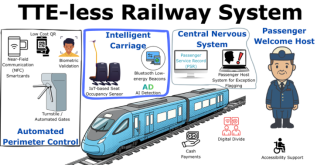
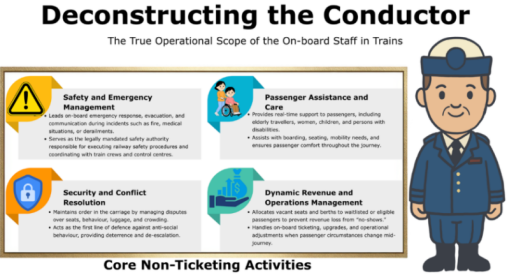
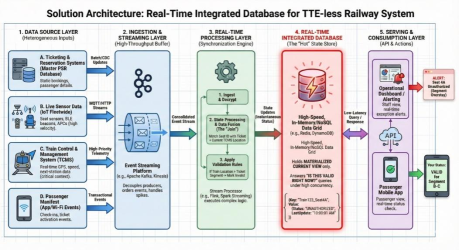




 Share This Article
 Twitter
 Linked In
 Facebook