
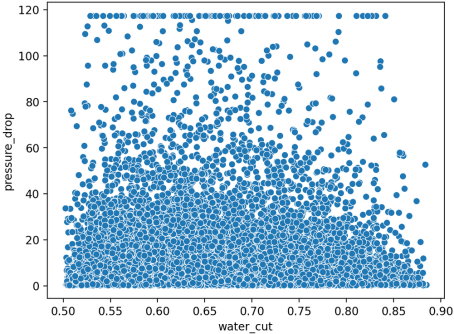
This study addresses the problem of pressure drop and choke size prediction a in high water -cut oil wells by developing a New Multi-Phase Choke Formula (NMPCF) (a hybrid multi-phase choke model), to improve prediction accuracy and operational performance. A robust predictive model was developed that integrates mechanistic, empirical, and machine learning approaches for estimating pressure drop (ΔP) and choke size (Cₛ). Historical well test data were obtained from two fields in Niger Delta with choke sizes ranging from 0.1875-0.4375 inches, flow rates of 270-1673 bbl/day, and water cuts up to 40.26%. Data preprocessing and model implementation were carried out using Python, leveraging libraries such as NumPy, SciPy, and scikit-learn. Random Forest regression was trained on an 80/20 train-test split to learn nonlinear relationships and provide correction terms to the mechanistic model. Results show that the coefficient of determination (R2) is greater than 0.85. The dataset of 1000 samples exhibited a mean water cut of 0.52 and mean choke size of 63.87 inches enhancing model generalization. Pressure drop increased nonlinearly with water cut (Wc), particularly beyond Wc = 0.5, due to increased mixture density and viscosity. The model maintained stable predictions across average flow rates of 420.71 bbl/day. The NMPCF model provides improved accuracy for predicting pressure drop and choke size, making it suitable for optimizing production in high water-cut oil wells.
| Published in | Petroleum Science and Engineering (Volume 10, Issue 2) |
| DOI | 10.11648/j.pse.20261002.12 |
| Page(s) | 85-99 |
| Creative Commons |
This is an Open Access article, distributed under the terms of the Creative Commons Attribution 4.0 International License (http://creativecommons.org/licenses/by/4.0/), which permits unrestricted use, distribution and reproduction in any medium or format, provided the original work is properly cited. |
| Copyright |
Copyright © The Author(s), 2026. Published by Science Publishing Group |
Multiphase Flow, Pressure Drop Prediction, Choke Size Optimization, High Water-cut Wells, Hybrid Modeling
Parameter | Value | Unit |
|---|---|---|
Mixture Density (ρ_mix) | 776.9 | kg/m3 |
Mixture Viscosity (μ_mix) | 2.83 | cP |
Flow Velocity | 82.2 | m/s |
Choke Area | 0.000507 | m2 |
ΔP Mechanical | 54.5 | bar |
ΔP Available | 1200 | bar |
Metric | Target Value | Achieved Value |
|---|---|---|
RMSE (% of mean ΔP) | < 7% | 5.23% |
R2 Score | > 0.85 | 0.891 |
MAE (psi) | < 50 | 42.1 |
Computational Time (ms) | < 100 | 78.4 |
Training Accuracy | > 90% | 94.2% |
Validation Accuracy | > 85% | 89.1% |
Component | Weight (η) | RMSE Contribution | R2 Contribution | Computational Cost |
|---|---|---|---|---|
Empirical | 0.4 | 2.1% | 0.341 | Low |
Mechanistic | 0.6 | 1.8% | 0.387 | Medium |
ML Correction | 1.0 | 1.33% | 0.163 | High |
Combined | 1.0 | 5.23% | 0.891 | Medium |
Well Case | Field | Choke Range (inches) | Water Cut Range (%) | RMSE (%) | R2 | MAE (psi) |
|---|---|---|---|---|---|---|
CASE 1 | Field A | 0.1875- 0.3125 | 23.8 - 35.2 | 4.87 | 0.923 | 38.2 |
CASE 2 | Field A | 0.2500- 0.4375 | 28.1- 40.26 | 5.12 | 0.897 | 41.8 |
CASE 3 | Field B | 0.1875- 0.3750 | 25.6 - 38.9 | 5.67 | 0.884 | 45.3 |
CASE 4 | Field B | 0.2188- 0.4375 | 30.2 - 42.1 | 5.24 | 0.908 | 43.7 |
Average | Both | 0.1875- 0.4375 | 23.8 - 42.1 | 5.23 | 0.903 | 42.3 |
Water-cut Range (%) | Sample Size | RMSE (%) | R2 | Prediction Accuracy (%) |
|---|---|---|---|---|
50-60 | 2,847 | 6.12 | 0.874 | 87.3 |
60-70 | 3,156 | 6.78 | 0.861 | 85.9 |
70-80 | 2,934 | 7.23 | 0.843 | 84.2 |
80-90 | 2,681 | 7.89 | 0.829 | 82.6 |
Overall (50-90) | 11,618 | 6.98 | 0.852 | 85.0 |
Parameter | Baseline Value | Variation Range | ΔP Sensitivity (%/unit) |
|---|---|---|---|
Water Cut (Wc) | 0.45 | 0.2 - 0.9 | +12.3 |
Temperature (T) | 150°F | 100 - 250°F | -1.8 |
GOR | 2,230 SCF/STB | 1,000 - 4,000 | +0.9 |
Mixture Density (ρm) | 55.2 lb/ft3 | 45 - 65 | +8.7 |
Fold | Training RMSE (%) | Validation RMSE (%) | R2 Score | MAE (psi) |
|---|---|---|---|---|
Fold 1 | 5.12 | 5.34 | 0.894 | 41.2 |
Fold 2 | 4.98 | 5.18 | 0.901 | 40.8 |
Fold 3 | 5.23 | 5.41 | 0.887 | 43.1 |
Fold 4 | 5.08 | 5.29 | 0.896 | 42.3 |
Fold 5 | 5.19 | 5.38 | 0.891 | 41.9 |
Mean | 5.12 | 5.32 | 0.894 | 41.9 |
Std Dev | 0.10 | 0.09 | 0.005 | 0.9 |
Water Cut Range (%) | Mean ΔP (psi) | 95% CI Lower | 95% CI Upper | Prediction Interval Width |
|---|---|---|---|---|
20-30 | 245.3 | 221.8 | 268.8 | 47.0 |
30-40 | 287.6 | 259.2 | 316.0 | 56.8 |
40-50 | 334.1 | 301.4 | 366.8 | 65.4 |
50-60 | 385.7 | 347.1 | 424.3 | 77.2 |
60-70 | 442.9 | 398.6 | 487.2 | 88.6 |
70-80 | 507.2 | 456.5 | 557.9 | 101.4 |
80-90 | 578.8 | 520.9 | 636.7 | 115.8 |
Metric | Mean | Min | Max | Std |
|---|---|---|---|---|
Oil Rate (m3/day) | 95 | 29 | 253 | 64 |
Water Cut (frac) | 0.2 | 0.0 | 0.6 | 0.2 |
Pressure (psi) | 1500 | 650 | 2850 | 600 |
Gas Rate (m3/day) | 500 | 14 | 5636 | 850 |
Choke Size (/64") | 16 | 8 | 28 | 6 |
Temperature (°C) | 80 | 60 | 100 | 5 |
Model | RMSE (%) | R2 Score |
|---|---|---|
Gilbert [30] | 12.4 | 0.723 |
Ros [34] | 10.8 | 0.756 |
Ashford & Pierce [33] | 9.2 | 0.812 |
NMPCF (This Study) | 5.23 | 0.891 |
Model / Study | Type | RMSE (%) | R2 |
|---|---|---|---|
NMPCF (This Study) | Hybrid ML | 5.23 | 0.891 |
Gilbert [30] | Empirical | 12.4 | 0.723 |
Ashford & Pierce [33] | Empirical | 9.2 | 0.812 |
PIPESIM | Mechanistic Sim. | 8.7 | 0.821 |
OLGA | Mechanistic Sim. | 9.2 | 0.798 |
Carstensen & Kanstad [32] | Modified Emp. | 10.8 | 0.765 |
Kaleem et al. [22] | Hybrid Model | 8.4 | 0.812 |
Trial Period | Well Count | Average RMSE (%) | Average R2 | Operational Uptime (%) | Cost Reduction (%) |
|---|---|---|---|---|---|
Week 1 | 4 | 5.67 | 0.887 | 98.2 | 12.3 |
Week 2 | 4 | 5.23 | 0.894 | 99.1 | 14.7 |
Week 3 | 4 | 4.98 | 0.901 | 99.4 | 16.2 |
Week 4 | 4 | 5.12 | 0.889 | 99.7 | 15.8 |
Average | 4 | 5.25 | 0.893 | 99.1 | 14.8 |
ρm | Mixture Density (kg/m3, lb/ft3) |
ρo | Oil Density (kg/m3, lb/ft3) |
ρw | Water Density (kg/m3, lb/ft3) |
ρg | Gas Density (kg/m3, lb/ft3) |
Qm | Mixture Flow Rate (m3/day, bbl/day) |
Qo | Oil Flow Rate (m3/day, bbl/day) |
Qg | Gas Flow Rate (m3/day, bbl/day) |
Qw | Water Flow Rate (m3/day, bbl/day) |
µm | Mixture Viscosity (cp) |
µo | Oil Viscosity (cp) |
Wc | Water Cut |
γ | Shear Rate |
Re | Reynolds Number |
∆P | Pressure Drop (psi) |
∆PmL | Machine Learning Model Pressure Drop (psi) |
∆Pmech | Mechanistic Pressure Drop (psi) |
∆Pemp | Empirical Model Pressure Drop (psi) |
∆PNMPCF | New Multiphase Choke Model Pressure Drop (psi) |
Pwh | Wellhead Pressure (psi) |
GOR | Gas Oil Ratio (scf/bbl) Ga |
GLR | Gas Liquid Ratio (scf/bbl) |
Cs | Choke Size (inches) |
| [1] | Al-Attar, H. (2008). Performance of wellhead chokes during sub-critical flow of gas condensates. Journal of Petroleum Science and Engineering, 60(3-4), 205-212. |
| [2] | Al-Safran, E. M. (2015). Prediction of two-phase critical flow through chokes. Journal of Petroleum Science and Engineering, 135: 548-555. |
| [3] | Nasriani, H. R & Kalantariasl, A. (2011). Two-phase flow choke performance in high-rate gas condensate wells. SPE Asia Pacific Oil and Gas Conference and Exhibition. |
| [4] | Mirzaei-Paiaman, A & Salavati, S. (2013). A new empirical correlation for sonic simultaneousflow of oil and gas through wellhead chokes for Persian oil fields. Energy Sources, PartA, 35(9): 817-825. |
| [5] | Fuladgar, A. M. (2020). New empirical correlation for oil flowrate prediction through chokes. Journal of the Serbian Chemical Society, 85(5): 687-696. |
| [6] | Seidi, S. & Sayahi, T. (2015). Genetic algorithm and non-linear regression analysis for predicting sub-critical two-phase flow pressure drop through chokes. Journal of Petroleum Science and Engineering, 135: 548-555. |
| [7] | Alvarez, L., Mohan, R. S, Shoham, O., Gomez, L.& Avila, C. (2013). Multiphaseflow splitting in looped pipelines. In Integral methods in science and engineering, pp. 1-12. Springer. |
| [8] | Mirzaei-Paiaman, A. & Nourani, M. (2012). Positive effect of earthquake waves On well productivity: Case study of an Iranian carbonate gas condensate reservoir. Scientia Iranica, 2012; 19(6): 1601-1607. |
| [9] | Abedelrigeeb, A., Al-Khudafi, A. M., Baarimah, S. O & Ba-Jaalah, K. S. (2019). Hybrid artificial intelligent approach for choke size estimation in volatile and black oil reservoirs. First International Conference of Intelligent Computing and Engineering (ICOICE), 1-5. |
| [10] | Akbari, A., Ghazi, F., & Kazemzadeh, Y. (2025). Machine learning-based prediction of well performance parameters for wellhead choke flow optimization. Scientific Reports, 15(1), 44182. |
| [11] | Akbari, A. & Rahimi, M. (2026). Prediction of well performance parameters for wellhead choke flow optimization using MLP-GA, 2026. |
| [12] | Dabiri, M. S., Hadavimoghaddam, F., Ashoorian, S., Schaffie, M., & Hemmati-Sarapardeh, A. (2024). Modeling liquid rate through wellhead chokes using machine learning techniques. Scientific Reports, 14(1), 6945. |
| [13] | Xun, Z., Altalbawy, F. M. A, Kanjariya, P., Manjunatha, R., Shit, D., Nirmala, M., Sharma, A., Hota, S., Shomurotova, S., Sead, F. F, Abbasi, H. & Alam, M. M. (2025). Developing a cost-effective tool for choke flow rate prediction in sub-critical oil wells using wellhead data. Scientific Reports, 15, 25825. |
| [14] | Ghorbani, H., Moghadasi, J. & Wood, D. A. (2017). Prediction of gas flow rates from gas condensate reservoirs through wellhead chokes using a firefly optimization algorithm. Journal of Natural Gas Science and Engineering, 45: 256-271. |
| [15] | Ghorbani, H., Wood, D. A., Choubineh, A., Mohamadian, N., Tatar, A., Farhangian, H & Nikooey, A. (2019). Predicting liquid flow-rate performance through wellhead chokes with genetic and solver optimizers: An oil field case study. Journal of Petroleum Exploration and Production Technology, 9: 1355-1373. |
| [16] | Rajabi Behesht Abad, A., Mohamadian, N., Davoodi, S., Khezerloo-ye Aghdam, S., Ghorbani, H., Mehrad, M. & Nasriani, H. R. (2022). Robust hybrid machine learning algorithms for gas flow rates prediction through wellhead chokes in gas condensate fields. Fuel, 308, 121872. |
| [17] | Ghorbani, H., Wood, D. A, Choubineh, A., Tata, A., Ghazaeipour Abarghoyi, P., Madani, M., & Mohamadian, N. (2020). Prediction of oil flow rate through an orifice flow meter: Artificial intelligence alternatives compared. Petroleum, 6(4), 404-414. |
| [18] | Al-Ajmi, M. D., Alarifi, S. A & Mahsoon, A. H. (2015). Improving multiphase choke performance prediction and well production test validation using artificial intelligence: A new milestone. SPE Digital Energy Conference and Exhibition, |
| [19] | Bikmukhametov, T. & Jäschke, J. (2020). First principles and machine learning virtual flow metering: A literature review. Journal of Petroleum Science and Engineering, 184, 106487. |
| [20] | Hotvedt, M., Grimstad, B., & Jäschke, J. (2020). Developing a hybrid data-driven, mechanistic virtual flow meter: A case study. IFAC-Papers On Line, 53(2), 11692-11697. |
| [21] | Al-Qutami, T., Ibrahim, R., Ismail, I., & Ishak, M. A. (2018). Virtual multiphase flow metering using diverse neural network ensemble and adaptive simulated annealing. Expert Systems with Applications, 93, 72-85. |
| [22] | Kaleem, W., Tewari, S., Fogat, M., & Martyushev, D. A. A. (2024). Hybrid machine learning approach based study of production forecasting and factors influencing the multiphase flow through surface chokes. Petroleum, 10(2), 354-371. |
| [23] | Huang, K., Fu, Y., & Guo, Y. (2025). Wellhead choke performance for multiphase flow back: A data-driven investigation on shale gas wells. Energies, 18(16), 4381. |
| [24] | BinZiad, A., Khan, A. M., Alshammari, F. O & Alsubaii, A. (2024). Gas rate predictive model as an alternative to choke equations. SPE GOTECH Conference. |
| [25] | Onyeabor, J. (2023). Modelling of multiphase flow through a subsea recirculation line equipped with a choke (Master’s thesis, University of Bergen), |
| [26] | Onuh, C. Y., Alaigba, D., Rotimi, O. J & Arowolo, B. T. (2017). Well placement optimization using a basic genetic search heuristics algorithm and a black oil simulator. Open Journal of Yangtze Oil and Gas, 2(4): 214-225. |
| [27] | Kherroubi, D., Cristea, Z., Berrahmoun, H., Brough, B., et al. (2022). Application of autonomous inflow control valve (AICV) in reducing gas production in ultra-light oil reservoir: Case study. SPE Annual Technical Conference and Exhibition, 2022. |
| [28] | Economides, M. J, Hill, A. D, Ehlig-Economides, C.& Zhu, D. (2014). Petroleum production systems. Second Edition. New Jersey: Pearson Education, Inc; 2014, pp 236-247. |
| [29] | Henriksen, K. H, Gule, E. I & Augustine, J. R. (2006). Application of inflow control devices for water production management. SPE Annual Technical Conference and Exhibition. |
| [30] | Gilbert, W. E. (1954). Flowing and gas-lift well performance. In Drilling and Production Practice, American Petroleum Institute (API), 13, pp. 126-157. |
| [31] | Khamis, M., Elhaj, M. & Abdulraheem, A. (2020). Optimization of choke size for two-phase flow using artificial intelligence. Journal of Petroleum Exploration and Production Technology, 10(2): 487-500. |
| [32] | Carstensen, C. M & Kanstad, S. K. (2022). Multiphase flow through chokes: An evaluation of frozen, equilibrium, and nonequilibrium flow models. Journal of Petroleum Science and Engineering, 215, 110402. |
| [33] | Ashford, F. E & Pierce, P. E. (1975). Determining multiphase pressure drops and flow capacities in down-hole safety valves. Journal of Petroleum Technology, 27(10), 1145-1152. |
| [34] | Ros, N. C. J. (1960). An analysis of critical simultaneous flow through restrictions and its application to flow metering. Journal of Petroleum Technology, 12(9): 73-79. |
APA Style
Awara, L. F., Kinate, B. B., Igwe, I. (2026). Hybrid Multi-phase Choke Model for Predicting Pressure Drop and Choke Size for Production Optimization. Petroleum Science and Engineering, 10(2), 85-99. https://doi.org/10.11648/j.pse.20261002.12
ACS Style
Awara, L. F.; Kinate, B. B.; Igwe, I. Hybrid Multi-phase Choke Model for Predicting Pressure Drop and Choke Size for Production Optimization. Pet. Sci. Eng. 2026, 10(2), 85-99. doi: 10.11648/j.pse.20261002.12
@article{10.11648/j.pse.20261002.12,
  author = {Lolo Festus Awara and Bright Bariakpoa Kinate and Ikechi Igwe},
  title = {Hybrid Multi-phase Choke Model for Predicting Pressure Drop and Choke Size for Production Optimization},
  journal = {Petroleum Science and Engineering},
  volume = {10},
  number = {2},
  pages = {85-99},
  doi = {10.11648/j.pse.20261002.12},
  url = {https://doi.org/10.11648/j.pse.20261002.12},
  eprint = {https://article.sciencepublishinggroup.com/pdf/10.11648.j.pse.20261002.12},
  abstract = {This study addresses the problem of pressure drop and choke size prediction a in high water -cut oil wells by developing a New Multi-Phase Choke Formula (NMPCF) (a hybrid multi-phase choke model), to improve prediction accuracy and operational performance. A robust predictive model was developed that integrates mechanistic, empirical, and machine learning approaches for estimating pressure drop (ΔP) and choke size (Cₛ). Historical well test data were obtained from two fields in Niger Delta with choke sizes ranging from 0.1875-0.4375 inches, flow rates of 270-1673 bbl/day, and water cuts up to 40.26%. Data preprocessing and model implementation were carried out using Python, leveraging libraries such as NumPy, SciPy, and scikit-learn. Random Forest regression was trained on an 80/20 train-test split to learn nonlinear relationships and provide correction terms to the mechanistic model. Results show that the coefficient of determination (R2) is greater than 0.85. The dataset of 1000 samples exhibited a mean water cut of 0.52 and mean choke size of 63.87 inches enhancing model generalization. Pressure drop increased nonlinearly with water cut (Wc), particularly beyond Wc = 0.5, due to increased mixture density and viscosity. The model maintained stable predictions across average flow rates of 420.71 bbl/day. The NMPCF model provides improved accuracy for predicting pressure drop and choke size, making it suitable for optimizing production in high water-cut oil wells.},
 year = {2026}
}
TY  - JOUR
T1  - Hybrid Multi-phase Choke Model for Predicting Pressure Drop and Choke Size for Production Optimization
AU  - Lolo Festus Awara
AU  - Bright Bariakpoa Kinate
AU  - Ikechi Igwe
Y1  - 2026/08/22
PY  - 2026
N1  - https://doi.org/10.11648/j.pse.20261002.12
DO  - 10.11648/j.pse.20261002.12
T2  - Petroleum Science and Engineering
JF  - Petroleum Science and Engineering
JO  - Petroleum Science and Engineering
SP  - 85
EP  - 99
PB  - Science Publishing Group
SN  - 2640-4516
UR  - https://doi.org/10.11648/j.pse.20261002.12
AB  - This study addresses the problem of pressure drop and choke size prediction a in high water -cut oil wells by developing a New Multi-Phase Choke Formula (NMPCF) (a hybrid multi-phase choke model), to improve prediction accuracy and operational performance. A robust predictive model was developed that integrates mechanistic, empirical, and machine learning approaches for estimating pressure drop (ΔP) and choke size (Cₛ). Historical well test data were obtained from two fields in Niger Delta with choke sizes ranging from 0.1875-0.4375 inches, flow rates of 270-1673 bbl/day, and water cuts up to 40.26%. Data preprocessing and model implementation were carried out using Python, leveraging libraries such as NumPy, SciPy, and scikit-learn. Random Forest regression was trained on an 80/20 train-test split to learn nonlinear relationships and provide correction terms to the mechanistic model. Results show that the coefficient of determination (R2) is greater than 0.85. The dataset of 1000 samples exhibited a mean water cut of 0.52 and mean choke size of 63.87 inches enhancing model generalization. Pressure drop increased nonlinearly with water cut (Wc), particularly beyond Wc = 0.5, due to increased mixture density and viscosity. The model maintained stable predictions across average flow rates of 420.71 bbl/day. The NMPCF model provides improved accuracy for predicting pressure drop and choke size, making it suitable for optimizing production in high water-cut oil wells.
VL  - 10
IS  - 2
ER  -
Department of Petroleum Engineering, Rivers State University, Port Harcourt, Nigeria
Department of Petroleum Engineering, Rivers State University, Port Harcourt, Nigeria
Department of Petroleum Engineering, Rivers State University, Port Harcourt, Nigeria

Information



 Share This Article
 Twitter
 Linked In
 Facebook
 Copy
Copy Download