
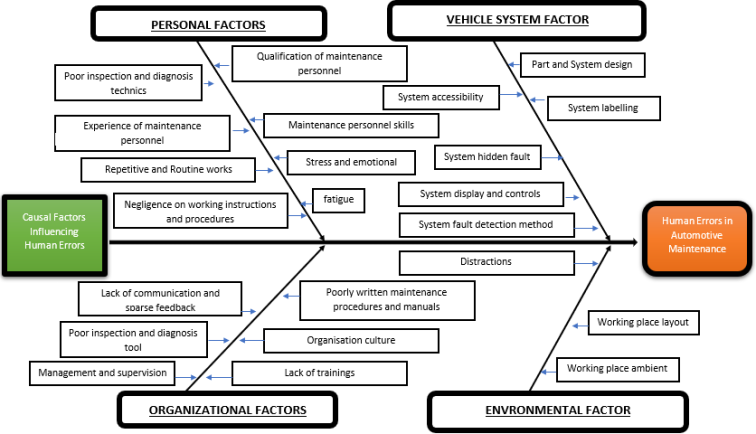
Maintenance error is cited as one among the major factors in most automotive accidents, including those involves human error in maintenance activities. However, in may system failures caused by human errors in automotive maintenance affects availability, reliability and safety of automotive. Maintenance errors that are resulted from human errors have impact in different ways such as organizational operations target loss, high operating cost, low safety and loss of life or body parts. Human error has not been taken into consideration in managing them unless the incidence or accident occurs. The use of incidence or accident then looking and solving problem is the outdated method, in current world of engineering forecasting, controlling and management should be on place as a part of organization management. The study on the causal factors influencing human errors in automotive maintenance have been carried out for the purpose of identifying the factors and then grouping the factors according to the sources of origin. The methodology used to attain the study objectives was literature and analysis of identified factors. The employed method to analyze and formulate the relationship of factors was the Ishikawa`s fish bone diagram. The identified factors were 24 in number then grouped into four according to their sources of origin as follows: personal factors, organizational factors, environmental factors and vehicle system factor.
| Published in | International Journal of Transportation Engineering and Technology (Volume 12, Issue 2) |
| DOI | 10.11648/j.ijtet.20261202.12 |
| Page(s) | 76-83 |
| Creative Commons |
This is an Open Access article, distributed under the terms of the Creative Commons Attribution 4.0 International License (http://creativecommons.org/licenses/by/4.0/), which permits unrestricted use, distribution and reproduction in any medium or format, provided the original work is properly cited. |
| Copyright |
Copyright © The Author(s), 2026. Published by Science Publishing Group |
Human Errors, Automotive, Maintenance, Maintenance Errors, Ishikawa Diagram
S/NO | Causal factors influencing human errors in automotive maintenance | Name of author and year of publication |
|---|---|---|
1. | Poor diagnosis and inspection ethnics | Khan et al. 2014; Hockley and Philips 2012; Singh, Kumar and Kumar, 2015; Aju Kumar, Gandhi and Gandhi, 2015; Di Fazio et al., 2014 |
2. | Qualification of maintenance personnel | Gupta, 2001; Mkilania, 2016 |
Goh and Tay, 1995 | ||
Arts, Knapp and Mann Jr, 1998; Thakur and Panghal, 2021 | ||
3. | Experience of maintenance personnel | Mkilania, 2016; Goh and Tay, 1995 |
4. | System display and control | Dhillon & Liu, 2006; Hobbs, 2008; Dhillon, 2014; |
Krulak, 2004; Rashid, 2010 | ||
5. | Parts, fasteners and consumables | Dhillon & Liu, 2006; Hobbs, 2008; Dhillon, 2014; Krulak, 2004; Rashid, 2010 |
6. | Maintenance personnel skills | Dhillon & Liu, 2006; Dunn, 2004; Peach, Ellis & Visser, 2016; Badenhorst & Van Tonder, 2004 |
7. | Negligence on work instructions and procedures | Badenhorst & Van Tonder, 2004); Kovacevic et al., 2016; Dunn, 2004; Singh, Kumar and Kumar, 2015, |
8. | Working place ambient | Dhillon & Liu, 2006; Krulak, 2004; Latorella & Prabhu, 2000; Dhillon & Liu, 2006 Dhillon (2014) |
9. | Parts, equipment or system design | Dhillon & Liu, 2006; Hobbs, 2008; Dhillon, 2014; Krulak, 2004; Rashid, 2010; Dhillon and Singh 1981; Wu and Hwang (1989) |
10. | Time pressure | Hobbs, 2008; Dunn, 2004; Virovac, Domitrović & Bazij, 2017. |
11. | Part or System accessibility | Wu and Hwang, 1989; Dhillon, 198; Pannell, 1997 |
12. | Working place layout | Dhillon & Liu, 2006; Peach, Ellis & Visser, 2016; B S Dhillon 2014; Dunn, 2004; Virovac, Domitrović & Bazij, 2017 |
13. | Weak management and supervision | Timmons, et al., 2014; Peach, Ellis & Visser, 2016; Krulak, 2004; Rashid, 2010 |
14. | Fatigue | Latorella & Prabhu, 2000; Hobbs, 2008; Dhillon, 2014; Dunn, 2004; Virovac, Domitrović & Bazij, 2017 |
15. | System hidden fault | Wu and Hwang, 1989; Dhillon, 1981; Pannell, 1997 |
16. | Lack of trainings | Dhillon & Liu, 2006; Dhillon, 2014; Kovacevic et al., 2016; Rashid, 2010 |
17. | organizational culture | Timmons, et al., 2014; Alonso & Broadribb, 2018; Latorella & Prabhu, 2000; Rashid, 2010 |
18. | Lack of communication and sparse feedback | Hobbs, 2008; Virovac, Domitrović & Bazij, 2017; Peach, Ellis & Visser, 2016; |
19. | Parts, equipment or system labelling | Dhillon & Liu, 2006; Hobbs, 2008; Dhillon, 2014; Krulak, 2004; Rashid, 2010 |
20. | Stress and Emotional demands of maintenance personnel | Dunn, 2004; Latorella & Prabhu, 2000; Hobbs, 2008; Alonso & Broadribb, 2018 |
21. | Repetitive and Routine works | Alonso & Broadribb, 2018; Dunn, 2004 |
22. | Poorly written maintenance procedures and manuals | Dhillon & Liu, 2006; Gould & Lovell, 2009; Hobbs, 2008; Dhillon, 2014; Dunn, 2004; Rashi, 2010; Singh, Kumar and Kumar, 2015 |
23. | Poor diagnosis and inspection tools | Khan et al. 2014; Hockley and Philips 2012; Singh, Kumar and Kumar, 2015: Di Fazio et al., 2014 |
24. | Part or system fault detection method | Dhillon & Liu, 2006; Hobbs, 2008; Dhillon, 2014; Krulak, 2004; Rashid, 2010 |
S/N | Causal factors influencing human errors in automotive maintenance | The source Group where factor originates |
|---|---|---|
1. | Poor diagnosis and inspection technics | Personal factor |
2. | Qualification of maintenance personnel | Personal factor |
3. | Experience of maintenance personnel | Personal factor |
4. | System display and control | Vehicle factor |
5. | Parts, fasteners and consumables | Organizational factor |
6. | Maintenance personnel skills | Personal factor |
7. | Negligence on work instructions and procedures | Personal factor |
8. | Working place ambient | Environmental factor |
9. | Parts, equipment or system design | Vehicle factor |
10. | Time pressure | Organizational factor |
11. | Part or System accessibility | Vehicle factor |
12. | Working place layout | Environmental factor |
13. | Weak management and supervision | Organizational factor |
14. | Fatigue | Personal factor |
15. | Part or System hidden fault | Vehicle factor |
16. | Lack of trainings | Organizational factor |
17. | organizational culture | Organizational factor |
18. | Lack of communication and sparse feedback | Organizational factor |
19. | Parts, equipment or system labelling | Vehicle factor |
20. | Stress and Emotional demands of maintenance personnel | Personal factor |
21. | Repetitive and Routine works | Personal factor |
22. | Poorly written maintenance procedures and manuals | Organizational factor |
23. | Poor diagnosis and inspection tools | Organizational factor |
24. | Part or system fault detection method | Vehicle factor |
| [1] | Aju Kumar, V. N., Gandhi, M. S. and Gandhi, O. P. (2015) ‘Identification and assessment of factors influencing human reliability in maintenance using fuzzy cognitive maps’, Quality and Reliability Engineering International, 31(2), pp. 169–181. |
| [2] | Alonso, I. J. and Broadribb, M. (2018) ‘Human error: A myth eclipsing real causes’, Process safety progress, 37(2), pp. 145–149. |
| [3] | Arts, R., Knapp, G. M. and Mann Jr, L. (1998) ‘Some aspects of measuring maintenance performance in the process industry’, Journal of Quality in Maintenance Engineering, 4(1), pp. 6–11. |
| [4] | Badenhorst, F. W. and Van Tonder, J. (2004) ‘Determining the factors causing human error deficiencies at a public utility company’, SA Journal of Human Resource Management, 2(3), pp. 62–69. |
| [5] | Dhillon, B. and Liu, Y. (2006) ‘Human error in maintenance: A review’, Journal of Quality in Maintenance Engineering, 12. Available at: |
| [6] | Dhillon, B. S. (1981) ‘Engineering reliability: new techniques and applications’. |
| [7] | Dhillon, B. S. (2002) Engineering maintenance: a modern approach. cRc press. |
| [8] | Dhillon, B. S. (2014) ‘Human error in maintenance: an investigative study for the factories of the future’, in IOP Conference Series: Materials Science and Engineering. IOP Publishing, p. 012031. |
| [9] | Dunn, S. (2004) ‘Managing human error in maintenance’, Maintenance Journal, pp. 13–18. |
| [10] | Dupont, G. (1995) ‘Maintenance Errors and Their Prevention’, in Annual International Air Safety Seminar. Flight Safety Foundation, pp. 353–358. |
| [11] | Di Fazio, A. R. et al. (2014) ‘Voltage sags in the automotive industry: Analysis and solutions’, Electric Power Systems Research, 110, pp. 25–30. |
| [12] | Goh, M. and Tay, G. (1995) ‘Implementing a quality maintenance system in a militaryorganization’, International Journal of Quality & Reliability Management, 12(4), pp. 26–39. |
| [13] | Gould, J. and Lovell, S. (2009) ‘Human error analysis at a refinery’, UK: IChemE [Preprint]. |
| [14] | Gupta, S. P. (2001) ‘Statistical methods 13th edition Sultan Chand and Sons’, New Delhi [Preprint]. |
| [15] | Hobbs, A. (2008) ‘An overview of human factors in aviation maintenance’, ATSB Safty Report, Aviation Research and Analysis Report AR, 55(2008), pp. 1–37. |
| [16] | Hockley, C. and Phillips, P. (2012) ‘The impact of no fault found on through‐life engineering services’, Journal of Quality in Maintenance Engineering, 18(2), pp. 141–153. |
| [17] | Ishikawa, K. (1982) ‘Guide to quality control’. |
| [18] | Khan, S. et al. (2014) ‘No Fault Found events in maintenance engineering Part 2: Root causes, technical developments and future research’, Reliability Engineering & System Safety, 123, pp. 196–208. |
| [19] | Kovacevic, S. et al. (2016) ‘The analysis of human error as causes in the maintenance of machines: a case study in mining companies’, South African Journal of Industrial Engineering, 27(4), pp. 193–202. |
| [20] | Krulak, D. C. (2004) ‘Human factors in maintenance: impact on aircraft mishap frequency and severity’, Aviation, space, and environmental medicine, 75(5), pp. 429–432. |
| [21] | Latorella, K. A. and Prabhu, P. V (2017) ‘A review of human error in aviation maintenance and inspection’, Human Error in Aviation, pp. 521–549. |
| [22] | Mkilania, J. N. (2016) ‘Factors related to human resources affecting the maintenance effectiveness in Tanzanian industries’, Int. J. Mech. Eng. Technol, 7, pp. 150–160. |
| [23] | Morag, I. et al. (2018) ‘Identifying the causes of human error in maintenance work in developing countries’, International Journal of Industrial Ergonomics, 68, pp. 222–230. |
| [24] | Moreno, V. C. et al. (2016) ‘Analysis of accidents in biogas production and upgrading’, Renewable Energy, 96, pp. 1127–1134. |
| [25] | Murugan, R. and Ramasamy, R. (2015) ‘Failure analysis of power transformer for effective maintenance planning in electric utilities’, Engineering Failure Analysis, 55, pp. 182–192. |
| [26] | Myszewski, J. M. (2012) ‘Management responsibility for human errors’, The TQM Journal, 24(4), pp. 326–337. |
| [27] | Pannell, D. J. (1997) ‘Sensitivity analysis of normative economic models: theoretical framework and practical strategies’, Agricultural economics, 16(2), pp. 139–152. |
| [28] | Peach, R., Ellis, H. and Visser, J. K. (2016) ‘A maintenance performance measurement framework that includes maintenance human factors: a case study from the electricity transmission industry’, South African Journal of Industrial Engineering, 27(2), pp. 177–189. |
| [29] | Rashid, H. (2010) Human factors effects in helicopter maintenance: proactive monitoring and controlling techniques, England: Cranfield University. Cranfield University. Available at: |
| [30] | Reason, J. (2000) ‘Cognitive engineering in aviation domain’, Lawrence Erlbaum Associates, Mahwah, NJ, 72, pp. 102–107. |
| [31] | Reason, J. and Hobbs, A. (2017) Managing maintenance error: a practical guide. CRC Press. |
| [32] | Singh, S., Kumar, R. and Kumar, U. (2015) ‘Modelling factors affecting human operator failure probability in railway maintenance tasks: an ISM-based analysis’, International Journal of System Assurance Engineering and Management, 6, pp. 129–138. |
| [33] | Thakur, R. and Panghal, D. (2021) ‘Total productive maintenance’, in Lean tools in apparel manufacturing. Elsevier, pp. 355–379. |
| [34] | Timmons, S. et al. (2015) ‘Implementing human factors in clinical practice’, Emergency Medicine Journal, 32(5), pp. 368–372. |
| [35] | Virovac, D., Domitrović, A. and Bazijanac, E. (2017) ‘The influence of human factor in aircraft maintenance’, Promet-Traffic&Transportation, 29(3), pp. 257–266. |
| [36] | Wu, T.-M. and Hwang, S.-L. (1989) ‘Maintenance error reduction strategies in nuclear power plants, using root cause analysis’, Applied ergonomics, 20(2), pp. 115–121. |
APA Style
Mwambage, E. J., Lutema, M. E., Nabora, C. S. (2026). Casual Factors Influencing Human Errors in Automotive Maintenance: A Review. International Journal of Transportation Engineering and Technology, 12(2), 76-83. https://doi.org/10.11648/j.ijtet.20261202.12
ACS Style
Mwambage, E. J.; Lutema, M. E.; Nabora, C. S. Casual Factors Influencing Human Errors in Automotive Maintenance: A Review. Int. J. Transp. Eng. Technol. 2026, 12(2), 76-83. doi: 10.11648/j.ijtet.20261202.12
@article{10.11648/j.ijtet.20261202.12,
  author = {Edward Julius Mwambage and Mazuri Erasto Lutema and Christian S. Nabora},
  title = {Casual Factors Influencing Human Errors in Automotive Maintenance: A Review},
  journal = {International Journal of Transportation Engineering and Technology},
  volume = {12},
  number = {2},
  pages = {76-83},
  doi = {10.11648/j.ijtet.20261202.12},
  url = {https://doi.org/10.11648/j.ijtet.20261202.12},
  eprint = {https://article.sciencepublishinggroup.com/pdf/10.11648.j.ijtet.20261202.12},
  abstract = {Maintenance error is cited as one among the major factors in most automotive accidents, including those involves human error in maintenance activities. However, in may system failures caused by human errors in automotive maintenance affects availability, reliability and safety of automotive. Maintenance errors that are resulted from human errors have impact in different ways such as organizational operations target loss, high operating cost, low safety and loss of life or body parts. Human error has not been taken into consideration in managing them unless the incidence or accident occurs. The use of incidence or accident then looking and solving problem is the outdated method, in current world of engineering forecasting, controlling and management should be on place as a part of organization management. The study on the causal factors influencing human errors in automotive maintenance have been carried out for the purpose of identifying the factors and then grouping the factors according to the sources of origin. The methodology used to attain the study objectives was literature and analysis of identified factors. The employed method to analyze and formulate the relationship of factors was the Ishikawa`s fish bone diagram. The identified factors were 24 in number then grouped into four according to their sources of origin as follows: personal factors, organizational factors, environmental factors and vehicle system factor.},
 year = {2026}
}
TY  - JOUR
T1  - Casual Factors Influencing Human Errors in Automotive Maintenance: A Review
AU  - Edward Julius Mwambage
AU  - Mazuri Erasto Lutema
AU  - Christian S. Nabora
Y1  - 2026/06/18
PY  - 2026
N1  - https://doi.org/10.11648/j.ijtet.20261202.12
DO  - 10.11648/j.ijtet.20261202.12
T2  - International Journal of Transportation Engineering and Technology
JF  - International Journal of Transportation Engineering and Technology
JO  - International Journal of Transportation Engineering and Technology
SP  - 76
EP  - 83
PB  - Science Publishing Group
SN  - 2575-1751
UR  - https://doi.org/10.11648/j.ijtet.20261202.12
AB  - Maintenance error is cited as one among the major factors in most automotive accidents, including those involves human error in maintenance activities. However, in may system failures caused by human errors in automotive maintenance affects availability, reliability and safety of automotive. Maintenance errors that are resulted from human errors have impact in different ways such as organizational operations target loss, high operating cost, low safety and loss of life or body parts. Human error has not been taken into consideration in managing them unless the incidence or accident occurs. The use of incidence or accident then looking and solving problem is the outdated method, in current world of engineering forecasting, controlling and management should be on place as a part of organization management. The study on the causal factors influencing human errors in automotive maintenance have been carried out for the purpose of identifying the factors and then grouping the factors according to the sources of origin. The methodology used to attain the study objectives was literature and analysis of identified factors. The employed method to analyze and formulate the relationship of factors was the Ishikawa`s fish bone diagram. The identified factors were 24 in number then grouped into four according to their sources of origin as follows: personal factors, organizational factors, environmental factors and vehicle system factor.
VL  - 12
IS  - 2
ER  -
Department of Automotive and Mechanical Engineering, National Institute of Transport, Dar es Salaam, Tanzania
Department of Automotive and Mechanical Engineering, National Institute of Transport, Dar es Salaam, Tanzania
Department of Automotive and Mechanical Engineering, National Institute of Transport, Dar es Salaam, Tanzania

Information



 Share This Article
 Twitter
 Linked In
 Facebook
 Copy
Copy Download