3. Literature Review
3.1. Concept of Chivalry
The term “Chivalry” is derived from the Old French term ‘chevalerie’, which means horse soldiery.
| [12] | Hoad, F. T. The Concise Oxford Dictionary of English Etymology. UK: Oxford University Press, 1993, p. 74. |
[12]
The origin of chivalry dates back to the end of the 5th century A. D., following the downfall of the Roman Empire.
The blend of the nomad’s horsemen culture with the Germanic system of mutual loyalty toward the leaders and followers resulted in what we know as “chivalry”.
.
The term “Chivalry” originally referred to the system of ideas prevalent among the mounted men-at-arms of the Middle Ages.
It denoted a refinement of the sense of justice, i.e., sympathizing with everyone who is a victim of oppression.
It was a distinct class culture that was more than fair play between men in battle and a generous treatment of non-combatants.
Over time, the concept of chivalry has evolved. It originally referred to horse-mounted men, but later came to signify lenient, kind behavior toward women. While its core ideals of courage, loyalty, and justice remained, its application shifted. Chivalry became less about battlefield conduct or the ideals of knights and more about courteous behavior toward women. Chivalry, in modern parlance, refers to polite, honest, and kind behavior, especially by men toward women.
It is associated with politeness, honesty, and kindness, particularly towards women.
3.2. Chivalry Hypothesis in the Criminal Justice System
In the criminal justice system, the concept of Chivalry first garnered attention as early as 1907, when Thomas explored its implications in his book “Sex and Society”.
| [16] | Issac, W. Thomas. Sex and Society: Studies in the Social Psychology of Sex. Chicago: University of Chicago Press, 1907. |
[16]
Subsequently, Pollack developed his theory on female criminality based on the Chivalry notion that the law treats women more “leniently” than men.
| [5] | Pollack, Otto. The Criminality of Women. Westport, Connecticut: Greenwood Press, 1978, xv, 1, 4-6, 44, 51. |
[5]
Pollack’s theory suggests that women are less likely to be arrested, prosecuted, or punished than their male counterparts.
| [5] | Pollack, Otto. The Criminality of Women. Westport, Connecticut: Greenwood Press, 1978, xv, 1, 4-6, 44, 51. |
[5]
This has become the foundation of the Chivalry hypothesis as it is known today.
The Chivalry hypothesis posits that women commit fewer crimes than men and that female offenders are treated more leniently within the justice system.
| [17] | Kruttschnitt, C. & Savolainen, J. Ages of Chivalry, places of paternalism: Gender and criminal sentencing in Finland. European Journal of Criminology. 2009, 6(3), 225-247.
https://doi.org/10.1177/1477370809102166 |
[17]
It contends that female offenders are granted leniency at various stages of the legal process, including lower arrest and prosecution rates. This hypothesis is rooted in the belief that women are weak and irrational, so the actors of the criminal justice system should treat them in a lenient manner.
| [18] | Grabe, E. Maria. Trager, D. K., Lear, Melissa. & Rauch, Jennifer. Gender in Crime News: A Case Study Test of the Chivalry Hypothesis. Mass Communication and Society. 2006, 9(2), 137-163. https://doi.org/10.1207/s15327825mcs0902_2 |
[18]
Further, scholars such as Klein and Kress argue that this leniency is afforded to women in return for the curtailment of their rights and the imposition of restrictions on them over the years.
| [6] | Klein, Dorie. & Kress, June. Any Woman’s Blues: A Critical Overview of Women, Crime and the Criminal Justice System, Social Justice. 2013, 40(1/2), 162-191.
https://www.jstor.org/stable/24361667 |
[6]
.
The Chivalry Hypothesis provides three main assertions:
3.2.1. Women Commit Comparatively Fewer and Less Violent Crimes Than Men
Studies consistently show that women commit significantly fewer crimes compared to men.
| [7] | Steffensmeier, Darrell. & Allan, Emilie. Gender and Crime: Toward a Gendered Theory of Female Offending. Annual Review of Sociology. 1996, 22, 459-487. https://www.jstor.org/stable/2083439 |
[7]
This disparity has been a subject of extensive analysis and debate among criminologists and sociologists, with various theories proposed to explain the underlying reasons.
Cesare Lombroso, an early criminologist, argued that women are less involved in serious and demanding crimes such as robbery, murder, and assault. He suggested that these crimes require a combination of intellectual and physical capabilities that women, according to his views, are less likely to possess.
| [19] | Lombroso, Cesare. Crime: Its Causes and Remedies. Boston: Little, Brown, and Company, 1911, p. 185. |
[19]
Willem Bonger, another prominent theorist, attributed the lower crime rates among women to their lesser physical strength and courage compared to men.
| [20] | Bonger, A. William. Criminality and Economic Conditions. Boston: Little, Brown, and Company, 1916, p. 472. |
[20]
Bonger posited that the physical and psychological attributes of women limit their capacity to engage in criminal activities, particularly those that involve violence or physical confrontation.
In contrast to these views, Otto Pollak presented a different perspective. He argued that women are inherently more manipulative and deceitful than men, which enables them to conceal their criminal activities more effectively.
| [5] | Pollack, Otto. The Criminality of Women. Westport, Connecticut: Greenwood Press, 1978, xv, 1, 4-6, 44, 51. |
[5]
According to Pollak, it is not that women commit fewer crimes, but rather that their crimes are less likely to be detected and reported.
| [5] | Pollack, Otto. The Criminality of Women. Westport, Connecticut: Greenwood Press, 1978, xv, 1, 4-6, 44, 51. |
[5]
He suggested that women often engage in types of crime that are more covert and less likely to draw attention, such as shoplifting or fraud.
Beyond biological explanations, societal roles and expectations significantly influence women's criminal behavior.
Traditionally, women were confined to being homemakers, which further reduced their opportunities and motivations to engage in criminal activities. However, as women have gained greater economic, social, and employment opportunities, their involvement in criminal activities has also increased.
Modern research indicates an increase in female involvement in traditionally male-dominated criminal spheres, particularly financial crimes.
.
Sociologist Rita J Simon argues that when women get access in the labor market as skilled labor, they commit employment-related property crimes like men.
| [24] | Simon, J. Rita. Women and Crime. Lexington: Lexington Books, 1975, pp. 2, 106. |
[24]
According to this perspective, increased economic independence and access to the labor market create opportunities for property offenses. At the same time, when a woman gains greater autonomy through education and employment, her dependence on men decreases, which ultimately reduces their desire to kill the object of their frustration or anger: their husband, lover, or men upon whom she is dependent.
| [24] | Simon, J. Rita. Women and Crime. Lexington: Lexington Books, 1975, pp. 2, 106. |
[24]
This explains the pattern why women are involved in non-violent and financial crimes, while their participation remains comparatively low in violent crimes.
3.2.2. Female Offenders Are Less Likely to Be Arrested and Detained Than Male Offenders
The Chivalry Hypothesis suggests that female offenders are less likely to be arrested than men. This leniency is based on societal perceptions and traditional gender roles that view women as less threatening and more deserving of protection and compassion.
| [25] | Daly, Kathleen. Discrimination in the Criminal Courts: Family, Gender, and the Problem of Equal Treatment. Social Forces. 1987, 66(1), 152-175. https://doi.org/10.2307/2578905 |
[25]
.
Pollack argues that the gender disparity in arrest rates is not due to women being more law-abiding but rather because the crimes they commit are less likely to be reported and detected.
| [5] | Pollack, Otto. The Criminality of Women. Westport, Connecticut: Greenwood Press, 1978, xv, 1, 4-6, 44, 51. |
[5]
Many female-perpetrated crimes go unreported, often viewed as less serious, or because victims are reluctant to report them.
This reluctance can stem from societal attitudes that downplay women's criminal conduct or the belief that female offenders will face lenient consequences. Additionally, the types of crimes more commonly committed by women, such as petty theft or domestic offenses, tend to receive less attention from law enforcement and the public compared to the more violent crimes typically associated with male offenders. As a result, women are less likely to be arrested and held accountable for their unlawful actions.
Recent data indicate a growing trend of increased arrest rates for female offenders.
It reflects a narrowing of the gender gap in the criminal justice system. This evolution can be attributed to several factors, including shifts in law enforcement approaches, heightened societal awareness of women's criminal conduct, and changing gender norms that challenge the conventional perception of women as inherently non-criminal. These developments suggest a gradual but significant shift in the way the criminal justice system handles and responds to female offenders.
3.2.3. Female Offenders Receive Lenient Treatment and Shorter Sentences Than Their Male Counterparts
The Chivalry Hypothesis also contends that female offenders are more likely to receive more lenient sentences compared to male offenders. Studies suggest that judges tend to be more lenient toward female offenders than toward male offenders.
| [8] | Doerner, K. Jill. & Demuth, Stephen. Gender and Sentencing in the Federal Courts: Are women treated more leniently?. Criminal Justice Policy Review. 2012, 25(2), 242-269.
https://doi.org/10.1177/0887403412466877 |
[8]
This leniency towards female offenders is attributed to the perception that women are inherently weak and irrational, leading the criminal justice system to adopt a more merciful approach to their sentencing.
| [18] | Grabe, E. Maria. Trager, D. K., Lear, Melissa. & Rauch, Jennifer. Gender in Crime News: A Case Study Test of the Chivalry Hypothesis. Mass Communication and Society. 2006, 9(2), 137-163. https://doi.org/10.1207/s15327825mcs0902_2 |
[18]
.
Warren Farrell, in his book, points out that female offenders benefit from shorter sentences and have access to unique "only female defenses" that are not available to male offenders.
| [28] | Farrrell, Warren. The Myth of Male Power: Why Men are the disposable sex. revised edition. London: Fourth Estate Limited, 1994, pp. 183-206, 244, 254-283. |
[28]
These defenses include the Depressed Mother Defense, Premenstrual Syndrome (PMS) Defense, Unfaithful Husband Defense, Battered Woman Syndrome, and Mothers Don’t Kill Defense, among others.
| [28] | Farrrell, Warren. The Myth of Male Power: Why Men are the disposable sex. revised edition. London: Fourth Estate Limited, 1994, pp. 183-206, 244, 254-283. |
[28]
The availability of such defenses reveals a potential gender bias and leniency toward female offenders within the criminal justice system.
The recent global trend contradicts the traditional view. Over the past few decades, the female prison population has grown at a faster rate than the male prison population.
This increase in prison population suggests a shift in sentencing patterns and a reduction in leniency toward female offenders. Contemporary research shows that gender has a limited effect on sentencing outcomes,
| [29] | Trist, S. Nina. Tzani-Pepelasi, Calli. Loannou, Maria. Williams, J. V. Thomas. Mojtahedi, Dara. Fumagalli, Anita. The Impact of Offence Type and Gender‐Role Attitudes on Sentencing Decisions for Male and Female Offenders. Journal of Investigative Psychology and Offender Profiling. 2024, 22(1), 1-11. https://doi.org/10.1002/jip.1646 |
[29]
which is inconsistent with the older literature that emphasized leniency toward female offenders.
3.3. Introduction to the Nepalese Criminal Justice System
Nepal's criminal justice system initially followed an inquisitorial model until 1950.
| [30] | Sangraula, Yubraj. Criminal Justice System: Comparative Study of the Criminal Justice System of Nepal with Reference to China, Japan, India, U.S.A., and U.K. Kathmandu: Sahayatra Nepal Publication Pvt. Ltd, 2018, 43, 69, 97-109. |
[30]
However, significant changes occurred in 1951 with the abolition of the century-long Rana Regime and Nepal's transition to a democratic society. This shift led to the restructuring of the criminal justice system along the lines of an adversarial model. New institutions were established, such as the Advocate General, the Police Office, and the Pradhan Nyayalaya (Supreme Court), replacing the former institutions to carry out the functions of the criminal justice system.
Despite the shift toward an adversarial system, the Nepalese criminal justice system has some unique features reminiscent of the inquisitorial system. The Suspects' statements must be obtained in court, although they can choose to accept or deny the statements given to the police. In practice, suspects often do not exercise their right to remain silent in court.
| [30] | Sangraula, Yubraj. Criminal Justice System: Comparative Study of the Criminal Justice System of Nepal with Reference to China, Japan, India, U.S.A., and U.K. Kathmandu: Sahayatra Nepal Publication Pvt. Ltd, 2018, 43, 69, 97-109. |
[30]
The emphasis on validating independent evidence is evident in the multi-stage trial process, which enables the introduction of new evidence.
| [30] | Sangraula, Yubraj. Criminal Justice System: Comparative Study of the Criminal Justice System of Nepal with Reference to China, Japan, India, U.S.A., and U.K. Kathmandu: Sahayatra Nepal Publication Pvt. Ltd, 2018, 43, 69, 97-109. |
[30]
Additionally, the prosecutor and police have independent duties in their investigations, rather than a coordinated effort between them.
| [30] | Sangraula, Yubraj. Criminal Justice System: Comparative Study of the Criminal Justice System of Nepal with Reference to China, Japan, India, U.S.A., and U.K. Kathmandu: Sahayatra Nepal Publication Pvt. Ltd, 2018, 43, 69, 97-109. |
[30]
In summary, while Nepal's criminal justice system has primarily transitioned to an adversarial model, traces of the inquisitorial system still influence certain procedural aspects. This unique blend of influences creates a dynamic legal landscape in Nepal, where a modern adversarial framework coexists with elements of its inquisitorial past.
The criminal justice system comprises several key institutions with distinct roles and responsibilities. The primary institutions involved in the Nepalese criminal justice system include the Police Organization, the Office of the Attorney General, the Judiciary, and the Prison Department.
| [30] | Sangraula, Yubraj. Criminal Justice System: Comparative Study of the Criminal Justice System of Nepal with Reference to China, Japan, India, U.S.A., and U.K. Kathmandu: Sahayatra Nepal Publication Pvt. Ltd, 2018, 43, 69, 97-109. |
[30]
These various entities work together to uphold the rule of law, investigate and prosecute crimes, and ensure the proper administration of justice throughout the country.
4. Analyses of the Chivalry Hypothesis in the Nepalese Criminal Justice System
To assess the applicability of the Chivalry Hypothesis within the Nepalese criminal justice system, it is essential to examine the three stages: Pre-trial, Trial, and Post-trial stages. The evaluation of the arrest rates for male and female offenders corresponds to the assessment of the Chivalry hypothesis during the pre-trial stage. It provides insights into differences in arrest patterns and trends in female criminality. The study of cases documented in the NKP helps evaluate whether sentencing disparities exist during the trial proceedings by assessing conviction rates and sentencing outcomes. Finally, the analysis of the male and female prison statistics links to the post-trial stage. By dissecting each stage of the criminal justice process within the Nepalese context, it is easier to understand the extent to which the Chivalry hypothesis is applicable throughout the entire Nepalese criminal justice system.
4.1. Evaluation of Gender Disparities in Arrest Statistics in Nepal
The first assertion of the Chivalry Hypothesis is that women commit fewer crimes and are less likely to be arrested than men.
| [7] | Steffensmeier, Darrell. & Allan, Emilie. Gender and Crime: Toward a Gendered Theory of Female Offending. Annual Review of Sociology. 1996, 22, 459-487. https://www.jstor.org/stable/2083439 |
[7]
While women only represent a small portion of the arrests, studies reveal an increase in the arrest rate of female offenders over the years.
This indicates a departure from the traditional notion of Chivalry and reflects the changing nature of female criminal behavior. The examination of the arrest rate of male and female offenders will help shed light on the gender-based differentials. It is crucial to determine whether the belief that women are less likely than men to get arrested is true or not.
4.1.1. Comparison of the Male and Female Arrest Data in Nepal
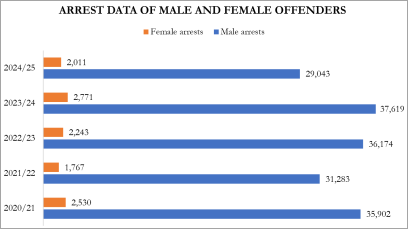
The bar graph displays the total arrests of male and female offenders in Nepal between 2020/21 and 2024/25. The data has been collected from the official database of the Central Investigation Bureau (CIB).
In Nepal, male arrests have consistently been higher than female arrests. The graph shows a notable gender gap in arrest rates, with male arrests consistently accounting for over 90% of total arrests each year, and female arrests ranging from 5% to 6%. As of 2024/25, the gap between the male and female arrests was 27,032. There were 87.2% more male arrests than female arrests, which accounted for only 6.4% of the total. This signifies that the female offenders are underrepresented in arrest statistics, thereby substantiating the Chivalry notion that females are less likely than males to commit crimes and be arrested.
However, it is crucial to acknowledge that the arrest statistics might not reflect the true extent of female criminality in Nepal. The lower arrest rates do not necessarily indicate that women commit fewer crimes than men. Various factors could contribute to the low arrest rates among female offenders in Nepal. The underreporting of crimes committed by women in Nepal may be one such factor. As pointed out by Pollock in his book, the crimes of women may go unnoticed or even be unreported to a greater extent.
| [5] | Pollack, Otto. The Criminality of Women. Westport, Connecticut: Greenwood Press, 1978, xv, 1, 4-6, 44, 51. |
[5]
Additionally, the police officers may hesitate to arrest women due to cultural biases.
These factors may influence the observed gender gap in the arrest data. This emphasizes the need for further research into such factors.
Further, the data reveal that the arrest rate for female offenders in Nepal has not increased steadily over the years. As shown by the bar graph, the number of female arrests decreased from 2530 in 2020/21 to 1767 in 2021/22, then increased to 2771 in 2023/24, and decreased again to 2011 in 2024/25. This demonstrates an irregular pattern in the arrest rate for female offenders over the last five years. Such fluctuations may be caused by socio-economic factors influencing the arrest rates. Further research is required to understand such factors. Notably, this observation counters the global trend of a gradual rise in arrests of female offenders over the years.
Figure 1. Bar graph showing the number of male and female offenders arrested in Nepal.
4.1.2. Observation of the Offenses Leading to Male and Female Arrests in Nepal
Various studies indicate that male and female offenders exhibit different patterns of offending.
| [32] | Estrada, Felipe. Nilsson, Anders. & Petterson, Tove. The Female Offender: A Century of Registered Crime and Daily Press Reporting on Women's Crime. Nordic Journal of Criminology. 2019, 20(2), 138-156.
https://doi.org/10.1080/2578983X.2019.1657269 |
[32]
Generally, males are more likely to engage in violent and serious property crimes,
whereas females are prone to commit minor crimes
| [34] | Chesney-Lind, Meda. Women and Crime: The Female Offender. Signs: Journal of Women in Culture and Society. 1986, 12(1) 78-96. https://doi.org/10.1086/494298 |
[34]
. By examining the types of offenses leading to the arrests of male and female offenders in Nepal, we can gain insights into patterns of male and female offending and their respective characteristics.
To visually represent this examination,
Table 1 and
Table 2 have been compiled. The tables list the top five offenses leading to the arrest of male and female offenders in Nepal between 2020/21 and 2024/25. The data used in the tables has been obtained from the official CIB database.
Table 1. Showing the top five offenses leading to male arrests in Nepal.
Offense | 2020/21 | 2021/22 | 2022/23 | 2023/24 | 2024/25 |
Offense against public interest, health, safety, convenience, and morals | 12,875 (35.8%) | 8,771 (28%) | 11,343 (31.3%) | 13,662 (36.3%) | 10,296 (35.4%) |
Drug-related offense | 4,351 (12.1%) | 4,418 (14.1%) | 5,525 (15.2%) | 5,844 (15.5%) | 4,539 (15.6%) |
Theft | 3,522 (9.8%) | 3,241 (10.3%) | 4,228 (11.6%) | 4,935 (13.1%) | 3,753 (12.9%) |
Sexual offenses | 2,731 (7.6%) | 3,007 (9.6%) | 2,869 (7.9%) | 2,582 (6.8%) | 1,890 (6.5%) |
Gambling | 3,457 (9.6%) | 3,347 (10.6%) | 3,080 (8.5%) | 2,149 (5.7%) | 2,225 (7.6%) |
Table 1 displays the top five offenses that resulted in arrests of male offenders in Nepal from 2020/21 to 2024/25. The table displays the exact number of male offender arrests for the five offenses over the years.
Over the years, the offenses against the public interest, health, safety, convenience, and morals have been the most common offenses leading to male arrests in Nepal. The offense accounted for a significant portion of male arrests, ranging from 28% to 36.3% each year. The second most common offense, amounting to 12.1% to 15.6% of arrests, is the drug-related offense. Theft accounts for 9.8% to 13.1% of arrests each year, making it the third most common offense resulting in male arrests. Sexual offenses are the fourth most common offense leading to male arrests in Nepal, accounting for 6.5% to 9.6% of all arrests. Finally, gambling ranks as the fifth most common offense, resulting in 5.7% to 10.6% of arrests each year.
Table 2. Showing the top offenses leading to the arrest of female offenders in Nepal.
Offense | 2020/21 | 2021/22 | 2022/23 | 2023/24 | 2024/25 |
Offense against public interest, health, safety, convenience, and morals | 929 (36.7%) | 374 (21.1%) | 633 (28.2%) | 906 (32.6%) | 607 (30.1%) |
Polygamy | 413 (16.3%) | 497 (28.1%) | 457 (20.3%) | 394 (14.2%) | 264 (13.1%) |
Drug-related offense | 198 (7.8%) | 208 (11.7%) | 264 (11.7%) | 343 (12.3%) | 271 (13.4%) |
Homicide offense (incl. attempt) | 259 (10.2%) | 186 (10.5%) | 206 (9.1%) | 178 (6.4%) | 135 (6.7%) |
Gambling | 127 (5%) | 109 (6.1%) | 143 (6.3%) | 109 (3.9%) | 96 (4.7%) |
Table 2 presents the top five offenses that led to the arrest of female offenders in Nepal from 2020/21 to 2024/25. Offenses against the public interest, health, safety, convenience, and morals is the most common offenses leading to female arrests in Nepal. The offense annually accounted for 21.1% to 36.7% female arrests. Unexpectedly, polygamy ranks as the second most common offense, amounting to 13.1% to 28.1% of arrests each year. Drug-related offense constitutes 7.8% to 13.4% of arrests each year, making it the third most common offense that results in female arrests. Homicide ranks as the fourth most common offense, accounting for 6.4% to 10.5% of female arrests annually in Nepal. The prevalence of homicide among female offenders refutes the Chivalry idea that women are less likely to commit violent crimes. Lastly, gambling is the fifth most common offense, ranging between 3.3% to 6.3% of female arrests each year.
Upon analyzing the arrest statistics in
Tables 1 and 2, we can observe both similarities and divergences in the offenses leading to male and female arrests. Offenses against public interest, health, safety, convenience, and morals are the most common offenses leading to the arrest of both male and female offenders in Nepal. Drug-related offenses and Gambling are also common offenses resulting in the arrest of both genders. Further, the total number of arrests appears to fluctuate over the years for both male and female offenders, as shown in
Tables 1 and 2. The fluctuations could be attributed to changes in crime rates or in reporting practices. Despite fluctuations in the overall arrest rate over the years, the types of offenses leading to male and female arrests remained relatively stable.
In Nepal, arrest patterns among male and female offenders reveal distinct trends. Sexual offenses and Theft are frequently associated with male arrests, while Polygamy and Homicide are more prone to result in the arrest of female offenders in Nepal. The high occurrence of sexual offenses and theft among male arrests suggests a dominance of these crimes by males. The prevalence of these offenses among male offenders may be influenced by various factors, such as economic opportunities, expectation of masculinity, etc.
| [35] | Messerschmidt, W. James. & Tomsen, Stephen. Masculinities, Crime, and Criminal Justice. In Oxford Handbook Topics in Criminology and Criminal Justice. UK: Oxford University Press, 2012, 1-23. |
[35]
On the other hand, homicide, being a common offense leading to female arrest in Nepal, contradicts the Chivalry hypothesis, which suggests that females are less likely to be involved in serious and violent crimes. It is an unexpected revelation that homicide offenses are more common among female offenders than male offenders. These discrepancies reflect the differing nature of crimes committed by male and female offenders in Nepal.
4.2. Evaluation of the Sentencing Disparity at the Supreme Court Level in Nepal
The Chivalry Hypothesis posits that female perpetrators tend to receive lenient treatment from the judges compared to male perpetrators.
This leniency by the court is reflected through the granting of different defenses that ultimately result in shorter sentences for female perpetrators.
| [28] | Farrrell, Warren. The Myth of Male Power: Why Men are the disposable sex. revised edition. London: Fourth Estate Limited, 1994, pp. 183-206, 244, 254-283. |
[28]
To assess the application of this hypothesis in practice, a detailed examination of court cases is necessary to evaluate its interplay at both the conviction and sentencing stages.
To assess whether the Chivalry Hypothesis is applicable within the Nepalese judicial system, the conviction rate and sentencing outcome at the Supreme Court level is referred to. This study examines criminal cases published in the Nepal Kanoon Patrika (NKP) between 2020/21 and 2024/25. This examination examines the types of crimes female perpetrators are tried for, the conviction and acquittal rates, and the extent to which the Court grants leniency to female perpetrators.
The NKP cases have been selected for this study because lower court decisions are not publicly available due to privacy protections and restricted access. The Supreme Court judgments published in the NKP is the most reliable and accessible judicial records for analysis. However, the study acknowledges that appellate-level cases may disproportionately represent serious or contested offenses, potentially introducing selection bias. To address this limitation, cases are categorized by offense type and, where possible, by severity to facilitate gender comparisons within similar offense categories.
4.2.1. Criminal Cases Involving Female Perpetrators at the Supreme Court Level
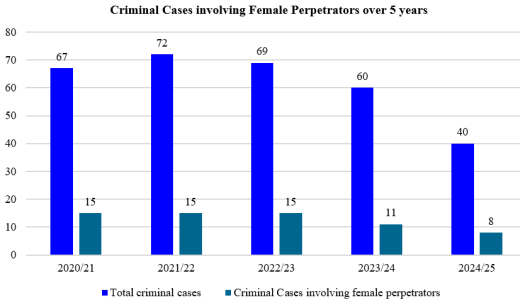
Figure 2. Bar graph showing criminal cases involving Female perpetrators published in NKP over five years.
Between 2020/21 and 2024/25, a total of 308 criminal cases were published in NKP. Of the published criminal cases, only 64 cases involved 99 female perpetrators, either as principal perpetrators, as aiders, or as co-accused in group offenses. Criminal cases involving female perpetrators account for around 20% of all criminal cases over these five years. This shows that there is comparatively lower representation of female perpetrators in criminal cases at the Supreme Court level. This finding aligns with the Chivalry hypothesis, suggesting that females engage in fewer crimes than males. However, there exists another perspective explaining the lower number of criminal cases involving female perpetrators. The crimes of women remain underreported to a greater extent than the crimes of men.
This discrepancy in reporting of the crimes by women could reasonably account for the lower statistical representation of women in crime. Also, the NKP only publishes selective Supreme Court cases, so these figures may not represent the true picture of female criminality in Nepal. The findings cannot be generalized to all criminal cases in Nepal. However, it provides insight into the Supreme Court's judicial reasoning.
4.2.2. Gender and Sentencing Outcomes: Chi-Square Analysis
To examine whether there exists an association between gender and sentencing outcome at the Supreme Court level, a Chi-square test of independence was conducted. Due to limited access to comprehensive judicial records, the analysis was restricted to criminal cases involving male and female defendants published in NKP from 2020/21 to 2024/25. The Chi-square test of independence was used to assess whether there is a statistically significant relationship between Gender (Male, Female) and Sentencing outcome (Convicted, Acquitted).
The hypotheses were formulated as follows:
H₀ (Null Hypothesis): Gender and sentencing outcome are independent.
H₁ (Alternative Hypothesis): Sentencing outcome is associated with gender.
The Chi-square statistic was calculated using the standard formula:
χ2 = ∑ (Oi – Ei)2/Ei
where Oi= observed frequency
Ei = expected frequency
The Observed frequency (Oi) is calculated by analyzing Sentencing Outcomes by Gender in Supreme Court cases published in NKP, 2020/21–2024/25.
Table 3. Observed frequency (Oi) of the Sentencing Outcomes by Gender in Supreme Court cases published in NKP (2020/21–2024/25).
Outcome | Male Defendants | Female Defendants | Total |
Convicted | 428 | 38 | 466 |
Acquitted | 292 | 61 | 353 |
Total (N) | 720 | 99 | 819 |
The Chi-square test of independence indicated a statistically significant association between gender and sentencing outcome, χ² (1, N = 819) = 15.74, p <.001. Hence, the Null Hypothesis (Ho) is rejected as the data shows there is an association between the Gender and sentencing outcome at the Supreme Court level. Male defendants were convicted at a higher rate (59.4%) compared to female defendants (38.4%). Alternatively, female defendants were acquitted at a comparatively higher rate (61.6%) than male defendants (40.6%). This finding supports the Chivalry Hypothesis, which posits that female criminals receive lenient treatment by the judicial system.
To assess the strength of the association between the gender and sentencing outcome by the Supreme Court, Cramér’s V was calculated using the formula V =√(χ^2/(N(k-1))), whereχ² = Chi-square value, N = total sample size, and k = number of rows or columns (whichever is smaller). The calculated Cramér’s V value was 0.14. This value indicates a small association between gender and sentencing outcome. The relation between gender and sentencing outcome is modest and not very significant. Furthermore, this analysis has been conducted while controlling for offense severity, crime type, or evidentiary findings. The finding should be interpreted cautiously, given that the higher acquittal rate for female criminals may be due to the controlled variables.
4.2.3. List of Offenses Leading to Female Incarceration at the Supreme Court-level
Analyzing the offenses leading to female incarceration by the court can help identify the patterns of female offending to some extent. It is important to evaluate whether the belief that women only commit minor, non-violent crimes
| [7] | Steffensmeier, Darrell. & Allan, Emilie. Gender and Crime: Toward a Gendered Theory of Female Offending. Annual Review of Sociology. 1996, 22, 459-487. https://www.jstor.org/stable/2083439 |
[7]
is accurate. International studies have shown that the major crimes leading to female incarceration include drug offenses, injury, fraud, and homicide.
To determine whether this finding applies to the Nepalese context, the offenses leading to female incarceration at the Supreme Court level are listed.
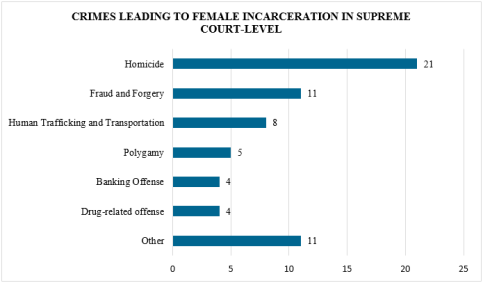
The following figure shows details of the crimes involving female perpetrators as published in NKP from 2020/21 to 2024/25. The graph illustrates the exact number of criminal cases involving female offenders over five years.
Figure 3. Bar graph showing crimes leading to the incarceration of female perpetrators at the Supreme Court level.
While studying the cases published in NKP from 2020/21 to 2024/25, it is found that females are involved in different criminal offenses. These offenses include a wide range of categories, including Homicide (Infanticide, Matricide), Human Trafficking and Transportation, Fraud and Forgery, Banking offenses, Polygamy, Drug-related offenses, and other offenses such as Disrespect of court, Assault, Kidnapping and Hostage Taking, Corruption, Copyright violation, Witchcraft, and Consumer Rights violation.
Homicide emerged as the most common offense perpetrated by female perpetrators, with 21 cases recorded in NKP over the last five years. Fraud and Forgery emerged as the second most committed by female perpetrators, followed by Polygamy and Banking offenses, respectively. The above observation is consistent with the international studies that highlight drug offenses, injury, fraud, and homicide as major crimes contributing to female incarceration.
.
The above-listed offenses are presented in the table below, illustrating the conviction rate, the roles of female perpetrators, sentencing disparities, and the defenses granted. This comprehensive analysis provides insights into the adherence to the principles of Chivalry within the Nepalese judiciary system.
Table 4. Showing the role of female offenders, conviction rates, sentencing disparities, defenses granted, and the applicability of the Chivalry Hypothesis for each offense.
Offense Type | Conviction rate | Sentencing Disparities and Defenses for lenient punishment | Applicability of the Chivalry Hypothesis |
Homicide (Infanticide and Matricide) | 51.85% | Reduced sentences despite a high conviction rate. Matricide: Battered Woman Syndrome, psychological disorders, guardianship of children. Infanticide: societal judgment, maternal instinct, poverty, suicide intent, lack of education. | Partially applicable: While high involvement and moderate conviction rates contradict the chivalry hypothesis in crime commission, leniency is evident at the sentencing stage. |
Human Trafficking and Transportation | 33.33% | No sentencing disparity and defenses granted. | Not applicable: Proportional sentencing despite low conviction rate, contradicts the Chivalry hypothesis. The lower conviction rate is due to insufficient evidence. |
Fraud and Forgery | 50% | No sentencing disparity and defenses granted. | Not applicable: Active involvement and proportional sentencing contradict the Chivalry hypothesis. |
Banking offenses | 50% | No sentencing disparity and defenses granted. | Not applicable: Active involvement and proportional sentencing contradict the Chivalry hypothesis. |
Polygamy | 0% | | |
Drug-related offenses | 75% | No sentencing disparity and defenses granted. | Not applicable: High conviction rate and proportional sentencing contradict the Chivalry hypothesis. |
Other offenses | 19.23% | No sentencing disparity and defenses granted. | Not applicable: Proportional sentencing despite low conviction rate contradicts the Chivalry hypothesis. The lower conviction rate is due to insufficient evidence and procedural errors. |
Women engage in a wide range of criminal activities in Nepal. The most predominant offenses leading to female incarceration at the Supreme Court-level are Homicide, Human Trafficking, transportation, and Fraud and forgery. This contradicts the Chivalry myth that women don’t commit violent and serious crimes. Further study of the data reveals a distinct pattern of conviction rates and sentencing disparities.
Table 4 shows a high conviction rate for offenses such as drug-related offenses (75%), Homicide (51.85%), banking offenses (50%), and Fraud and Forgery (50%). The high conviction rate in such offenses demonstrates a gender-neutral criminal justice system where the Supreme Court, which is the highest tier of court in Nepal, does not show any bias or leniency toward female offenders. Despite the high conviction rates, there appears to be a lenient approach to sentencing in homicide cases. Female offenders are often granted defenses such as battered women syndrome, societal judgment, poverty, etc., leading to shorter sentences. These defenses are female-centric and not applicable to male offenders. In contrast, lower conviction rates are observed in Human Trafficking and Transportation (33.33%) and Polygamy (0%). The lower conviction rate in such offenses is largely due to procedural errors and insufficient evidence. The lower conviction rate does not necessarily indicate leniency.
The analysis of the NKP cases reveals a reality different from the one the Chivalry hypothesis suggests. In contrast to the systemic tendency of leniency toward female offenders, the judicial response varies significantly in Nepal. There is no uniform leniency pattern for female offenders across all crimes at the Supreme Court level. Lenient treatment and shorter sentences are observed in certain cases, particularly in the sentencing phase of Homicide cases. However, leniency is granted in Homicide cases only in light of valid defenses. Female offenders are not immune to prosecution and punishment for crimes, particularly at the Supreme Court level. Overall, the Supreme Court of Nepal has a gender-neutral approach to prosecuting crimes committed by both men and women.
4.3. Evaluation of the Prison Population
Women make up only a small percentage of the global prison population,
indicating a significant gender gap between the numbers of male and female prisoners. Recent studies reveal that there has been an increase in the female prison population over the years. According to the World Prison Brief report of 2022, there has been an increase in the female prison population worldwide by nearly 60% since 2000.
Particularly, in Asia, the number of female prisoners has doubled since 2000.
This increase in the number of female prisoners has sparked an interest in the examination of the changing nature of female criminality. The analysis of the male and female prison population helps understand the gender-based dynamics at play within the prison system.
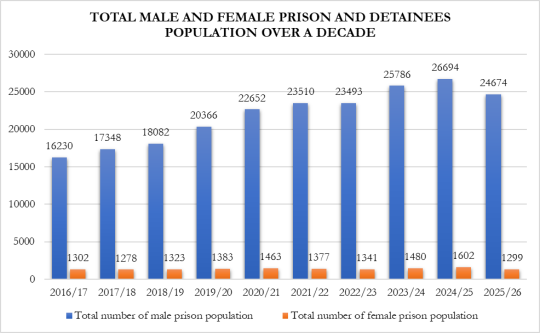
To conduct a comprehensive examination of the gender gap in the prison population in Nepal, data spanning over a decade, from 2016/17 to 2025/26, were collected from the Department of Prison Management (DOPM) website.
Figure 4. Bar graph showing Male and Female prison populations in Nepal from 2016/17 to 2025/26.
Over a decade, the male prison population has remained consistently higher than the female prison population in Nepal. This reveals that the Nepalese criminal justice system has a prominent gender disparity in sentence outcomes. According to recent prison statistics, the difference between the male and female prison populations was 23,775. Male offenders constitute around 95% of the prison population, while female offenders make up only around 5% throughout the years. This observation is consistent with the notion of chivalry that women commit fewer crimes than men, and even if they do, they often receive lenient treatment within the criminal justice system.
While the prison population is growing over time for both male and female offenders, the rate of increase is greater for male offenders in comparison to female offenders. Between 2016/17 and 2024/25, the male prison population increased dramatically from 16230 to 26694, while the female population increased mildly from 1302 to 1602. There is a decline in both male and female prison populations in 2025. This decline is attributed to the Generation Z protest, during which the detainees and prisoners escaped.
Despite this disruption, there has been a steady and moderate growth in female incarceration as opposed to a swift increase in male incarceration. This finding is contrary to the results of international studies, which show a significant rise in female incarceration.
The examination of Nepal’s prison population between 2016/17 and 2025/26 reveals a notable gender discrepancy in incarceration. While the male prison population exhibits an upward trajectory with little fluctuation, the female prison population stays steady and gradual. The results support the Chivalry hypothesis by demonstrating the underrepresentation of female offenders within the criminal justice system. However, it is important to acknowledge the possibility that the prison statistics might not accurately depict the situation of female criminality in Nepal. Women are more likely to commit non-violent, less serious crimes that might go unreported, unprosecuted, or unpunished.
| [7] | Steffensmeier, Darrell. & Allan, Emilie. Gender and Crime: Toward a Gendered Theory of Female Offending. Annual Review of Sociology. 1996, 22, 459-487. https://www.jstor.org/stable/2083439 |
[7]
As a result, the lower female prison population may not be due to lower offending rates but rather due to the potential for alternative criminal justice responses to female offenders, such as non-custodial measures.
5. Conclusion and Recommendations
5.1. Conclusion
The study shows varying degrees of applicability of the Chivalry Hypothesis within the Nepalese criminal justice system. The arrest rates and prison statistics in Nepal is consistent with the chivalry hypothesis. Analyzing the arrest rate of male and female offenders revealed a significant gender gap, with women primarily arrested for offenses such as Polygamy, offenses against the public interest, health, safety, convenience, and morals, Homicide, Drug offenses, and Gambling. The wide gender gap between male and female arrests signifies that women are less likely to be arrested, thereby substantiating the hypothesis. The study of NKP cases demonstrated that the number of criminal cases involving female perpetrators was much less compared to the total number of criminal cases at the Supreme Court level. The Chi-square test of independence further supported the Hypothesis by showing an association between gender and sentencing outcome. However, the association is moderate as illustrated by the Cramer’s V value. The comparison of the male and female prison statistics also supported the Chivalry Hypothesis. Women constituted only a small percentage of Nepal's total prison population.
However, sentencing disparity is not observed in the Nepalese criminal justice system. Particularly, only in Homicide cases, in sentencing phases, female perpetrators receive lenient treatment and shorter sentences in light of various defenses pleaded. Such leniency was not consistent across all offenses, indicating a selective application of the hypothesis. Overall, the Chivalry Hypothesis is applicable within the Nepalese Criminal Justice System, but it operates to varying degrees across phases.
5.2. Recommendations
Based on the discussion above, the following recommendations are proposed to address the potential influence of the Chivalry hypothesis and promote a gender-equitable Nepalese Criminal Justice System.
5.2.1. Further Research on Female Criminality
In Nepal, research on male perpetrators is extensive, whereas research on female criminality remains unexplored. For a complete understanding of the criminal system, further research on female criminality and the treatment of female offenders is required. The research should explore the motivations and factors that lead women to commit crimes, and the factors leading to the lenient treatment of female perpetrators by the justice system.
5.2.2. Training to Law Enforcement and Judicial Actors
Law enforcement officers, prosecutors, and judges within the criminal justice system should undergo gender-sensitization training programs. These programs should be launched periodically by concerned authorities to mitigate stereotypes and biases that may influence decision-making in the criminal justice system. The training should be designed in collaboration between legal professionals, civil society, and psychologists to provide a complete perspective on gender issues in the criminal justice system.
5.2.3. Monitoring Mechanism
The monitoring mechanisms should be introduced to ensure that the Nepalese criminal justice system is gender-equitable. The monitoring mechanisms could involve establishing a body responsible for tracking the key performance indicators related to the gender-equitable criminal justice system. The key performance indicators could include arrest and conviction rates, sentencing lengths, and defense grant rates for male and female offenders. Further, a reporting system could be developed to document and investigate allegations of gender bias within the criminal justice system.
5.2.4. Public Awareness
Raising public awareness about female criminality and gender-based stereotypes in the criminal justice system is crucial to challenging the societal attitudes and stereotypes of female criminality. These campaigns could include media channels, educational workshops, public awareness campaigns, and events to raise public awareness of the realities of female involvement in criminal activities. The above programs could be organized in collaboration with local communities, civil society, INGOs, and NGOs.





 Share This Article
 Twitter
 Linked In
 Facebook
 Copy
Copy Download