Review Article | | Peer-Reviewed

Arabica Coffee: Genetic Diversity, Conservation Challenges, and Breeding Approaches

Received: 28 October 2024     Accepted: 19 November 2024     Published: 13 December 2024
Views:       Downloads:
Abstract

Arabica coffee, native to Ethiopia, is esteemed for its exceptional quality and dominates the global specialty coffee market. As the primary cultivated coffee species, it accounts for approximately 60–65% of global coffee production. The genetic diversity of Arabica coffee, shaped through natural evolution and human domestication, is a cornerstone of its adaptability and resilience against biotic and abiotic stresses. Domestication syndrome traits such as reduced seed dispersal, compact growth, and increased uniformity have facilitated its cultivation, yet these traits have inadvertently narrowed its genetic base, making the crop more vulnerable to environmental and pathogenic threats. The genetic makeup of Arabica coffee is unique, with an allotetraploid genome that combines contributions from two diploid species, Coffea canephora and Coffea eugenioides. Despite its evolutionary significance, Arabica coffee exhibits relatively low genetic variation compared to other Coffea species. This limited diversity heightens its susceptibility to genetic erosion caused by deforestation, climate change, and unsustainable monoculture practices. Conservation efforts are crucial to preserving Arabica’s genetic resources, employing both ex-situ and in-situ strategies. Ex-situ methods include seed banks, cryopreservation, and field gene banks, while in-situ conservation protects wild populations in their natural habitats. Modern biotechnological tools such as molecular markers, genetic mapping, and somatic embryogenesis enhance the precision and efficiency of germplasm conservation and utilization. Breeding programs aim to address the challenges posed by climate change, pests, and diseases by developing varieties with enhanced drought tolerance, disease resistance, and higher yields. Hybrid vigor (heterosis) has shown promise in boosting adaptability and productivity. While vegetative propagation ensures uniformity and retention of elite traits, it limits genetic recombination, which is vital for long-term adaptability. In contrast, seed-based propagation facilitates genetic improvement but may compromise trait consistency. Notable achievements in breeding include improved cultivars like Geisha, SL28, and F1 hybrids, which balance productivity with stress resilience. Preserving Arabica coffee’s genetic base and advancing breeding efforts remain essential to securing the crop’s future and maintaining its contribution to global agriculture and livelihoods.

Published in International Journal of Food Science and Biotechnology (Volume 9, Issue 4)
DOI 10.11648/j.ijfsb.20240904.14
Page(s) 80-106
Creative Commons

This is an Open Access article, distributed under the terms of the Creative Commons Attribution 4.0 International License (http://creativecommons.org/licenses/by/4.0/), which permits unrestricted use, distribution and reproduction in any medium or format, provided the original work is properly cited.

Copyright

Copyright © The Author(s), 2024. Published by Science Publishing Group

Keywords

Arabica Coffee, Genetic Diversity, Germplasm Conservation, Breeding Strategies, Heterosis, Biotechnology in Coffee, Improved Coffee Varieties

1. Introduction
Traditional breeding is aimed at improving the income of the planters, who are mainly small farmers. As other perennial crops, coffee has a long juvenile period. Conventional breeding can take between 25 and 35 years. It is a major drawback for coffee improvement. Genetic engineering could shorten this time by allowing the incorporation of known genes into elite genetic backgrounds. Two major species, Coffea arabica (self-pollinated and allotetraploid: 2 n = 44, 68 % of the global production) and Coffea canephora (self-sterile and diploid: 2 n = 22) are cultivated all over tropical areas. Arabica breeding is traditionally based on pure line selection, but since 15 years, an F1 hybrid selection strategy has been developed . The main traits of interest for breeding are the following: yield and beverage quality along with pests and diseases resistance. Ethiopia is the primary centre of origin and centre of genetic diversity of coffee (C. arabica L.) . Arabica coffee (Coffea arabica L.) belongs to the Rubiaceae family and is one of the world’s most valuable agricultural commodities, accounting for two-thirds of the global coffee market . Coffee is one of the most economically important crops produced in about 80 tropical countries with an annual production of nearly seven million tons of green beans . It is the second most valuable commodity exported by developing countries with over 75 million people depending on it for their livelihood .
Ethiopia is the homeland and center of genetic diversity of Arabica coffee (Coffea arabica L., Rubiaceae) . It is believed to have originated in the humid, high rain forests of south western Ethiopia and the entire genetic diversity of indigenous (wild) Arabica coffee is confined mainly in the afromontane rain forest located in the west and east of Great Rift Valley It grows in almost all areas under conditions ranging from semi-savannah climate of the Gambella plain (500 m.a.s.l.) to the continuously wet mountain forest zones of the southwest and in gardens and back yards of south, east and northern parts of the country up to 2600 m.a.s.l. .
According to Coffea plants of the Arabica type in the world are generally estimated to be 10 to 20 billion, all descendants from just a handful of original plants taken from Ethiopia, which indicates Ethiopia to be the centre of origin and diversification of the Coffee arabica L. where it grows naturally at altitude of 1300 to 1800 masl . Being the canter of origin and diversification of coffee, Ethiopia possesses naturally diverse genetic resources of Coffea arabica for different agronomic traits such as resistant materials for coffee berry disease (CBD), leaf rust, coffee wilt, etc. and it is believed to be an important source and the home of coffee genetic resources for the world coffee production . This natural gene pool diversity of Ethiopian coffee forest, however, has been undergoing drastic erosion mainly due to deforestation and change in land use for several decades .
The main growing regions are Oromiya Regional state and Southern Nations and Nationalities Peoples Region with 63 and 35% total production respectively. Gambela and Benshangul Gumuz Regions are also contributing about 2% of the total annual production. The country is endowed with wide genetic diversity which allowed the production of different coffee types each with its own specific inherent quality. The favorable soil and climatic conditions under all the coffee-growing regions allowed the production of coffees of unique aroma and flavor characteristics. In the country, among the most diversified coffee types, the major five which deserved international appreciation in the world market are; Harer, Sidama, Yirgachefe, Gimbi and Limu coffee types .
2. Important Domestication Syndrome Traits for the Crop
Nobody is sure of the exact location where Coffea arabica was originally domesticated and discovered as a beverage, except few unevidenced belief or story. The most famous story was that of the goat herd, Kaldi (who lived around 9th century) who observed his normally docile goats had suddenly behaved exceptionally lively, skipping, rearing and bleating loudly after eating the bright red berries from a shiny dark-leaved shrub nearby and that Kaldi tried a few berries himself and soon felt extraordinary, stimulated or a novel sense of elation. Best stimulant beverages, has favoured the expansion of coffee cultivation and commerce .
According to the domestication and use of coffee in Ethiopia dates back some 2000 years ago. Some legends of its early consumptions even date it back, around 1000 BC . During the early period of domestication, coffee was only used as food by the native Oromo people. Coffee becomes known to the rest of the world only during the beginning of the last millennium. It was first brought by traders to Yemen around year 600 . The Arabs developed its present use as liquor, and the culture of drinking coffee reached Turkey and Syria during the late 1400s and early 1500s. This habit of drinking coffee gradually spread to the rest of the world, leading to an increased interest in producing it as a commodity on a large scale. The Dutch first introduced coffee plantations to Java in 1690, and it gradually spread to other parts of the word, especially Latin America . Today, Latin American countries are the major producers of Arabica coffee.
2.1. Evolution and Ploidy Level
The available information on the cytogenetic origin of the tetraploid C. arabica is uncertain. Based on morphological comparisons and crossability with some species of the subsection Erythrocoffea and the fact that its center of genetic diversity is situated outside the area of distribution of the diploid species. concluded that C. arabica was possibly an allotetraploid and that C. canephora and C. eugenioides may have been involved in its formation and evolution. Recently, some molecular investigations have been also carried out to determine the origin of C. arabica. studied a range of species and found that C. congensis and C. eugenioides are the diploid progenitors of C. arabica. compared the RLFP (restriction fragment length polymorphism) patterns of some potential diploid progenitor species with that of C. arabica and suggested that C. arabica is an amphidiploid formed by hybridization between C. eugenioides and C. canephora. In general, from both early and recent findings, while C eugenioides is most probably one of the parents, there is still uncertainty between C. canephora and C. congensis as the other. This species is divided in several varieties, some tall (Bourbon, Typica) and some dwarf (Caturra, Catuai).
Results of studies on chromosome numbers, characters of simple inheritance and cytology in coffee specifically in C. arabica carried out between 1930 and 1950 at Campinus, Brazil, have been reviewed by . The basic genome, X, of the genus Coffea comprises 11 chromosomes. C. arabica L. is the only tetraploid species so far identified with 2n = 4x = 44 chromosomes. All other species are diploid with 2n = 2x = 22 chromosomes. All the cultivars of C. arabica are tetraploid with the exception of the variety ‘bullata ‘which has two forms, a hexaploid (2n = 66) or an octoploid (2n = 88), and the variety ‘monosperma’ which is haploid with 2n = 22 chromosomes. Nevertheless, all commercial cultivars of Arabica coffee have 44 chromosomes, as the 22-, 66- and 88- chromosome types are sterile due to abnormal meiosis .
2.2. Major Patterns of Evolution
Origin of the C. arabica genome:
The evolutionary trend in Coffea as postulated by is as follows: The diploid Coffea species are thought to be descendants of common allogamous ancestors in Central Africa. These have achieved speciation by migrating in different directions where they gave rise to morphologically distinct populations. Thus, Canephoroides and Liberio-excelsoides differentiated westwards, whereas Mozambicoffea and Mascarocoffea differentiated south-westwards and Coffea arabica north­wards. Each of these phylogenetic branches had a divergent evolution coupled with slight chromosome differentiation which however has not reached a stage of establishment of strong reproductive isolation barriers. The amphidiploids C. arabica has a common genome with one found in the diploid species. The origin of the second genome however, is still unknown . The normal diploid behavior of C. arabica is thought to be either due to strong preferential pairing or due to a genetic system that regulates synapsis of the Triticum aestivum type.
Observations on the meiotic behavior of interspecific hybrids between C. arabica and different diploid coffee species, by various investigators, were reviewed by . The observed number of bivalents and trivalents formed during meiosis, which was close to 11, with few exceptions, suggested that one genome of C. arabica had close affinity to the genome present in all the diploid species tested. This in turn indicated that in the genus Coffea, all species share the same basic genome and have a monophyletic origin. also reviewed some biochemical studies and reported closer affinity of C. arabica with C. eugenioides and C. congensis than with C. canephora.
2.3. Genetic Resources of the Crop: Primary, Secondary and Tertiary Gene Pool
Ethiopia is well noted as centre of origin and diversity of many domesticated crops including Arabica coffee. The montane rainforests of southwest Ethiopia are the primary centre of diversity of Coffea arabica and the origin of all Arabica coffee cultivated worldwide. It possesses all three categories of the gene pool for C. arabica witnessed the existence of a great variation among the wild coffee plants in Ethiopia. Different research findings illustrate the importance of the Ethiopian coffee genetic materials in breeding programs for high productivity and disease resistance . Ethiopian C. arabica accessions were used as parents and crossed with commercial varieties to obtain strong hybrid vigor, resulting in over 34% higher productivity of the F1 hybrids in full sun in Central America , indicating higher diversity of Ethiopian coffee.
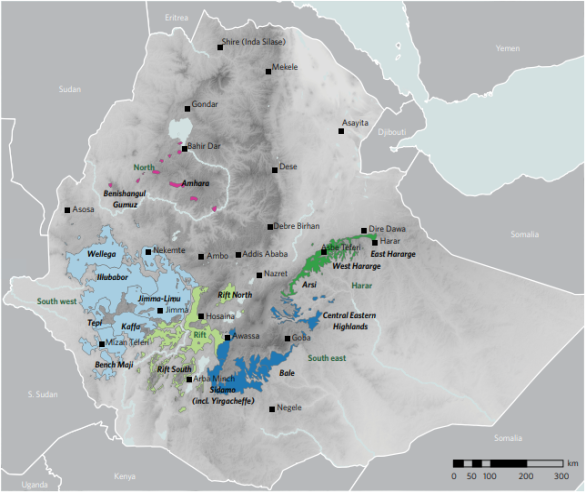
Despite being a globally distributed tropical crop, wild populations of Arabica are restricted to the humid forests of Ethiopia, and a small area of neighboring South Sudan (Figure 1) . These wild populations have considerable value as the main storehouse of genetic resources for Arabica coffee , and have provided fundamental resources for Ethiopia and the global coffee sector . In Ethiopia, these genetic resources continue to provide an important source of new planting material for coffee-farming, via seed and seedlings, including disease resistant variants, and the intrinsic (genetic) variation associated with the various flavour profiles found across the coffee landscape. Historically, and in recent times, wild Arabica coffee has provided germplasm for the development of the Arabica coffee sector outside Ethiopia. Protection of wild populations of Arabica coffee is therefore viewed as a key part of the long-term sustainability strategy for Ethiopian coffee production and the global coffee sector .
2.4. Germplasm Collection and Where Such Collection Is Largely Found
Plant material surveys and collections were undertaken in Ethiopia from the beginning of the 20th century , which led to the establishment of valuable gene banks at several international research centers in Africa (Cameroon, Co te d’Ivoire, Ethiopia, Kenya, Madagascar, and Tanzania), America (Brazil, Costa Rica, and Colombia), and Asia (India and Indonesia) . The largest and most comprehensively documented collections were those carried out under the aegis of the FAO in 1964–1965 and by ORSTOM in 1966 .
In Ethiopia, conservation of coffee genetic resources is the mandate of the Ethiopian Biodiversity Institute (EBI), and the Jimma Agricultural Research Centre (JARC), the latter being responsible for coordinating coffee research within the Ethiopian Institute of Agricultural Research (EIAR). In efforts to collect and document the use of coffee genes in breeding programs, researchers have collected Arabica coffee germplasm accessions from different coffee growing areas throughout Ethiopia. The collections are conserved ex situ in field gene banks at Jimma Agricultural Research Center and its sub-centers (5,960 accessions of pointed collection) and in Choche (5,731 accessions random collection), in Jimma zone of Oromia state, Ethiopia . The collection at Choche is mainly for conservation and managed by the Ethiopian Biodiversity Institute.
2.5. Threats of Genetic Erosion
The disappearance of the genetic resources is taking place at an alarming rate more particularly in the last two to three decades . Among the factors that contribute to the erosion of coffee genetic diversity in Ethiopia, the more noticeable is deforestation. First, as elsewhere in the tropics, forest conversion to agriculture and other land uses related to urban population growth have resulted in the fragmentation of the Ethiopian montane forest . The wild coffee populations are highly endangered by deforestation due to the demand for agricultural land and settlement areas. This development is alarming as wild coffee is not only consumed by local people; it is also an important cash crop for local markets as well as the international specialty market Above all, it is an invaluable genetic resource for future coffee breeding worldwide.
Figure 1. Map of potential wild Arabica coffee in Ethiopia and South Sudan. The colored areas represent the coverage of the humid forest types* where Light Blue represents South West coffee areas: Wellega, Illubabor, Jimma, Kaffa, Tepi and Bench Maji; LIGHT GREEN, represents Rift coffee areas i.e., Rift North and Rift South; DARK BLUE represents South East coffee areas: Sidamo, Yirgacheffe, Bale and Central Eastern Highlands; DARK GREEN represents Harar coffee areas: Arsi, West Hararge and East Hararge and PINK represents the North coffee areas: Amhara and Benishangul Gumuz. Wild Arabica coffee could occur (where there is =1% of forest cover in each km2). Map generated from species distribution models (SDMs) and remote sensing [one SDM]; [SDMs and remote sensing]). *Humid forest represented by Moist Evergreen Afromontane Forest (MAF) and Transitional Rain Forest (TRF) types . Agroforestry systems in Sidama (south of Hawassa) are no longer wild habitats but may contain wild type plants originating from this area. Other forest areas may be highly modified compared to primary forest areas.
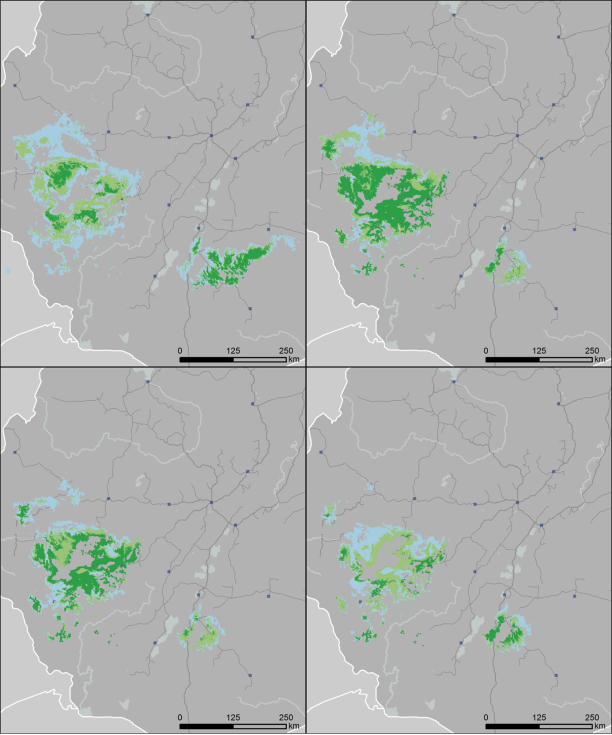
Figure 2. Maps and metrics for one example future projection; emission scenario A1b, GCM gfdl_cm2_1 and migration scenario D (see Table 1) showing SDMs and figures for AOO, EOO, and population numbers, for 1960–1990, 2010–2039, 2040–2069, and 2070–2099. The record from Bahir Dar (in the far north, for the time periods 1960–1990 and 2010–2039) is included here, although it is uncertain whether this represents an indigenous population .
In some areas, the interest of farmers in coffee growing decreased in the past recent years due to economic, climatic or agronomic factors, leading to partial abandoning of coffee trees in forests or gardens. Very low prices paid to farmers, particularly during the ‘price crisis’ between 1999 and 2004, resulted in the drop of producers’ revenues and shifting to food crops or to the more lucrative khat cultivation after uprooting coffee plants . With global climate change, some marginal coffee areas suffer from prolonged dry periods; this favours the cultivation of khat more resistant to drought than coffee. Low yields, particularly in highly CBD-prone areas, do not encourage farmers to exploit and conserve forest coffee populations and landraces, which are mostly not resistant to CBD. There is also very little incentive to conserve remnants of forest with very low yields and poor quality of forest coffee. The incidence of coffee wilt disease or tracheomycosis caused by Gibberella xylarioides, which slowly but surely destroys coffee plants, is also increasing in the country, mainly in the garden coffee systems .
An example of area particularly affected by coffee genetic erosion is Harerge in the eastern part of the country. This area suffers from recurrent droughts and, since the last half century, khat growing has been reported to compete with coffee . Another factor affecting genetic diversity is the replacement of local landraces by few improved varieties with a narrower genetic base and it is proposed, with the support of the international scientific community and donor organizations, to undertake a concerted effort to rescue highly threatened Arabica coffee genetic resources in Ethiopia.
Despite the importance of wild Arabica populations in Ethiopia and South Sudan, there are serious threats to the survival and genetic integrity of this species. Amongst the most serious of these threats are deforestation , climate change , and genetic erosion . Recorded climate data in Ethiopia from the 1960s onwards show an average increase in the mean annual temperature of 0.28°C per decade , a shortening of the wet season, and an increase in the number of hot days . Given the scale, severity, and potential impact of these threats and other negative influences it is important that the extinction risk of wild Arabica coffee is comprehensively assessed. Until now, no formal extinction risk assessment has been made for Arabica coffee.
2.6. Major Germplasm Conservation Strategies for the Crop, Including Biotechnology Techniques
Insitu conservation:- Truly wild coffee populations can still be found in a few remote pockets of mountain rainforest in southwestern and southeastern parts of the country (mainly in areas like Bale, Bench-Maji, Illubabor, Kafa, Jimma, Shaka/Tepi, and West Wollega). Three sites, namely Kontir-Berhan in Bench-Maji zone (ca. 20,000 ha), Boginda-Yeba in Keffa (5,500 ha) and Geba-Dogi River in Illubabor (18,600 ha), had been identified for forest coffee conservation as Bio-reserve.
Number of locations
For the number of locations we used the IUCN definition of location: “a geographically or ecologically distinct area in which a single event will affect all individuals” . For wild and cultivated Arabica coffee, climate is the main driver for the distribution of the species . The locations covered by the natural distribution of wild Arabica represent different climate regimes , which will affect the species differently under a changing climate. Within Ethiopia there is a major climatic division, east and west of the Great Rift Valley, as discussed in , giving two locations for wild Arabica coffee.
A third would be the Boma Plateau in South Sudan, although this location is projected to fall out of climatic suitability by 2020, representing the time period 2010–2029 . There is a fourth locality in the north, on the Zege Peninsula (Bahir Dar), located at the southern edge of Lake Tana. Niche models indicate that the Zege Peninsula is potentially part of the wild distribution of Arabica coffee, and forest coffee is cultivated here, but it is uncertain if these are true wild Arabica coffee populations, as the residents of the area say the forest and its coffee was planted around two hundred years ago. This gives three to four locations, but to invoke the number of locations criteria (based on the threshold of less than five locations this species would need to be pushed to Critically Endangered or Extinct in a very short period, and there is no evidence for this.
Ex situ field genebanks offer an alternative to conserve genetic resources of crop plants for preserving germplasm of taxa that are difficult to conserve as seed . One of the big drawbacks of plants held in ex situ collections is that they are grown in monoculture leading to susceptibility to pests and diseases and the growing of plants in ecological conditions not suitable for their growth, leading to strong selection pressure and genetic erosion. One way to combat that is by setting up a core collection with accessions chosen to represent diverse genetic variability and duplicating the collection in diverse ecogeographic sites. To achieve this, there is an urgent need to assess the extent of genetic variability of plants held in existing ex situ collections and initiating new collecting programs to fill gaps in these field collections . In addition, in situ conservation of wild species and landraces should also be emphasized. Molecular tools utilizing DNA markers should be utilized to increase our understanding of coffee genetic diversity and to develop strategies for conservation of coffee genetic resources with wide genetic representation.
Ex-situ Conservation in Ethiopia: - in field gene banks at Jimma Agricultural Research Center and its sub-centers (5,960 accessions) and in Choche (5,731 accessions), but handling is costly and risk loss as problem of poor adaptation of accessions. Much work also remains to be done to assess the diversity existing in the collections currently conserved ex situ by JARC and EBI. The analysis of both phenotypic and genetic data will help to guide the collecting strategy for the future, fill gaps in the collections, rationalise field genebank conservation through the creation of security back-up collections or for renewal operations, and guide hybridization programmes by searching for heterotic groups. Implementing such a genotyping programme on all the JARC and EBI collections may seem difficult to envisage now, due to the costs involved, but progress in molecular biology techniques will probably overcome this limitation in the medium term. Thereafter, it will become possible to define a core collection for priority preservation.
Due to the non-orthodox nature of seeds and difficulty of long-term storage, Coffea species have been traditionally conserved as living plants ex situ in field collections . Alternative methods for long-term preservation of Coffea germplasm include cryopreservation and in vitro slow growth methods.
Cryopreservation
Cryopreservation in liquid nitrogen (-196°C or -320°F) is the best technique described so far for the long-term storage of coffee germplasm . Researchers have used different tissues and organs for cryopreservation such as: terminal buds from C. costatifructa and C. racemosa; somatic embryos from C. canephora and C. arabica; zygotic embryos from C. arabica, C. canephora, C. liberica, and the interspecific hybrid Arabusta; embryogenic cell lines from C. arabica and C. canephora; and seeds from C. arabica, C. liberica, C. costatifructa, C. racemosa, C. sessiliflora, and Arabusta . IRD (Institut de Recherche pour le Développement) in Montpellier, France have made considerable efforts in coffee seed cryopreservation research since 1997 leading to development of procedures with satisfactory survival rates. Two cryopreservation strategies have been routinely used in coffee genebanks, each with its own advantages and drawbacks .
The advantages of Strategy 1 are that the frozen seeds can be transferred to greenhouse directly without going through a tissue culture process. The two main drawbacks of this strategy are that the mean survival rate is moderate at about 52% and the requirement of a programmable freezer. The advantages of Strategy 2 are the high average survival rate of about 74% and the elimination of a programmable freezer since the seeds are immersed directly in liquid nitrogen. The main disadvantage of this strategy is the laborious nature of tissue culture compared to direct germination. Additionally, loss of plantlets due to the risk of contamination and the acclimatization of in vitro plantlets recovered from frozen embryos pose problems .
Considerable progress has been made in understanding the mechanisms of coffee seed sensitivity to desiccation and exposure to liquid nitrogen and refining the rewarming and rehydration protocols allowing the achievement of 100% survival of frozen seeds. These improvements will enable in applying cryopreservation techniques for future long-term conservation of coffee germplasm .
However, at the moment, only seed cryopreservation has been given sufficient attention to enable its routine use for long-term conservation in coffee genebanks . The possibility of using a protocol developed with Typica and Bourbon seeds as a standard procedure for cryopreservation of C. arabica genetic resources was recently demonstrated with 67 accessions in CATIE's field collection . Up to 92% of the accessions could be successfully cryopreserved. But in Ethiopia, no effort has been made in biotechnology aspect.
In Vitro Slow Growth
Alternative storage techniques such as in vitro culture techniques have been developed for coffee germplasm storage to overcome the problems associated with traditional ex situ conservation techniques. The main aim of slow growth in vitro conservation is to reduce the number of transfers required of the plant material onto fresh medium, which is achieved by manipulating storage temperature, growth regulator levels, sugar, mineral salts, addition of growth retardant, reduction of oxygen tension levels, etc. . Medium-term conservation based on slow growth has been achieved for C. arabica at 20°C and for C. canephora at 23°C. Slow growth technique in coffee has been performed on explants such as shoot apex, orthotropic nodes, and zygotic embryos .
Reasons for preferring one conservation strategy to the other for this crop
Each of the above mentioned methods have their respective advantages and disadvantages. It is now well recognized that an appropriate conservation strategy for a particular plant genepool requires a holistic approach, combining in a complementary manner the different ex situ and in situ conservation techniques available. Selection of the appropriate methods should be based on a range of criteria, including the biological nature of the species in question and the practicality and feasibility of the particular method chosen, as well as the cost-effectiveness and security afforded by its application. Coffee pollen is known to conserve well and has major advantage for germplasm exchange as disease free material. There is still much to be done in optimization the conservation methods for coffee germplasm; the variation in response to different conservation techniques of different Coffea species demonstrates the importance of complementarily in effective ex situ conservation strategies. Complementarity is a flexible concept, which evolves with the availability of techniques aiming at conserving, propagating and characterizing the genetic resources in question. In situ conservation of genetic resources is a conservation approach that is acknowledged as being complementary to ex situ conservation and its implementation for Ethiopian coffee has long been considered as a national urgency .
2.7. Important Traits for Germplasm Characterization of the Crop
Germplasm collections were characterized for various morpho-agronomic traits. Wide variation was observed for almost all traits. Data on morphological traits (both quantitative and qualitative) characters using a total of 30 character descriptors adopted from International Plant Genetic Research Institute by random sampling method.
Quantitative Traits
The twenty-three coffee quantitative characters data to be recorded and their measurement descriptions are listed as follows:-
Plant height (cm): Total height of the tree from the ground level to the tip of the main stem
Stem diameter (cm): Measure as a diameter of the main stem at five cm above the ground
Number of main stem nodes: are total numbers of nodes count per tree
Angle of primaries branches (degree): is the angle between the main stem and that of Primary branch using protractor
Canopy diameter (cm): Average length of tree canopy measure twice, east-west and north- south, from the widest portion of the tree canopy
Average internode length of main stem (cm): By computing per tree as (TH–HFPB)/TNN-1, where TH = total plant height, HFPB =height up to first primary branch, TNN = total number of main stem nodes
Average length of primary branches (cm): is average length of three primary branches per tree
Average girth primary branches (cm): is average girth of three primary branches per tree
Average internode length of primary branches (cm): will be estimated from four primaries per tree. The first four undamaged primaries from the bottom will be selected and for each primary the length divided by its number of nodes will be given inter-node length
Number of primary branches: is total number of primary branches count per tree
Number of secondary branches: are total numbers of secondary branches count per tree
Percentage of bearing primaries branches: This can be compute per tree as (NBPB/Npb) * 100, where NBPB = number of bearing primary branches per tree, Npb= total number of primary branches per tree
Height up to first primary branches (cm): Height of the tree from the ground level to the first primary branch of the main stem
Leaf length (cm): Average of five normal (excluding node 3 from the terminal bud) leaves, measure from petiole end to apex
Leaf width (cm): Average of five normal (excluding node 3 from the terminal bud) leaves, measure at the widest part
Leaf area (cm2): This will be measured using leaf area meter as an average of five leaves per tree (destructive sampling)
Fruit length (mm): Average of ten normal and mature green fruits of each tree measured at the longest part
Fruit width (mm): Average of ten normal and mature green fruits of each tree measured at the widest part
Fruit thickness (mm): Average of ten normal fruits of each tree measured at the thickest part
100 bean weights (gm): Average of four tree samples of 100 beans weight measured
Yield (kg): For this trait data average of the representative tree in each plot taken as values for each experimental unit.
Bean length (mm): Average of ten normal beans of each tree measured at the longest part
Bean width (mm): Average of ten normal beans of each tree measured at the widest part
Qualitative Traits
Seven coffee quantitative characters data to be recorded and their measurement descriptions are listed as follows:-
Growth habit: Open or with spreading branch (1), Intermediate (2) and compact (3)
Stem habit: By pushing the main stem with hand. Stiff or strong (1), Flexible (2)
Branching habit: Very few branches (primary)(1), Many branches (primary) with few secondary branches(2), Many branches (primary) with many secondary branches(3) and Many branches (primary) with many secondary and tertiary branches(4)
Leaf shape: By comparing the picture indicate in coffee descriptor Obovate (1), Ovate (2), Elliptic (3) and Lanceolate (4)
Young leaf color: By observing the young leaves on the coffee trees. Greenish (1), Brownish (2), Reddish brown (3) and Bronze (4)
Fruit shape: By comparing the picture indicate in coffee descriptor Round (0), Obovate (1)
Fruit color: By observing coffee cherry color during time of harvesting. Yellow (0), light red (1), dark red (2)
Important traits for germplasm evaluation of the crop.
Yield (g): fresh cherry in gram per plot collected and converted in to Qt/ha
Data collection for major diseases
(CBD)
Visual assessment of 10 trees per plot taken and diagnosed for presence and absence of the disease on each tree. Thereafter disease incidence is calculated as (number of diseased trees/total observed trees) x 100.
B. Berry count: three uniform trees per coffee accession are randomly selected and three to four branches are selected from each coffee tree to record the number of CBD infected and healthy berries to calculate percentage of diseased berries.
Assessment of coffee wilt disease (CWD)
CWD assessment is taken by following the method procedure. Healthy and diseased (dying and dead) trees showing typical characteristic symptoms (internal and external) of the disease and/or sign of the pathogen is visually observed. Then the numbers of healthy and diseased trees is counted, and the incidence of CWD is computed as (number of diseased trees/total number of observed coffee trees) x 100.
Field assessment for resistance to CLR
Resistance to CLR is carried out in progeny plots in the field under natural infection. Three trees accession-1 are assessed. Three pair of branches are selected from the middle to lower coffee canopy of each selection to determine coffee leaf rust incidence. The rust incidence is determined as proportion of diseased leaves per branch. Moreover, the pictorial assessment scale (0-9 scoring scale, scale I) designed by for field evaluation is also used or evaluating the field performance of each coffee selection.
Quality Data collection
Quality evaluation is conducted as per the recommended procedure . Six to eight kilogram red ripe cherries are harvested from each coffee sample/accession. The collected red cherries are prepared under washed processing method. The cherries are pulped in the same day of harvest and left to ferment under water bath on the recommended time of fermentation for the testing agro-ecology. After fermentation and washing process takes place the parchment coffee are dried to standard moisture content. The prepared samples are evaluated for quality attributes at JARC coffee quality laboratory by certified Q grader team. Each sample are evaluated for their raw and cup quality. The raw coffee quality assessment (40%) is evaluated for moisture content, screen size, bean shape and make, colour and odour. Cup quality is evaluated for aromatic intensity, aromatic quality, astringency, bitterness, flavour, typicity and over all standards that adds 60%.
3. The Breeding Objectives and Goals for the Crop
Modern coffee breeding programs need to address some of the crucial needs of the coffee industry, moving away from yield increases as the highest priority toward high cup quality and broader genetic base . Among the main goals of most current breeding programmes, including the one in progress at the Jimma Agricultural Research centre (JARC) are: improved yield coupled with compact growth, quality and disease resistance. In order to achieve these goals, breeding procedures have to involve hybridization among different varieties selected for certain desirable attributes which they carry. Planning of such a programme and indications of immediate consequences of selection is best understood against a background of information relating to the mode of inheritance, and the amount of genetic variation among the available genotypes, for the character in question.
Breeding programs should address the following goals; in addition to Higher yields than those of the current best lines attempts are currently being made to achieve several objectives, namely:
Broaden genetic base of modern varieties to combat the constant threat caused by the emergence of new strains of existing diseases and pests (leaf rust, berry disease, wilt disease, berry borer, leaf miner);
Increase in yield without compromising coffee quality;
High bean and cup quality comparable to or better than that of best local types;
Good adaptability to limiting conditions and, in particular, stable production
Production efficiency through easier harvesting (compact growth);
Confer host resistance for reduced disease and pest control; and
Develop environmentally friendly or organic production systems through zero or minimal pesticide use in disease- and pest-resistant varieties.
Recently, tolerance to abiotic stresses is also becoming important; especially in the face of climate change (drought and acidic soil tolerance are examples).
3.1. Important Quantitative and Qualitative Traits Considered in Breeding Program
The traits considered in breeding program are similar to that of for germplasm characterization. The procedures are as outlined above. Data on morphological traits (both quantitative and qualitative) characters using a total of 30 character descriptors adopted from International Plant Genetic Research Institute by random sampling method are being used by JARC breeders. The twenty-three coffee quantitative characters seven qualitative characters are being recorded to evaluate their distinctness.
3.2. Important Gene Actions for the Important Traits for the Crop
In order to study gene actions for the important traits for Arabica coffee, Mesfin studied a five-parent diallel cross which involved three CBD resistant cultivars (741, 7332, 7395) and two high yielders (2970, F59). Both GCA and SCA variances were highly significant for girth, number of flowers and fruits, length of first single primary branch and number of primary nodes whilst GCA alone was significant for the number of secondary branches. For yield of coffee, however, only the SCA mean squares were significant . From these results it was concluded that both additive and nonadditive genetic variances are important for the components of yield and growth characters measured, and that yield is predominantly controlled by non-additive genetic variance. Among the parents, the commercial cultivars F59 (now called ‘Dessu’ after release) and 741 which produced the best commercial hybrid ‘Ababuna’, were the best combiners for six and four of the seven characters studied, including yield. It is also noteworthy that the parent ‘7395’ which exhibited a large and negative GCA effect for yield produced the highest hybrid combination (7395 x F59) for the same character when combined with a parent having a good GCA effect.
A study of a six-parent diallel at the seedling stage revealed significant GCA for all 18 characters measured and significant SCA for 16 of them . The variance ratios computed considering the expected mean squares, however, indicated the predominance of nonadditive genetic variance for most of these characters. Comparison of the parents, showed that PI, P2, P3, P4, P5 and P6 possessed positive GCA effects for 18, 1, 9, 4, 9 and 12 of the 18 characters studied, respectively. These results indicated that PI followed by P6 were the best general combiners for inclusion in subsequent breeding programmes although the other parents could also be used for the improvement of those traits in which they showed high and positive GCA effects.
In Kenya, evaluated an 11-parent diallel cross for eight selected yield and growth characters, viz., height, girth, canopy radius, internode length of primaries, bearing primaries, berries per node, yield of cherry and yield of clean coffee. He reported that both GCA and SCA variances were significant for all the characters studied. Additive genetic variance was found to be larger than non-additive in all cases. He indicated that if, however, the expectation of mean squares of these components were taken in to account, the variance components due to GCA and SCA were of roughly the same magnitude. Reciprocal differences for almost all the characters studied were of trivial importance. Graphical analysis of the diallel further indicated the importance non-allelic interaction of genes for most of the characters studied including yield .
3.3. The Method of Reproduction of the Crop
Arabica is sexual reproduction crop and all pure-line varieties of C. arabica show sufficient homogeneity among their progenies that they are normally propagated by seeds.
3.4. The Mode of Pollination of the Crop
Coffea arabica is self-compatible and self-pollinating this means that flowers from a particular tree can pollinate each other, i.e. there is no differentiation between male and female flowers. It is self-fertile with less than 10% cross-pollination, while all other coffee species studied so far are diploid (2n = 22) and self-incompatible . Pollination may occurs by insects and to a lesser extent by wind. Positive effects were observed on initial fruit set in Arabica coffee in the presence of honey bee colonies, and the yield of mature berries increased significantly.
3.5. Floral Biology and Procedures of Selfing and Crossing
Floral biology
Flowers produced in dense clusters along reproductive branches in the axils of the leaves. White, sweet scented, star-shaped and carried on stout but short peduncles. Bracteoles united, forming a cup-shaped epicalyx at the base of the flower. There are 5 calyx segments halfway the length, spreading out very widely at the anthesis and 5 stamens inserted in the corolla tube. Anthers carried on long, slender, upright filaments. Ovary inferior, 2 united unilocular carpels, each containing a single ovule attached to the base of the carpel wall. The ovary bears a slender style, which terminates in short, pointed bifid stigmas.
3.5.1. Direct Seed Production (Selfing) Procedure
1. Select ideal (vigorous and uniform) mother trees with in a plot planted to a given cultivar.
2. Select also current fruiting branches, that mostly available on upper parts of the selected trees
3. When flower bud well develop (matured flower buds with yellowish to whitish colors but flowers not opened on the selected branches tie a yellow string (by common understanding) on upper and bottom part of the branches.
4. Remove all previously grown developed berries and immature flowers bud from the branch in b/n the two strings.
5. Cover each selected branch (marked with 2 yellow strings) with a waterproof paper bag (crossing bag) with two sided opened.
6. Tie the two ends of the bag lightly with a branch not to allow entrance of pollen grains from other cultivars or neighboring trees and branches
7. Write the name of the cultivar plus a mark of selfing by convention <X> on a label and tie the label with the selected branch
8. Remove the bags about 10 to 15 days after flower opening (i.e. with all flowers on the trees completely shaded away)
9. Frequent visit to the tagged branches until harvesting (do not allow growth of newly emerging flower buds on the branches after bag removal)
10. Harvest well mature fruits /cherries as they develop
11. Remove the pulp (use pulpers or manual) to pulping should be carried out possibly with the day of harvest)
12. Spray fine ash uniformly on the seeds before drying not to allow dev’t of micro organisms.
13. Dry in a cool place and well shaded urea (do not expose the seeds to strong sunlight
14. Store possibly, in well constructed cold rooms until sowing .
3.5.2. Hybrid Seed Production (Crossing) Procedure
N.B. crossing should be carried out after getting practical experience or in the presence of experienced technical staff
1. Plant parental lines under irrigated area and apply appropriate managemental practices
2. Select vigorous and uniform mother trees for crossing
3. Also select current fruiting branches on the trees and tag them at the bottom and upper parts (by convention with red string).
4. Remove all previously developed fruit and immature flower buds at along the length of the tagged branches leaving any potential flower buds for the purpose
5. Emasculate the female parent (seed plant) when flowers on the branches well mature (flower buds with yellowish to whitish colors)
6. Cover the emasculated branches with water proof paper bags similar used in selfing.
7. Cut well mature flower buds from the male parent along with short branch one day before pollination and put in a laboratory with adequate light intensity to facilitate flower opening
8. Prepare fully opened pollen sources in the laboratory and put in petridishes for ease of handling and transportation
9. Pollinate the emasculated branches with the pollengrain of prepared (pollination should be carried out after opening the tied-up branch with the paper bag)
10. After pollination cover also the branches with the paper bag previously used
11. Tag the pollinated branches with labels (write the type of cross and date on the label)
12. Remove the bags about 10 to 15 days after pollination (if the outside weather is sunny and dry. Remove 10 days after pollination but if the weather is cloudy with occasional shower, it may be extended up to 15 days
13. Fertilization in C. arabica happens around 24 hours after pollination and the first cell division of the endosperm occurs 21-27 days after fertilization. The first zygote division occurs 60-70 days after pollination .
N.B. All other subsequent activities after pollination are similar to direct seed production mentioned above.
The breeding advantages and disadvantages associated with the vegetative propagation.
Vegetative propagation (V.P) is a method of producing planting materials using plant vegetative parts instead of seeds. The materials produced vegetatively are genetically identical to the mother plant. In C. arabica, an autogamous plant, the propagation of pure-lines depends basically on seedlings originating from seeds. However, with the possibility of using hybrid vigor for productivity, the vegetative propagation of hybrid F1 is very important in commercial scale. It is known that hybrids can be more productive than the parents when they are genotypically well complement . Vegetative propagation can be done in two ways: via grafting (healing of the union between the scion and rootstock) and rooted cutting. Both will be discussed here. The purpose of grafting is to combine several traits of different trees into one. For example, some trees have very good root systems, but have low yields. Other trees have good quality characteristics whereas their root system is mediocre. Combining a good root system with a decent quality yielding tree can result in a better overall performance in the field. The cloning in C. arabic can be produced somatic embryogenesis . However; in Ethiopia, for micropropagation (tissue culture) technique protocol optimization is still underway and can’t be achieved yet.
Advantage of vegetative over tissue culture is it is less costly and no problem of somaclonal variation. The disadvantage is less effectiveness in getting more number of seedlings. The advantage tissue culture over cuttings is getting more number of seedlings than with stem cutting methd. The disadvantage of tissue culture method is it is costly and there is problem of somaclonal variation.
3.6. The Natural Mechanism/s Enforcing the Mode of Pollination of the Crop
Chasmogamy: the mechanism in which flower opens after pollination and fertilization takes place. This mechanism of pollination and fertilization while the flower is closed enforces Arabica coffee to be self-pollinated and prohibits cross-pollination. Knowing this mode of pollination is very important in hybridization of coffee. During crossing; emasculation should be performed before self-pollination and fertilization occurs, that is as soon as the flower bud developed but before two days earlier to opening will take place, normally understood through experience.
The genetic population structure of the crop under normal circumstance.
Arabica coffee grows over a wide range of agro-ecological zones and geographical regions in Ethiopia . Across these coffee growing regions, it is common to observe different coffee production systems. On the basis of management level, vegetation, structural complexity, and agronomic practices, coffee production systems in Ethiopia can be categorized into four; namely: forest coffee (FC), semi-managed forest coffee (SFC), garden coffee (GC) and plantation . The first three production systems have been practiced for centuries by smallholder farmers, and therefore, are considered as ‘traditional’ coffee production systems . In addition, they are not isolated from each other. For instance, in forest coffee and semi-forest coffee systems, the coffee genotypes, often called ‘wild coffee’ in the literature, are directly derived from spontaneous coffee trees of the forest. In the garden coffee system, the planting material results from a complex process of transport, exchanges and selection by farmers, and adaptation to environments that are sometimes distant (in geographical and ecological terms) from its original habitat. This planting material is commonly referred to as landraces and genetic population structure of wild accessions appeared to constitute a valuable gene reservoir and are made up of many varieties or cultivars-distinct types that are able to sexually reproduce with one another.
The type of population structure that can be used in releasing improved variety of the crop.
Wild coffee populations known as forest and semi-forest population, Farmers coffee landraces, that are grown as garden coffees, Ex situ conserved coffee germplasms and May be introductions targeted mainly for biotic (CLR and CWD) and/ or abiotic (drought) stresses
The genetic features of the crop.
Within the genus, it is the only self-fertilization of C. arabica probably contributes to its relatively low genetic diversity compared to diploid Coffea species and characterized by its homozygous genetic feature. Arabica cultivars, characterized by homogeneous agronomic behavior with high susceptibility to pests and diseases, have become high priorities for researchers .
The response of the crop to inbreeding depression.
Coffee is self-compatible and reproduces mostly by self-fertilization, which occurs in about 90% of the flowers. The cross-fertilization rate has been evaluated along several consecutive years in Campinas by using different recessive mutants. The most appropriate for this determination is the cera mutant, which exhibits yellowish endosperm when self­fertilized. Because of the xenia effect and recessiveness of the allele a cera coffee plants originate greenish seeds when fertilized by pollen of surrounding coffee plants homozygous for the dominant allele for green endosperm. The percentage of natural cross-fertilization has been determined to be around 10% in C. arabica . Successive generations of selfing do not reduce the vigour or productivity of the plants.
4. The Response of the Crop to Heterosis
The term ‘heterosis’ was first coined by Shull in 1914 to furnish a convenient term to replace a phrase such as ‘stimulus of heterozygosis’ which was earlier used to designate hybrid superiority. It referred to ‘the increased vigour, size, fruitfulness, speed of development, resistance to disease and to insect pests, or to climatic rigours of any kind, manifested by crossbred organisms as compared with corresponding inbreds, as the specific results of unlikeness in the constitutions of the uniting parental gametes . In short, superiority of F1 over either parents.
4.1. Genetic Basis of Heterosis
A great effort that has been made to understand the concept of heterosis allied with the re­ discovery of Mendel’s laws of inheritance around 1900 rapidly accelerated knowledge of genetics, cytogenetics and about the concept of heterosis itself. Surprisingly, despite the great success of commercial exploitation of heterosis in various crops, the increased knowledge of genetics, and a vast and to some extent very successful elaboration of the theory of inbreeding, the genetical causes of heterosis are not well understood .
Since the earliest attempt to explain hybrid vigor or heterosis in Mendelian terms, there have been two principal hypotheses: dominance and overdominances. and other authors indicated that the genetic principles governing the expression of heterosis may result from one or more of the following three genetic situations:
I. The accumulated action of favorable dominant or semi dominant alleles of genes dispersed amongst the two parents, i.e. dominance.
The dominance hypothesis assumes that hybrid vigour is due to the accumulation of favorable/beneficial dominant alleles in the F1 hybrids where the corresponding unfavorable alleles are recessive, so that their effects are masked by the effects of the dominants. According to this theory, heterosis in the F1 hybrid is the result of the masking of the harmful effects of recessive alleles present in one parent by the dominant alleles present in the other parent.
II. Favourabe interactions between two alleles at the same locus, i.e. intralocus, or interallelic interaction, referred to as overdominance.
The overdominance hypothesis was proposed by Shull in 1908 as a basis of heterosis. This hypothesis assumes that the heterozygote is superior to the two homozygotes for the same gene. Therefore, an F1 individual having the greatest number of heterozyous genes will be more vigorous than its two parents. According to this hypothesis, homozygosity leads to weakness and it would be impossible to find inbreds as vigorous as F1 hybrids, i.e. AA < Aa > aa .
III. Complementary interaction of additive, dominance or recessive genes at different loci, i.e. nonallelic interaction or epistasis.
Heterosis has been extensively studied and reported for a wide range of crop species, including both cross- and self- pollinators. In heterotic studies, the breeder is interested in the magnitude of heterosis obtained relative to the higher parent and/or the current commercial cultivar rather than with its frequency of occurrence.
4.2. Heterosis in Coffee
Unlike other crops such as cereals and forages, information on heterosis in arabica coffee is scanty. This is mainly attributed to its perennial nature that requires several years to obtain meaningful results. In Brazil, heterosis for yield was studied in crosses among selected progenies of the same and different cultivars. In all hybrids between the best progenies of Mundonovo and Bourbon Amarello cultivars and in many other hybrids, analyzed over ten years, none of the hybrids were better than the better parent, suggesting a lack of heterosis.
In Tanzania, heterosis was studied in crosses among five parents of which three were local selections (H66, KP423 (Kent), N39) and two were introductions from Ethiopia (VC496 or Geisha selection; VC541 or Amphillo selection) . The top hybrid exhibited 53% and 11% heterosis over the mean of two standard cultivars (H66 and N39) for yield and stem diameter, respectively.
In India, reported the highest yield heterosis of 86% and 100% over the better- parent from crosses between Agaro x 2045 and Chochie x 1934, respectively. The respective actual yields of the two hybrids were 10.46 and 14.59 quintals of clean coffee per hectare. The parents Agaro and Chochie are introductions from Ethiopia. Therefore, the achievement of high heterosis involved introductions from Ethiopia as one of the parents in both Tanzania and India. This clearly indicates the possible increase of heterosis with increasing parental diversity.
In Kenya, the greatest better-parent heterosis for yield was 19.7% in Caturra x Hybrido de Timor and 15% in Padang x SL34 assessed the yield heterosis in an 11 x 11 parent diallel cross. Thirty four F1 hybrids showed positive heterosis, with better-parent heterosis ranging from 8 - 300%. However, the highest yielding hybrid, Padang x SL34, with 1.45 kg per tree exhibited 21% heterosis.
In Ethiopia, reported up to 60% yield heterosis over the better-parent from a 5 x 5 half diallel cross among indigenous cultivars. Out of nine F1 hybrids, only one hybrid has exhibited negative heterosis of -8%. The highest yielding hybrids, Melko-CH2 and Ababuna, which have been approved for release to growers, respectively showed 20% and 18% heterosis over their better-parent. The actual yields of these hybrids were 23.97 and 23.68 quintals per hectare respectively on the basis of 2500 trees/hectare or 31.96 and 31.57 quintals of clean coffee at 3333 trees/hectare. In addition, these hybrids have shown up to 12% heterosis over the better-parent for girth and number of primary nodes . In another 6 x 6 half diallel cross, analysis of 19 seedling characters (seven shoot and six each for root and leaf characters) indicated better-parent heterosis that ranged from -28% for intemode length to +69% for shoot volume . Hybrid mean levels of heterosis were, however, positive for all the characters measured and ranged from 2% to 19% compared to the better-parent. The recently released hybrids namely, EIAR-50/CH, Melko-Ibsitu & TepiHC5 mean yield hetrosis of the three were 27.6 %, 18.1 % & 33.0 % over hybrid check respectively.
5. The Conventional Breeding Methods Used for the Crop
Pure-line variety development and F1 hybrid variety development are two breeding methods that are being followed at Jimma Agricultural Research Center.
5.1. The Pure-Line Selection Program
The whole selection program comprised four major steps:
(i) Collection/ Selection of mother trees,
(ii) Testing of promising progenies, to test whether superiority is due to gene or enviroment
(iii) Verification under multi-location and variety registration and release
(iv) Multiplication and seed distribution and regular assessment.
A detailed description of these activities is reported by , the FAO coffee pathologist who took over the responsibility and implemented the program upon the departure of Robinson in 1974.
5.2. Hybrid (F1) Variety Development Programme
The presence of high level of heterosis in crosses among elite indigenous coffee (Coffeaarabica L.) cultivars has been well determined. This was noted from different set of crosses that exhibited better parent heterosis ranging from 60% to 120% for yield . Once the presence of heterosis in crosses among indigenous arabica coffee cultivars was noticed, the next step was to investigate as to how to maximize the observed level of heterosis and make use of the available enormous genetic potential. The hybridization programme for resistance to CBD was initiated in 1978 with two major objectives: (1) to determine the inheritance of resistance to CBD, and (2) to combine the desirable attributes mainly yield, CBD resistance and quality into a single genotype .
Steps:
i) Identification of divergent parents
ii) Selfing to get homozygous parental line
iii) Crossing in half diallel mating fashion
iv) Analyzing for GCA and SCA performances for target traits of breeding
v) Multi-location yield trial to see G*E interaction
vi) Verification under multi-location and variety registration and release
vii) Multiplication and seed distribution and regular assessment .
5.3. Genotype by Environment Interaction in Coffee
G×E is defined as a phenomenon that phenotypes respond to genotypes differently according to different environmental factors. The performance of a crop variety is the resultant effect of its genotype and the environment in which it is grown. The term genotype-environment (GE) interaction is used to indicate inconsistency in the performance of genotypes or a change in the magnitude of the difference between genotypes under a range of environments. GE interactions are of major importance to the plant breeder in developing improved cultivars . The influence of GE interactions on crops when tested over a range of environments was well recognized by the early pioneers of crop science such as . He stated that “genes are not responsible for personal endowments of an individual; the environment also has part to play in determining the life situation.” Hence, any breeding programme aiming at increasing yield should consider association between yield and its attributes through estimation of influence of environmental factors on the expression of some key characters, as indicated by environmental variances as compared to its genotypic variances which help a great deal in formulating selection indices to aid plant breeders operate selection programmes efficiently.
The concept of genotype-environment interactions leads to measure the agronomic stability of the genotype and under the biological concept stable genotype is one, whose phenotype shows little deviation from the expected character level when performance of genotype is tested over a number of environments. Grain yield stability is influenced by the capacity of a genotype to react to environmental conditions, which is determined by the genotype’s genetic composition. The adaptability and stability of a genotype are useful parameters for recommending cultivars for known cropping conditions. The method commonly used for analysis of G×E interaction is the Linear Regression model in which the bi-values give information about adaptability and S2 is used as measure of stability of performance, AMMI (Additive Main Effects and Multiplicative Interaction) approach is also a measure of stability and adaptability and etc. In order to incorporate the desired characters in a cultivar, the breeder has to consider the performance of these characters with respect to environmental interaction and test the genotypes accordingly at more than one location to study their stability for these desired characters .
A cultivar by environment interaction of Arabica coffee genotypes was evaluated within and across regions in two sets. The first set of the study included four locations in different coffee growing regions (different origins). These were: Teppi, Metu, Wonago and Bedessa. But the locations in the second set of the study were all taken from a single coffee growing region of south west Ethiopia. These locations were: Jimma, Agaro, Gera and Metu. The genotypes included in the two sets of the experiments were different. The combined analysis of variance across environment within and over regions revealed that the interaction sum of square were highly significant for yield showing the differential performance of genotypes. But, the interaction observed across regions was found to be much stronger than the interaction observed within a region. No cultivar or set of cultivars was identified that exhibited high performance at all locations over regions. The result of this experiment clearly shows that the locations over different regions comprise different type of environments and the performance of the Ethiopian coffee cultivars showed specificity over these regions. The Ethiopian coffee cultivars also exhibited high specificity of performance over altitudes even within a region . But several cultivars were identified that exhibited high performance across locations within the south west coffee growing region of Ethiopia showing that it is possible to identify stable cultivar within a region provided that the Ethiopian coffee growing regions are sub-divided in to sub-regions. In this regard genotypes: 8143, 75187B and 8019 were found to be the most superior cultivars that exhibited stable performance across environments within a region. On the other hand cultivar 8213 exhibited specific adaptation at optimum environments. Generally, the results of the study show that the Ethiopian coffee types are region specific in performance .
5.4. Variation as the Basis of Plant Breeding in Coffee
Variability is the occurrence of differences among individuals due to differences in their genetic composition and/or the environment in which they are raised . Heritable variation is essential in plant breeding. Genetic variability, which is due to the genetic differences among individuals within a population, is the core of plant breeding because proper management of diversity can produce permanent gain in the performance of plant and can buffer against seasonal fluctuations . In the presence of genetic variation selection moves plant population from less improved to more improved. Naturally occurring genetic variability is useful in any plant breeding program. It is the amount of the total genotypic and phenotypic variability that exists in a crop germplasm dictates the initiation of crop improvement programs and develops better varieties. Of the total variability present in a population the genetic component is most important to the breeder as it could be transmitted to the progeny. In addition, proper management of this type of variability can produce permanent gain in the performance of the crop concerned . In the absence of genetic diversity, any improvement endeavor is not successful.
5.5. Genetic Diversity in Coffee Arabica
Since Ethiopia is the only centers of origin and diversifications of Coffea arabica, there is a high genetic diversity and therefore, a diverse coffee gene pool is of paramount importance for breeding, particularly cross breeding of cultivars and wild genetic material leads to results above average due to heterosis effects. In this regard, because of this high genetic diversity, coffee breeding programs have been striving to identify disease tolerance, drought resistance, and low caffeine varieties. Such traits of variability have been enabled Ethiopian coffee breeders in screening of selected coffee berry diseases resistant varieties and heterotic hybrid cultivars through crossing .
The type of tissue culture techniques that have been used for this crop.
Some of the commonly used in vitro techniques used in coffee plant regeneration include: somatic embryogenesis, direct organogenesis through meristem and axillary bud culture, androgenesis and protoplast culture.
5.6. Somatic Embryogenesis
Numerous studies have shown the suitability of somatic embryogenesis for the multiplication of coffee, which has been tested on different explants such as leaves, stems, embryos, etc. . Two types of somatic embryogenesis have been described using leaf sections as explants .
a. Low Frequency. A small number of somatic embryos (a few to 100 per explants) are generated using one medium without the production of calli. This quick process takes approximately 70 days .
b. High Frequency. A large number of somatic embryos (several hundreds to thousands per gram of callus) are generated using two liquid media; an induction medium for primary callogenesis and a secondary regeneration medium to generate friable embryogenic callus. This process takes about 7-8 months for Coffea canephora and the interspecific hybrid, Arabusta, and 9-10 months for C. arabica .
In coffee, somatic embryogenesis has been used for rapid multiplication of C. canephora genotypes, to shorten breeding cycle of C. arabica by true-to-type micropropagation of hybrids, and as a tool for genetic transformation. In C. arabica, somaclonal variation has been found frequently and must be taken into consideration for commercial propagation by somatic embryogenesis . Somaclonal variation was estimated to be between 3 and 10% depending on genotype with the off-type percentage increasing drastically when embryogenic suspensions are held beyond the sixth month. Off-types caused by somaclonal variation included predominantly angustifolia trees as well as dwarf trees, giant trees, variegate trees and trees with immature leaves exhibiting a change in color . Even though somaclonal variation is considered undesirable in most cases, due to the narrow genetic diversity of C. arabica, this has been considered as a promising alternative for creating variability .
Bioreactor-based mass clonal propagation has been achieved in coffee allowing for large-scale rapid multiplication of high quality genetic material . Bioreactors play an important role in commercial scale production utilizing plant micropropagation based somatic embryogenesis . Even though numerous studies in the use of conventional and temporary immersion systems for somatic embryogenesis of coffee have been made, major hindrances to commercial scale production is the synchronization of embryogenesis and conversion of plantlets . CIRAD (Centre de Cooperation Internationale en Recherche Agronomique pour le Developpement) in cooperation with CATIE (Centro de Agronomia Tropical de Investigacion e Ensenanza) and PROMECAFE (Programa Cooperativo Regional para el Desarrollo Tecnológico de la Caficultura en Centroamérica) in Central America have been using the RITA® temporary immersion system to mass propagate by somatic embryogenesis to disseminate selected clones of F1 C. arabica hybrids .
Some of the advantages of the temporary immersion systems include:
1. better plant growth and proliferation rates compared to semi-solid media or bioreactors;
2. better quality of regenerated plantlets and somatic embryos; good results with plant acclimatization;
3. higher survival rates and plant vigor in the nursery; better control of hyperhydricity; and
4. lower production costs through lower labor and shelving area requirements .
Problems with somatic embryo quality (morphological abnormalities, hyperhydricity, asynchronous development, size heterogeneity) and the difficulty in extending embryo development beyond its torpedo stage in liquid medium have been reported in most of these studies. The frequency of embryos showing normal torpedo morphology varied from 7% to 20% and those embryos were then selected by hand and subcultured frequently for further in vitro germination, resulting in plant conversion rates varying from 30% to 60%. These laborious manipulations greatly increase a production cost, which explains why somatic embryogenesis has never been applied on a commercial scale. A somatic embryogenesis procedure using a temporary immersion bioreactor was recently developed for Coffea arabica F1 hybrids, enabling mass and virtually synchronous production of germinated somatic embryos, without the need for selection before acclimatization .
5.7. Direct Organogenesis
In vitro production of axillary buds from nodal cultures was first reported by in 1980 followed by (as cited in . Several other studies using apical or axillary meristem and nodal cultures have been reported for the micropropagation of superior coffee genotypes; though the average rate of multiplication is quite low yielding only 9 shoots per shoot explant . The cost per unit is very expensive with this method due to the low multiplication rate yielding limited number of cloned individuals and hence is more suited for research activities such as propagation for germplasm preservation and establishment of clonal gardens . A six-fold increase in multiplication rate was reported by by culturing micro-cuttings in temporary immersion systems (as cited in . Direct differentiation of shoot buds from the collar region of hypocotyl segments of Coffea canephora has been achieved using optimal levels of AgNO with 65% survival rate upon hardening and transplantation to pots. Plantlets developed through this method were further used for genetic transformation by Agrobacterium tumefaciens .
5.8. Androgenesis
Though anther culture studies are limited in coffee, this technique opens the way for new breeding techniques . The first attempt to produce haploid plants from anther culture was made by in C. arabica (as cited in . Various other authors have reported successful androgenesis using various coffee cultivars and a correlation was found between the different developmental stages of anther, flower bud size and the quantity of callus produced after 90 days in culture .
5.9. Protoplast Culture
Protoplast culture and fusion offer new possibilities for genetic improvement of coffee. Protoplasts are ideal for genetic transformation with foreign DNA and for producing interspecific and intergeneric hybrids with desirable traits. Various authors have reported successful protoplast isolation and culture in coffee using leaves, leaf-derived calli, embryogenic calli, somatic embryos, embryogenic suspension cultures from leaf-derived calli, cell suspension cultures from hypocotyl-derived and non-embryogenic root-derived calli .
6. Genetic Transformation
Genetic transformation techniques and promoters used in coffee and source (s) of the gene (s) of interest.
Due to the long biological cycle of coffee and hence long breeding cycles, development of unconventional breeding techniques resulting in quick progress is essential. Biotechnological advances such as genetic transformation allows the insertion of specific traits without changing the whole genome .
Two main techniques used in plant transformation include:
1) Direct transformation through biolistics, DNA uptake, or protoplast electroporation and
2) Indirect transformation using viruses or Agrobacterium sp. .
To date, there is no method to yield agronomically useful transgenic plants from transformation of C. arabica and/or C. canephora. First reports of genetic transformation in coffee appeared in the 1990s . Transgenic plants were successfully created in 1993 by Spiral et al. in C. canephora by co-culturing somatic embryos with Agrobacterium rhizogenes (as cited in . The challenges limiting transgenic research progress include low efficiency of transformation, very poor regeneration, and severe somaclonal variation .
Advances in genetic transformation techniques will be beneficial in coffee crop improvement by targeting specific traits. A few examples of transformation programs that could benefit coffee crop production include .
1. Incorporation of Bt genes of Bacillus thuringienses to introduce resistance to pests such as coffee leaf miner, coffee berry borer and nematodes.
2. Incorporation of the bacterial gene with enzyme resistant to glyphosate herbicide to confer plants with resistance to the herbicide.
3. Modification of ethylene biosynthesis to impart uniform fruit ripening.
4. Transfer of genes involved in traits such as drought tolerance, low temperature tolerance and flooding adaptation.
5. Modification of caffeine biosynthesis to produce caffeine-deficient coffee plants using the RNA anti-sense technology.
6.1. Input and/or Output Trait of This Crop Engineered and the Advantages and Disadvantages
The first transgenic coffee plants expressing the B. thuringiensis cryIAc gene conferring insect resistance were obtained . The leaf miner Perileucoptera coffeela is responsible of leaf degradation and, subsequently, yield decrease. Using A. tumefaciens-mediated transformation, successfully transferred the cryIAc gene into C. canephora and C. arabica genotypes. Efficiency of transformation varied depending on the genotype tested, the Arabica genotypes being less amenable to embryo regeneration. Molecular characterization of transformed plants showed that 69% of them carried a unique copy of T-DNA, and Cry1Ac protein expression in leaves was obtained for 18 of 23 plantlets tested. Bioassays conducted using two leaf miner species showed the Cry1Ac protein conferred resistance to transgenic plants . Three different levels of resistance could be measured, with some highly resistant plants, slightly susceptible and fully susceptible plants. Agronomic evaluation and the insect resistance of the regenerated C. canephora plants are currently being assessed in field trials. Genetic transformation of coffee plants has been achieved successfully by several research groups but it still remains a tedious process.
6.2. Molecular Marker Techniques
Molecular marker techniques have been used in coffee to assess genetic diversity of the species, construct genetic maps, and identify quantitative trait loci (QTLs) . The development and use of molecular methods has expanded the possibilities and tools available for genetic analysis for efficient conservation and use of coffee genetic resources .
The development of marker-assisted selection (MAS) provides an alternative to overcome the limitations of conventional coffee breeding . The general principle of MAS is the use and selection of an identified molecular marker linked to a gene for a specific trait rather than selection for the trait itself and reduces the number of backcrosses required .
Molecular markers have been used in coffee for introgression assessment, determination of mode of inheritance of disease and pest resistance, assessment of beverage quality, and analysis of quantitative trait loci (QTLs), all of which have great implications for future breeding. Using AFLP markers, introgressed genotypes derived from the Timor Hybrid were evaluated and compared to parental genotypes of C. arabica and C. canephora to estimate the amount of introgression present to gain insights into the mechanism of introgression in C. arabica . These researchers concluded that AFLP is an extremely efficient technique for DNA marker generation in coffee and offers an efficient way of distinguishing and fingerprinting coffee germplasm collections. In early breeding programs in India, S.26, a putative natural hybrid between C. arabica and a diploid species has been used as a main source of rust resistance. Using AFLP markers, deduced that the polymorphism identified in this natural hybrid and its derivatives was a consequence of introgressive hybridizations involving C. liberica. amplified 176 AFLP primer combinations using bulked segregant analysis (BSA) in the Timor Hybrid and its derivatives and identified three markers linked to a coffee leaf rust resistance gene, of which two were distributed on either side flanking the resistant gene, with great implications for future marker assisted selection in coffee breeding programs.
In a study examining the phenotypic and genetic differentiation between C. liberica and C. canephora using amplified fragment length polymorphism (AFLP), ISSR and simple sequence repeats (SSR) markers relative to 16 quantitative traits, 15 of them were found to be significantly different with eight QTLs associated with detectable variation in petiole length, leaf area, number of flowers per inflorescence, fruit shape, fruit disc diameter, seed shape and seed length . Using F2 progeny derived from a cross between a root-knot nematode (Meloidogyne exigua) resistant introgression line T2296 and a susceptible accession Et6, segregation data analysis was performed showing that resistance to M. exigua is controlled by a simply inherited major gene designated as the Mex-1 locus with 14 AFLP markers associated with the resistance . In another study to identify the genetic basis and host resistance and identification of molecular markers associated with coffee berry disease caused by Colletotrichum kahawae, eight AFLP and two microsatellite markers were identified to be tightly linked to the resistant phenotypes, which were mapped to one unique chromosomal fragment introgressed from C. canephora . Three randomly amplified polymorphic DNA (RAPD) markers were also found to be closely associated with resistance to coffee berry disease in Arabica coffee controlled by the T gene found in the varieties Hibrido de Timor and Catimor . In one of the first attempts to develop PCR-based sequence specific markers linked to partial resistance to coffee leaf rust (Hemileia vastatrix), five AFLP and two SSR markers exhibiting significant association with partial resistance were identified .
Efficient use of the genetic variation in wild species involves the genetic determination of the desirable trait and the ability to introgress the desirable DNA segments from wild species to the genome of the cultivated species without affecting quality traits . The identification of markers linked to specific traits represents an important starting point for early selection of seedlings with these specific traits through enhanced backcross breeding programs and will allow conversion of these to PCR-specific markers, making them suitable for MAS .
6.3. The Advantages of Applying Biotechnological Techniques in Conservation and Breeding of This Crop
Conventional plant breeding has had a huge impact on agricultural productivity over the last decades. However, conventional plant breeding also has limitations. First, breeding is only possible between plants that can sexually mate with each other. This limits the traits that can be added to a particular species. Another limitation is that other traits, including undesirable ones, are also transferred along with the trait/s of interest, which may affect yield potential.
Biotechnology offers alternative strategies for crop improvement, generating new and improved varieties with desirable traits such as resistances to environmental stresses, pests, and diseases, reduced caffeine content, and uniform fruit maturation . The development of molecular marker technologies in coffee has paved the way for a better understanding of the origin and phylogeny of cultivated coffee and wild species, genetic diversity of cultivated and wild coffee, identification of quantitative trait loci and their utilization in marker assisted selection in breeding programs to improve quality, yield, and pest and disease resistance, and for prioritizing conservation of valuable genetic resources. With many livelihoods in developing countries dependent on coffee cultivation, advances in coffee genomics and biotechnology will lead to sustainable coffee production with great economic and ecological implications.
6.4. The Main Uses of These Molecular Markers in Coffee Genetic Studies Are
1. Assessment of genetic variability and characterization of germplasm
2. Identification and fingerprinting of genotypes
3. Estimation of genetic distances between population, inbreeds, and breeding materials
4. Detection of monogenic and quantitative trait loci (QTL)
5. Marker-assisted selection
6. Identification of sequences of useful candidate genes
6.5. Positive or Negative Impact Agricultural Biotechnology
Biotechnology is a set of tools that uses living organisms (or parts of organisms) to make or modify a product, improve plants, trees or animals, or develop microorganisms for specific uses. A variety of biotechnology tools is available that includes conventional plant breeding, tissue culture technology, plant disease diagnostics to more modern techniques such as genetic engineering, molecular breeding and marker-assisted selection. Scientists continue to develop several applications and products that are contributing to alleviation of poverty and hunger.
Since the coffee cultivars available in the market are highly productive, it can be affirmed that the recent tendencies for improvement are related to resistance to diseases, insects and nematodes, resistance and tolerance to adverse environmental conditions, better root systems and plant architecture, with reduction in the size and production of a better quality drink. In most cases, classical breeding was and still is important. However, the possibility of using modem biotechnology such as tissue culture, molecular markers and transformation is evident.
The use of transformation in coffee with genes cloned from bacteria, fungi and viruses should be analyzed under two aspects: the scientific and the community interests. The scientific aspect refers to an unavoidable advance in the next decades. From the community point of view more considerations are required, since at the moment the environment is not suitable for the utilization of this type of methodology. On the other hand, the use of tissue culture and especially of molecular markers will certainly be in the spotlight of studies on coffee breeding and could mean great advances in a very near future.
The development of genomic technologies has broadened our scope of understanding of how organisms function at the genome level, which has improved our knowledge of vast disciplines such as phylogenetics, taxonomy, evolutionary biology, ecology, genetics and breeding.
In biotechnology, the use genetically modified organism (GMO), is the issue of controversy. Many people argue that consuming GMO may bring about irreversible genetic problems on humans. But others argue that GMO plants are being used for the last three decades and no problem is encountered till now and they say no problem. In case of coffee one of the most criteria in certifying organic coffee is non-GMO variety. In Ethiopia; since we have enormous coffee genetic diversity that contains various traits of interest, no need of genetic transformation.
6.6. Age of Biotechnology in Coffee Crop
The last thirty years have seen major developments and advances in in vitro cell culture, somatic embryogenesis, plant regeneration and transformation, an increased emphasis on biochemical and molecular studies, and adoption of biodiversity maintenance and protection as a vital factor. During these last three decades, molecular techniques based on polymorphisms in proteins or DNA have played a key role in the evaluation of genetic variability, catalyzing research in a variety of disciplines such as phylogenetics, taxonomy, ecology, genetics, and breeding . Properties making a specific molecular marker desirable include: 1) moderately to highly polymorphic; 2) co-dominant inheritance; 3) unambiguous assignment of alleles; 4) frequent occurrence in the genome; 5) even distribution throughout the genome; 6) selectively neutral; 7) easy access; 8) easy and fast assay; 9) high reproducibility; 10) easy exchange of data between laboratories; and 11) low cost for both marker development and assay . Though no single marker will fulfill all of these criteria, based on the particular application, there are many marker systems to choose from, combining many of the desirable characteristics.
Studies in coffee biotechnology over the past three decades have emphasized the improvement of agronomic and processing qualities . Biotechnology applications in coffee have been studied for several decades, particularly plant tissue culture. These advances have led to the development of efficient systems for crop improvement and germplasm preservation. However, there are still challenges for cultivar improvement, which can be tackled through concerted, collaborative research efforts. The formation of the Global Coffee Quality Research Initiative spearheaded by the Specialty Coffee Association of America and the Norman Borlaug Institute of Texas A & M University is one such effort outlining future research needs for the improvement of the coffee crop and germplasm preservation of cultivated and wild coffee genotypes.
7. The Important Improved Varieties of This Crop in Ethiopia and/or the World and the Achievements Made
World Arabica coffee production is largely based on using a very small number of cultivars: C. arabica var. typical Cramer, C. arabica var. bourbon, and mutants or hybrids of those two varieties . The low genetic diversity observed within those cultivars makes this crop particularly vulnerable to biotic and climatic hazards.
Some of the varieties in this paper are selected for inclusion because of their economic, historical, cultural, or genetic importance to the global cultivation of coffee. It does not aim to represent an exhaustive list of all coffee varieties in existence. The varieties included here have been selected or developed by farmers and breeders primarily over the last century, although the domestication of coffee began at least 500 years ago .
7.1. Main Types
Bourbon and Typica Group (They include about 24 varieties)
These are varieties of the Bourbon and Typica genetic groups (so-called because of the names of the famous Bourbon and Typica varieties which are the progenitors of this group).
C. arabica is native of Ethiopia, where the major genetic diversity of the species is found. In the 15th and 16th century, coffee trees from southwest Ethiopia were introduced to Yemen. Then, in the early 17th century, a few seeds or trees were introduced from Yemen to India and then from India to Indonesia island of Java by the Dutch, which gave rise to the “Typica” lineage (also called Arabigo or Indio). Typica plants were taken to conservatories in Europe and then spread across the American continent along colonial trade routes during the 18th century. Seeds were also introduced from Yemen to the island of Bourbon, which gave rise to the “Bourbon” lineage. The first Bourbon plants reached the American continent through Brazil after 1850. Both Typica and Bourbon plants were introduced to Africa in the 19th century through various routes: From Indian plantations (both Typica and Bourbon), from French missionaries on Bourbon Island (Bourbon), from Scottish missionaries in Yemen (Typica and Bourbon), and from Jamaica (Typica).
These varieties are associated with standard or high cup quality, but are susceptible to the major coffee diseases. World Coffee Research estimates that more than 80% of Arabica coffee production worldwide derives from Typica- and Bourbon-related varieties.
Table 1. Bourbon and Typica Group.

No

Bourbon

Typical

Bourbon and Typical

1

Bourbon

13

Harrar Rwanda

22

Catuai

2

Bourbon Mayguez 139

14

Maragogipe

23

Mondo Novo

3

Bourbon Mayguez 71

15

Mibirizi

24

Pacamara

4

Caturra

16

Nyasaland

5

Jackson 2/1257

17

Pache

6

K 7

18

Pop3303/21

7

kP423

19

SL14

8

Pacas

20

SL34

9

SL28

21

Typical

10

Tekisic

11

Venecia

12

Villa Sarchi

Ethiopian Landrace (includes Panama Geisha and Java)
A landrace is a domesticated, locally adapted, traditional variety of a species of plants that has developed over time, through adaptation to its natural and cultural environment of agriculture and pastoralism, and due to isolation from other populations of the species.
In coffee, most landrace varieties originate from the forests of Ethiopia, where C. arabica evolved, through a process of human-led domestication. They are generally associated with very high cup quality and lower yields .
Table 2. Ethiopian Landrace.

25

Geisha (Panama)

26

Java

7.2. Introgressed (Catimor/Sarchimor/Other = (Include About 18 Varieties)
Introgressed varieties are those that possess some genetic traits from another species—mainly, C.canephora (Robusta), but also sometimes C. liberica. (“Introgressed” means “brought over.”) In the 1920s, a C. arabica and a C. canephora plant on the island of East Timor sexually reproduced to create a new coffee now known as the Timor Hybrid. This Arabica variety contains Robusta genetic material that allowed the plant to resist coffee leaf rust. Coffee experts realized the value of this disease resistance and began using the Timor Hybrid in experiments to create new varieties that could resist leaf rust. They selected many different “lines” of Timor Hybrid, and then crossed them with other varieties, most commonly the high-yielding dwarf Arabica varieties Caturra and Villa Sarchi. These crosses (Timor Hybrid x Caturra, and Timor Hybrid x Villa Sarchi) led to the creation of the two main groups of introgressed Arabica varieties: Catimors and Sarchimors. It’s important to note that; contrary to common belief, neither Catimors nor Sarchimors are themselves distinct varieties. Instead, they are groups of many different distinct varieties with similar parentage. Other introgressed varieties, like Batian, were creating from complex multiple crosses involving the Timor Hybrid; RAB C15 is the only introgressed variety in this catalog that was not created using the Timor Hybrid- it originates from a controlled cross made by Indian breeders between C. canephora and the Arabica Kent variety. Many introgressed varieties are developed and these varieties have traditionally been associated with lower cup quality than others, but they have been essential for coffee farmers for whom coffee leaf rust and coffee berry disease are a major threat .
Re-introductions and released in Ethiopia are Catimor J-19 and Catmor J-21 which are released for lowland coffee growing areas like Tepi and Bebeka mainly for their higher yield and resistance to coffee leaf rust but are inferior to locals ones in cup quality.
Table 3. Introgressed (Catimor/Sarchimor/Other.

No

Catimor Group

Sarchimor Group

Others

27

Anacafe

36

Cuscatleco

43

Batian

28

Catimor 129

37

IAPAR 59

44

RAB C15

29

Catisic

38

Limani

30

Costa Rica 95

39

Marsellesa

31

IHCAFE 90

40

Obata Rojo

32

Lempira

41

Parainema

33

Oro Azteca

42

T 5296

34

T 5175

35

T 8667

7.3. F1 Hybrids (Include About 9 Varieties)
Hybrids generally are offspring resulting from the crossing of two genetically distinct individuals. “Hybrids” refers to F1 hybrids, a new group of varieties created by crossing genetically distinct Arabica parents and using the first-generation offspring. Many of these relatively new varieties were created to combine the best characteristics of the two parents, including high cup quality, high yield, and disease resistance. F1 hybrids are notable because they tend to have significantly higher production than non-hybrids.
An important note about F1 hybrids: Seeds taken from F1 hybrid plants will not have the same characteristics as the parent plants. This is called “segregation.” It means that the offspring (the child plant) will not look or behave the same as the parent, with potential losses of yield, disease resistance, quality, or other agronomic performance traits. The variety should only be reproduced through clonal propagation. It is therefore important for farmers to know that F1 hybrids seedlings should be purchased from trusted nurseries .
Table 4. F1 Hybrids.

No

Introgressed

Not Introgressed

45

Centroamericano

52

Casiopea

46

Evaluna

53

H3

47

Milenio

48

Mundo Maya

49

Nayarita

50

Ruiru 11

51

Starmaya

7.4. Genetic Modification in Coffee
All of the varieties have been created through traditional breeding approaches. To the knowledge of scientists at World Coffee Research, no commercially available coffee variety has been created through genetic engineering. World Coffee Research and all parties receiving funding from WCR are prohibited from engaging in the development of genetically modified coffees.
7.5. Improved Varieties in Ethiopia:
The Jimma Research Center has released coffee varieties (40 pure lines and 9 hybrids), which are high yielding, resistant to diseases, and possess unique inherent quality attributes of each locality. Out of 35 pure lines cultivars released; 13 are location specific coffee varieties (Wellega = 4, Sidamo/Yirgacheffe = 4, Harar = 4, 1= for Limu and2 for Bale). F1 hybrids are recommended 1 is for highland and 6varieties are for low and midland agro ecologies of south west Ethiopia, and 2 for Sidamo coffee growing area; which make a total of 49 improved coffee Cultivars/ varieties in the country. In general the achievements made were the result of genetic diversity within different agro ecologies of the country.
List of pure-lines
741, 744, 7440, 7454, 7487, 74110, 74112, 74140, 74148, 74158, 74165, 754, 75227, Dessu, Mioftu, Gisha, Catimor J-19, Catmor J-21, Merda-cheriko, Wushwush, Buno-Woshi, Yachi, Limu-1, Menesibu, Haru-1, Chala, Sinde, Moka, Mechara-1, Bultum, Harusa, Angafa, Feyate, Koti, Odicha, Oda Roba, Harana, JBI2-BAYE, JBI3-TEPI & JBI4- SOY.
Lists of Hybrids
Ababuna, Gahwe, Melko CH-2, EIAR-50 /HC, Melko-Ibsitu, Tepi-HC-5, Gera CH-1, Rori & Awada.
Varietal difference for table, processing in Ethiopia.
In Ethiopia, there is no varietal difference for end uses, rather there is varietal difference for recommendation domain for each varieties developed, as coffee is location specific in their performance. Location specific coffee varieties flavor typicity 4 varieties for Wellega (fruity flavor), 4 for Sidamo/Yirgacheffe (Spicy /Flora flavor), 4 for Hararghe (Moka flavor) and 1 for Limu (winy flavour); but these quality traits are as a result of genetic and environmental interactions and we can’t conclude that these varieties are responsible for above mentioned quality traits by themselves.
In Kenya, there may be varietal difference in bean size, which determines quality and are important especially for keeping uniform bean size for uniformity of roasting that in turn determines cup quality.
Internationally, for instant coffee poor processed Arabicas and Robustas are mainly used but no established variety difference for end use.
8. Necessity of Plant Breeders’ Right is for Ethiopia
In accordance with Article 55 (1) of the Constitution of the Federal Democratic Republic of Ethiopia, it is hereby proclaimed a Proclamation No. 481/2006: Plant Breeders’ Rights Proclamation and came into force upon publication in the Federal Negarit Gazeta 27th day of February, 2006.
Plant Breeders’ Right is necessary for:
1. The utilization of new plant varieties developed through research play a significant role in improving agricultural production and productivity;
2. The development of new plant varieties requires considerable effort and investment;
3. It is necessary to provide for recognition and economic reward for those who contribute to such effort and investment so as to encourage their involvement in the sector;
4. It is necessary and appropriate to ensure that the farming and pastoral communities of Ethiopia, who have been conserving and continue to do so in the future the agro-biodiversity resource used to develop new plant varieties, continue to their centuries old customary practice of use and exchange of seed;
9. Benefits of Plant Breeding
Why breed plants?
The reasons for manipulating plant attributes or performance change according to the needs of society. Plants provide food, feed, fiber, pharmaceuticals, and shelter for humans. Furthermore, plants are used for aesthetic and other functional purposes in the landscape and indoors.
9.1. Addressing Food Supply Needs for a Growing World Population
In spite of a doubling of the world population in the last three decades, agricultural production rose at an adequate rate to meet world food needs. However, an additional three billion people will be added to the world population in the next three decades, requiring an expansion in world food supplies to meet the projected needs. As the world population increases, there would be a need for an agricultural production system that is aligned with population growth. Unfortunately, land for farming is scarce. Farmers have expanded their enterprise onto new lands. Further expansion is a challenge because land that can be used for farming is now being used for commercial and residential purposes to meet the demands of a growing population. Consequently, more food will have to be produced on less land. This calls for improved and high yielding cultivars to be developed by plant breeders. With the aid of plant breeding, the yields of major crops have dramatically changed over the years. Another major concern is the fact that most of the population growth will occur in developing countries, where food needs are currently most serious and where resources for feeding the people are already most severely strained, because of natural or human-made disasters, or ineffective political systems
9.2. Addressing World Food and Feed Quality Needs
Food is the most basic of human needs. Plants are the primary producers in the ecosystem (a community of living organisms including all the nonliving factors in the environment). Without them, life on earth for higher organisms would be impossible. Most of the crops that feed the world are cereals.
9.3. Need to Adapt Plants to Environmental Stresses
The phenomenon of global climatic change that is occurring is partly responsible for modifying the crop production environment (e.g., some regions of the world are getting drier and others saltier). This means that new cultivars of crops need to be bred for new production environments. Whereas developed economies may be able to counter the effects of unseasonable weather by supplementing the production environment (e.g., by irrigating crops), poorer countries are easily devastated by even brief episodes of adverse weather conditions. For example, development and use of drought resistant cultivars is beneficial to crop production in areas of marginal or erratic rainfall regimes. Breeders also need to develop new plant types that can resist various biotic (diseases and insect pests) and other abiotic (e.g., salt, drought, heat, cold) stresses in the production environment. Crop distribution can be expanded by adapting crops to new production environments (e.g., adapting tropical plants to temperate regions). Development of photoperiod insensitive crop cultivars would allow an expansion in production of previously photoperiod sensitive species .
9.4. Need to Adapt Crops to Specific Production Systems
Breeders need to produce plant cultivars for different production systems to facilitate crop production and optimize crop productivity. For example, crop cultivars must be developed for rain-fed or irrigated production, and for mechanized or non-mechanized production. In the case of rice, separate sets of cultivars are needed for upland production and for paddy production. In organic production systems where pesticide use is highly restricted, producers need insect and disease resistant cultivars in crop production.
9.5. Developing New Horticultural Plant Varieties
The ornamental horticultural production industry thrives on the development of new varieties through plant breeding. Aesthetics is of major importance to horticulture. Periodically, ornamental plant breeders release new varieties that exhibit new colors and other morphological features (e.g., height, size, shape). Also, breeders develop new varieties of vegetables and fruits with superior yield, nutritional qualities, adaptation, and general appeal.
9.6. Satisfying Industrial and Other End-use Requirements
Processed foods are a major item in the world food supply system. Quality requirements for fresh produce meant for the table are different from those for the food processing industry. For example, there are table grapes and grapes bred for wine production. One of the reasons why the first genetically modified (GM) crop (produced by using genetic engineering tools to incorporate foreign DNA) approved for food, the “FlavrSavr TM ” tomato, did not succeed was because the product was marketed as table or fresh tomato, when in fact the gene of interest was placed in a genetic background for developing a processing tomato variety. Other factors contributed to the demise of this historic product. Different markets have different needs that plant breeders can address in their undertakings. For example, potato is a versatile crop used for food and industrial products. Different varieties are being developed by breeders for baking, cooking, fries (frozen), chipping, and starch. These cultivars differ in size, specific gravity, and sugar content, among other properties. High sugar content is undesirable for frying or chipping because the sugar caramelizes under high heat to produce undesirable browning of fries and chips.
Abbreviations

AFLP

Amplified Fragment Length Polymorphism

CBD

Coffee Berry Disease

CLR

Coffee Leaf Rust

CWD

Coffee Wilt Disease

GCA

General Combining Ability

GMO

Genetically Modified Organisms

MAS

Marker Assisted Selection

PCR

Polymerization Chain Reaction

QTL

Quantitative Trait Loci

RAPD

Randomly Amplified Polymorphic DNA

RFLP

Restriction Fragment Length Polymorphism

SCA

Specific Combining Ability

SSR

Simple Sequence Repeats

Author Contributions
Kalifa Nasiro is the sole author. The author read and approved the final manuscript.
Conflicts of Interest
The author declares no conflicts of interest.
Appendix
Figure 3. Picture showing the flower and fruit of Arabica coffee.

References
[1] Adams, R. P. & Adams, J. E. (1992). Conservation of Plant Genes: DNA Banking and In vitro Biotechnology. Academic Press, San Diego, USA.
[2] Adugna G, Hindorf H, Steiner U, Nirenberg H, Dehne I, et al. (2005). Genetic diversity in the coffee wilt pathogen (Gibberella xylarioides) populations: differentiation by host specialization and RAPD analysis. J Plant Dis Protect 112: 134–145.
[3] Aerts RJ, Baumann TW (1994). Distribution and utilization of chlorogenic acid in Coffea seedlings. J. Exp. Bot. 45: 497-503.
[4] Agwanda, C. O., Lashermes, P., Trouslot, P., Combes, M. C. and Charrier, A. (1997). Identification of RAPD markers for resistance to coffee berry disease, Colletotrichum kahawae, in arabica coffee. Euphytica 97: 241-248.
[5] Allard, R. W. (1960). Principles of Plant Breeding. John Wiley and Sons. Inc. New York.
[6] Ameha, M. (1983). Heterosis in crosses of indigenous coffee selected for yield and resistance to coffee berry disease. I. First bearing stage. Acta Hort. 140: 155±161.
[7] Anthony, F., Combes, M. C., Astorga, C., Bertrand, B., Graziosi, G., and Lashermes, P. (2002). The origin of cultivated Coffea arabica L. varieties revealed by AFLP and SSR markers. Theor. Appl. Genet. 104: 894- 900.
[8] Anthony, F.; Bertrand, B.; Quiros, O.; Lashermes, P.; Berthaud, J.; Charrier, A. (2001). Genetic diversity of wild coffee (Coffea arabica L.) using molecular markers. Euphytica 118: 53±65.
[9] Bayeta, B. (2001). Arabica coffee breeding for yield and resistance to coffee berry disease (collectotrichum cahawe Sp. Nov.) A thesis submitted to the University of London in partial fulfillment of the requirements of the degree of Doctor philosophy, Wye College, university of London, U. K.
[10] Bayetta, B. (1986). Exploration and coffee germplasm collection in the Gambella plain. IARNews letter, 1: 3-5.
[11] Bayetta, B. (1991). Nursery evaluation of heterosis and combining ability in reference to origin and morphology of parents in coffee (Coffea arbica L.). M. Sc. Thesis. Alemaya University of Agriculture, Alemaya. 128pp.
[12] Berthouly, M. and Etienne, H. (2000a). Somatic embryogenesis of coffee. p. 71-90. In: T. Sera, C. R. Soccol, A. Pandey and S. Roussos (eds.), Coffee Biotechnology and Quality. Kluwer Academic Publishers, Netherlands.
[13] Berthouly, M.; Alvarand, D.; Carrasco, C. and Teisson, C. (1994). In vitro micropropagation of coffee sp. by temporary immersion. In: Abstracts: 8 International Congress of Plant Tissue and Cell Culture. Florence, Italy. p. 162.
[14] Berthouly, M.; Etienne, H. (2000b). Somatic embryogenesis of Coffee. In: Jain, S. M., Gupta, P. K., Newton, R. J., eds. Somatic embryogenesis in woody plants, vol 5. London: Kluwer Academic Publishers;: 259±288.
[15] Berthouly, M.; Michaux-Ferrie Á re, N. (1996). High frequency somatic embryogenesis in Coffea canephora: induction conditions and histological evolution. Plant Cell Tiss. Organ Cult. 44: 169±176.
[16] Bertrand, B.; Etienne, H.; Cilas, C et al (2005). Coffea arabica hybrid performance for yield, fertility and bean weight. Euphytica 141: 255–262 2.
[17] Bertrand, B.; Alpizar, E.; Llara, L.; et al (2011). Performance of Arabica F1 hybrids in agroforestry and full-sun cropping systems in comparison with pure lines varieties. Euphytica 181: 147–158.
[18] Berthaud, J and Charrier A. (1998). Genetic Resources of Coffea. pp. 1-42. In Clarke RJ and Marcrae R (eds). Coffee Vol. 4 Agronomy, Elsevier Applied Science, London and New York.
[19] Brooke, C. (1960). Khat (Catha edulis): its production and trade in the Middle East. Geogr J 126(1): 52–59.
[20] CABI, (2003). Surveys to assess the extent and impact of coffee wilt disease in East and Central Africa, Final Technical Report, CORNET/ASARECA 36pp + 5 Appendices + 3 Annexes.
[21] Carneiro, M. F. (1997). Coffee biotechnology and its application in genetic transformation. Euphytica 96: 167-172.
[22] Carvalho, A. (1958). Recent advances in our knowledge of coffee trees: 2. Genetics. P. 30 - 36. In: B. Sachs (ed) Advances in crop production technology. Coffee and tea industries.
[23] Carvalho, A. and L. C. Monaco. (1962). Natural cross pollination in Coffea arabica L. Proc. 16th Int. Hort. Congr. 4: 447 - 449.
[24] Carvalho, A. (1988). Principles and practice of coffee plant breeding for productivity and quality factors: Coffea arabica. In: Fewerda, F. P., Wit, F., eds Coffee: agronomy, vol. 4. London: Elsevier Applied Science: 129±165.
[25] Carvalho, A., F. P.; Ferwerda, J. A.; Frahm-lelived, D. M.; Medina and L. C. Monaco. (1969). Coffee (C. arabica L and C. canephora Pierre ex Froehner). P. 186-244. In: F. P. Ferwerda and F. Wilt (eds) Outlines of perennial crop breeding in the tropics. Landbouwhogeschool (Agricultural University) Wageningen, The Netherlands.
[26] Charrier, A and Eskes, AB. (2004). Botany and Genetics of coffee. pp. 25-55. In Wintgens JN (ed). Coffee: growing, processing, sustainable production. Wiley. VCH, Weiheim.
[27] Charrier, A. (1977). La structure génétique des caféiers spontanés de la région Malgache (Mascarocoffea). Leurs relations avec les caféiers d’origine africaine (Eucoffea). Mémoires ORSTOM 87, IRD, Paris.
[28] Charrier, A. (1978). Etude de la structure et de la variabilite´ ge´ne´tique des cafe´iers. Bulletin IFCC 14: 100.
[29] Charrier, A. and Berthaud, J. (1985). Botanical classification of coffee. In: Clifford, M. N. and Wilson, K. C.(eds), Coffee Botany, Biochemistry and Production of Beans and Beverage, Croom Helm, London, Pp. 13-47.
[30] Custer, J. B. M.; Van Ed., G. and Buijs, L. C. (1980). Clonal propagation of Coffea Arabica L. by nodal culture. IX Intl in vitro Scientific Colloquium on Coffee, London, ASIC, Paris, p. 589-596.
[31] Davis, A. P.; Gole, T. W.; Baena, S., & Moat, J. (2012). The impact of climate change on indigenous Arabica coffee (Coffea arabica): Predicting future trends and identifying priorities. PLoS ONE, 7(11), e47981.
[32] De Brito, G. G.; Caixeta, E. T.; Gallina, A. P. et al. (2010). Inheritance of coffee leaf rust resistance and identification of AFLP markers linked to the resistance gene. Euphytica 173: 255-264.
[33] De Kochko, A.; Akaffou, S.; Andrade, A. C. et al. (2010). Advances in Coffee Genomics. In: J.-C. Kader and M. Delseny (eds.), Advances in Botanical Research (Volume 53). Academic Press.
[34] Dessalegn, Y.; Herselman, L. and Labuschagne, M., (2009). Comparison of SSR and AFLP analysis for genetic diversity assessment of Ethiopian arabica coffee genotypes. South African Journal of Plant and Soil, 26(2), pp. 119-125.
[35] Dufour, M.; Leroy, T.; Carasco-Lacombe, C.; Philippe, R. and Fenouillet, C. (2000). Coffee (Coffea sp.) genetic transformation for insect resistance. p. 209-217. In: T. Sera, C. R. Soccol, A. Pandey and S. Roussos (eds.), Coffee Biotechnology and Quality. Kluwer Academic Publishers, Netherlands.
[36] Dulloo, M. E.; Charrier, A.; Dussert, S.; Anthony, F.; Tesfaye, S.; Rakotomalala, J. J. & Agwanda, C. (2001). Conservation of coffee genetic resources: constraints and opportunities. Ref. B208, in: Proceedings (CD-ROM) of the 19th International Scientific Colloquium on Coffee. Trieste, Italy, 14–18 May 2001. ASIC, Montpellier, France.
[37] Dulloo, M. E.; Guarino, L.; Engelmann, F. et al. (1998). Complementary conservation strategies for the genus Coffea: A case study of Mascarene Coffea species. Genet. Resour. Crop Evol. 45: 565-579.
[38] Dussert, S.; Chabrillange, N.; Anthony, F.; Engelmann, F.; Recalt, C. & Hamon, S. (1997a). Variability in storage response within a coffee (Coffea spp.) core collection under slow-growth conditions. Plant Cell Reports 16: 344–348.
[39] Dussert, S.; Chabrillange, N.; Engelmann, F.; Anthony, F. & Hamon, S. (1997b). Cryopreservation of coffee (Coffea arabica L.) seeds: importance of the precooling temperature. CryoLetters 18: 269–276.
[40] Dussert, S.; Chabrillange, N.; Vasquez, N.; Engelmann, F.; Anthony, F.; Guyot, A. & Hamon, S. (2000). Beneficial effect of post-thawing osmoconditioning on the recovery of cryopreserved coffee (Coffea arabica L.) seeds. CryoLetters 21: 47–52.
[41] Dussert, S.; Engelmann, F.; Chabrillange, N.; Anthony, F.; Noirot, M. & Hamon, S. (1997c). In vitro conservation of coffee (Coffea spp.) germplasm. pp. 287–305, in: M. K. Razdan and E. C. Cocking (editors). Conservation of Plant Genetic Resources In Vitro Vol. 1. M/S Science, USA.
[42] Dussert, S.; Vasquez, N.; Salazar, K.; Anthony, F. and Engelmann, F. (2007). Cryopreservation of coffee genetic resources. p. 49-58. In: F. Engelmann, M. E. Dulloo, C. Astorga, S. Dussert and F. Anthony (eds.), Complementary strategies for ex situ conservation of coffee (Coffea arabica L.) genetic resources. A case study in CATIE, Costa Rica. Tropical reviews in Agricultural Biodiversity. Bioversity International, Rome, Italy.
[43] Duvic, D. N. (1997). Commercial strategies for exploiting heterosis. P. 206 - 207. In: CIMMYT books of abstracts, the genetics and exploitation of heterosis in crops: an international symposium. Mexico, D. F., Mexico.
[44] Eskes, A. B. & Toma – Braghinin M. (1981). Assessment methods for resistance to coffee leaf rust, Hemileia vastatix Bark & Br. Plant Protection Bulletin. FAO 29: 56 -56.
[45] Etienne, H.; Anthony, F.; Dussert, S.; Fernandez, D.; Lashermes, P. & Bertrand, B. (2002). Biotechnological applications for the improvement of coffee (Coffea arabica L.). In Vitro Cellular and Development Biology - Plant 38: 129–138.
[46] Etienne, H.; Berthouly, M. (2002). Temporary immersion systems in plant micropropagation (review). Plant Cell Tiss. Organ Cult. (in press).
[47] Etienne, H.; Bertrand, B.; Anthony, F.; Co à te, F.; Berthouly, M. (1997). Somatic embryogenesis: a tool for coffee breeding. Proceedings of 17th Colloquium of International Coffee Science Association, Nairobi, Kenya. Vevey, Switzerland: ASIC;: 457±465.
[48] Ferwerda, F. P. (1986). Coffee: coffee species (Rubiaceae). P. 231 - 249. In: L. C. A. Leakey (ed.) Crop improvement in East Africa. Billing and Sons Ltd, Guildford and London.
[49] Friis, I.; Demissew, S. & Breugel, P. V. (2010). Atlas of the potential vegetation of Ethiopia. Biol. Skrif. 58, 1–307.
[50] Gichuru, E. K.; Agwanda, C. O.; Combes, M. C. et al. (2008). Identification of molecular markers linked to a gene conferring resistance to coffee berry disease (Colletotrichum kahawae) in Coffea arabica. Plant Pathol. 57: 1117-1124.
[51] Girma A,; Hulluka M, & Hindorf H. (2001). Incidence of tracheomycosis, Gibberella xylarioides (Fusarium xylarioides) on Arabica coffee in Ethiopia. J Plant Dis Prot 108(2): 136– 142.
[52] Gole, T. W. (2003). Conservation and Use of Coffea Genetic Resources in Ethiopia: Challenges and Opportunities in the Context Current Global Situations.
[53] Gole, T. W.; Denich, M.; Teketay, D. and Borsch, T. (2001). Diversity of traditional coffee production systems in Ethiopia and their contributions to the conservation of coffee genetic diversity. Conference on International Agricultural Research for Developpment. Deutscher Tropentag, Bonn, 9-11 October.
[54] Gole, T. W.; Denich, M.; Teketay, D. Vlek, P. L. G. (2002). Human impacts on Coffea arabica gene pools in Ethiopia and the need for its in situ conservation. In: R. Rao, A. Brown, M. Jackson (eds.) Managing Plant Genetic Diversity. CABI and IPGRI, 237-247.
[55] Haarer, A. E. (1962). Modern Coffee Production, 2nd ed. London.
[56] Hatanaka, T.; Choi, YE.; Kusano T.; Sano, H. (1999). Transgenic plants of Coffea canephora from embryogenic callus via Agrobacterium tumefaciens-mediated transformation. Plant Cell Reports 19, 106-110.
[57] Hayes, J. D. and C. A. Foster. (1976). Heterosis in self-pollinated crops, with particular reference to barley. P239 - 256. In: A. Janossy and F. G. H. Lupton (eds) Heterosis in plant breeding, proceedings of the 7th congress of EUCARPIA. Elsevier Scientific Publishing Company, Amsterdam.
[58] Hayman, B. I. (1960). Heterosis and quantitative inheritance. Heredity, 15: 324-327.
[59] Hein, L & Gatzweiler, F. (2006). The economic value of coffee (Coffea arabica) genetic resources. Ecol Econ 60: 176–185.
[60] Herrera, J. C.; Combes, M. C.; Anthony, F.; Charrier, A. and Lashermes, P. (2002). Introgression into the allotetraploid coffee (Coffea arabica L.): segregation and recombination of the C. canephora genome in the tetraploid interspecific hybrid (C. arabica x C. canephora). Theor. Appl. Genet. 104: 661-668.
[61] Herrera, P. J. C.; Alvarado, A. G.; Cortina, G. H. A.; Combes, M. C.; Romero, G. G. and Lashermes, P. (2009). Genetic analysis of partial resistance to coffee leaf rust (Hemileia vastatrix Berk & Br.) introgressed into the cultivated Coffea arabica L. from the diploid C. canephora species. Euphytica 167: 57-67.
[62] IPGRI (1996). Description for Coffee (Coffea sp. and Psilanthus sp.). International Plant Genetic Resource Institute, Rome.
[63] IUCN, UNEP (2010). The World Database on Protected Areas (WDPA). UNEPWCMC. Cambridge, UK. Available:
[64] Johnson, R. (1992). Past, present and future opportunities in breeding for disease resistance, with examples from wheat. Euphytica 63: 3 - 22.
[65] Jury, M. R. (2014). Statistical evaluation of CMIP5 climate change model simulations for the Ethiopian highlands. Int. J. Climatol. 35, 37–44.
[66] Krug, C. A. and A. Carvalho. (1952). Coffee breeding. Rep. 13th Int. Hort. Congr., Brussels. P. 2 - 33.
[67] Krug,. A. & Carvalho, A. (1951). The genetics of Cojfea. Advances in Genetics, New York, 4: 127-158.
[68] Kumar, V.; Naidu, M. M. and Ravishankar, G. A. (2006). Developments in coffee biotechnology – in vitro plant propagation and crop improvement. Plant Cell Tiss. Organ Cult. 87: 49-65.
[69] Labouisse, J-P.; Bellachew, B.; Kotecha, S. & Bertrand B. (2008). Current status of coffee (Coffea arabica L.) genetic resources in Ethiopia: implications for conservation. Genet Resour Crop Ev 55: 1079–1093.
[70] Lashennes, P.; Trouslot, P.; Anthony, F.; Combes, M. C & Charrier, A. (l996a). Genetic diversity for RAPD markers between cultivated and wild accessions of Coffea arabica. Euphytica 87: 59 - 64.
[71] Lashermes, P.; Combes, M. C.; Topart, P.; Graziosi, G.; Bertrand, B. and Anthony, F. (2000b). Molecular breeding in coffee (Coffea arabica L.). p. 101-112. In: T. Sera, C. R. Soccol, A. Pandey and S. Roussos (eds.), Coffee Biotechnology and Quality. Kluwer Academic Publishers, Netherlands.
[72] Lashermes, P.; Cros, J.; Combes, M. e.; Trouslot, P.; Anthony, F., Hamon, S. & Charrier, A. (1996a), Inheritance and restriction fragment lenght polymorphism of chloroplast DNA in the genus Cojfea L. Theor. App\. Genet._93: 626 -632.
[73] Lashermes, P. J., Andrzejewiski., Bertrand, B., Combes, M. C., Dussert, S., Graziosi, G., Trouslot, P. and Anthony, F. (2000a). Molecular analysis of introgressive breeding in coffee (Coffea abica L.). Theor. Appl. Genet. 100: 139-146.
[74] Leroy, T.; Henry AM.; Royer M et al (2000). Genetically modified coffee plants expressing the Bacillus thuringiensis cry 1Ac gene for resistance to leaf miner. Plant Cell Rep 19: 382–389.
[75] Li, J. and Yuan, L. (2000). Hybrid rice: Genetics, breeding and seed production. Plant Breed. Rev. 17: 15 — 158.
[76] Mackey, J. (1976). Genetic and evolutionary principles of heterosis. P. 17 - 32. In; A. Janossy and F. G. H. Lupton (eds) Heterosis in plant breeding, proceedings of the 7th congress of EUCARPIA. Elsevier Scientific publishing company, Amsterdam.
[77] Mayo, O. (1980). The Theory of Plant Breeding. Oxford University Press, New York. 293 pp.
[78] Mayo, O. (1987). The theory of plant breeding. Clarendon Press, Oxford. 334pp.
[79] McSweeney, C., New, M. & Lizcano, G. (2010). UNDP Climate Change Country Profiles: Ethiopia (UNDP, 2010);
[80] Medina Filho, H. P.; Carvalho, A.; Sondahl, M. R.; Fazuoli, L. C. & Costa, W. M. (1984). Coffee breeding related evolutionary aspects. In: Plant Breeding Reviews (J. Janick, ed.). Avi Publish. Co. Connecticut, USA V. 2 p. 157-193.
[81] Mendes AJT. (1941). Cytological observations in Coffea VI. Embryo and endosperm development in Coffea arabica L. Am. J. Bot. 28: 784-789.
[82] Mesfin, A. & Bayetta, B. (1987). Genotype-Environmental interactions in coffee (Coffea arabica L.). 12th. International scientific colloQuium on coffee (ASIC). Paris pp. 476482.
[83] Mesfin, A. (1982). Heterosis in crosses of indigenous coffee (C. arabica L.) selected for yield and resistance to coffee berry disease: I. At first bearing stage. Eth. J. Agr. Sci., IV: 33 -43.
[84] Mesfin, A. and Bayetta, B. (1983). Heterosis in crosses of indigenous coffee selected for yield and resistance to coffee berry disease: II. First three years. Eth. J. Agr. Sci., V: 13 -21.
[85] Meyer, FG.; Fernie LM.; Narasimhaswamy RL.; Monaco LC.; Greathead DJ. (1968). FAO coffee mission to Ethiopia 1964–1965. FAO, Rome.
[86] Meyer, F. G. (1965). Notes on wild Coffee arabica from South western Ethiopia, with some historical considerations. Econ. Bot. 19: 136 – 151.
[87] Moat, J.; Gole, TW. & Davis AP. (2019). Least concern to endangered: Applying climate change projections profoundly influences the extinction risk assessment for wild Arabica coffee. Glob Change Biol. 2019; 00: 1–14.
[88] Moat, J.; Williams, J.; Baena, S.; Wilkinson, T.; Gole, T. W.; Challa, Z. K. & Davis, A. P. (2017). Resilience potential of the Ethiopian coffee sector under climate change. Nature Plants, 3, 17081.
[89] Monaco, L. C. (1968). Considerations on the genetic variability of the Coffea arabica populations in Ethiopia. In: FAO (Eds), FAO Coffee Mission to Ethiopia 1964-65, FAO, Rome, Italy. Pp 49 – 69.
[90] Motta, L. B.; Soares, T. C. B.; Ferrão, M. A. G.; Caixeta, E. T.; Lorenzoni, R. M. and Souza Neto, J. D. D. (2014). Molecular characterization of Arabica and Conilon coffee plants genotypes by SSR and ISSR markers. Brazilian archives of biology and technology, 57(5), pp. 728-735.
[91] Musoli, P.; Cubry, P.; Aluka, P. et al. (2009). Genetic differentiation of wild and cultivated populations: diversity of Coffea canephora Pierre in Uganda. Genome 52: 634-646.
[92] N’Diaye, A.; Noirot, M.; Hamon, S. and Poncet, V. (2007). Genetic basis of species differentiation between Coffea liberica Hiern and C. canephora Pierre: Analysis of an interspecific cross. Genet. Resour. Crop Evol. 54: 1011-1021.
[93] Noir, S.; Anthony, F.; Bertrand, B.; Combes, M. C. and Lashermes, P. (2003). Identification of a major gene (Mex-1) from Coffea canephora conferring resistance to Meloidogyne exigua in Coffea arabica. Plant Pathol. 52: 97-103.
[94] Orozco-Castillo, C.; Chalmers, K. J.; Waugh, R. and Powell, W. (1994). Detection of genetic diversity and selective gene introgression in coffee using RAPD markers. TAG Theoretical and Applied Genetics, 87(8), pp. 934-940.
[95] Osorio, N. (2002). The global coffee crisis: a threat to sustainable development. ICO report. Submitted to the World Summit on Sustainable Development, Johannesburg. Available at
[96] Ovalle-Rivera, O.; Läderach, P.; Bunn, C.; Obersteiner, M. & Schroth, G. (2015). Projected shifts in coffea arabica suitability among major global producing regions due to climate change. PLoS ONE 10, e0124155.
[97] Paulos, D, Demil, T. (2000). The need for forest coffee germplasm conservation in Ethiopia and its significance in the control of coffee diseases. In: Proceedings of the workshop on control of Coffee Berry Disease (CBD) in Ethiopia held in Addis Ababa. Ethiopian Agricultural Research Organization, Addis Ababa, pp 125–134.
[98] Pearl, H. M. C.; Nagai, P. H.; Moore, D. L.; Steiger, R. V.; Osgood and Ming, R. (2004). Construction of a genetic map for arabica coffee. Theor. and Appl. Genet. 108: 829-835.
[99] Pendergrast, M. (2009). Coffee second only to oil? Tea & Coffee Trade Journal. April: 38- 41.
[100] Philippe, L.; Benoȋt, B. and Harvé, E. (2009). Breeding coffee (Coffea arabica L) for sustainable production. In: S. M. Jain and P. M. Priyadarshan (eds.), Breeding Plantation Tree Crops: Tropical Species. Springer Science+Business Media. LLC.
[101] Powell, W.; Orozco-Castillo, C.; Chalmers, K. J.; Provan, J. and Waugh, R. (1995). Polymerase chain reaction-based assays for the characterisation of plant genetic resources. Electrophoresis, 16(1), pp. 1726-1730.
[102] Prakash, N. S.; Combes, M. C.; Somanna, N. and Lashermes, P. (2002). AFLP analysis of introgression in coffee cultivars (Coffea arabica L.) derived from a natural interspecific hybrid. Euphytica 124: 265-271.
[103] Raina, S. N.; Mukai, Y. and Yamamoto, M. (1998). In situ hybridisation identifies the diploid progenitor species of Coffea arabica (Rubiaceae) (abstract). Theoret. Appl. Genet. 97: 8.
[104] Rhodes, G.; Ju, W.; Yang Ju and Samaras Y. (1992). Plant metabolism and heterosis. Plant Breed. Rev. 10: 54-9 1.
[105] Santana-Buzzy, N.; Rojas-Herrara, R.; Galaz-Avalos, R. M.; Ku-Cauich, J. R.; MijangosCortes, J.; Gutierrez-Pancheco, L. C.; Canto, A.; Quiroz-Figueroa, F. and LoyolaVargas, V. M. (2007). Advances in coffee tissue culture and its practical applications. In Vitro Cell. Dev. Biol. Plant. 43: 507-520.
[106] Senbeta, F. and Denich, M. (2006). Effects of wild coffee management on species Diversity in the afromontane rain forest of Ethiopia. Forest Ecology and Management. 232: 68–74.
[107] Senbeta, F. (2006). Biodiversity and Ecology of Afromontane Rainforests with Wild Coffea arabica L. Populations in Ethiopia: PhD thesis, Ecology and Development Sreries, No 38, Cuvillier Verlag Göttingen, University of Bonn, Germany. No. 38.
[108] Sharp, W. R.; Caldas, L. S.; Crocomo, O. J.; Monaco, L. C. and Carvalho, A. (1973). Production of Coffea arabica callus of three ploidy levels and subsequent morphogenesis. Phyton. 31: 67-74.
[109] Söndahl, M. R.; Nakamura, T.; Medina-Filho, H. P.; Carvalho, A.; Fazuoli, L. C. and Costa, W. M. (1984). Coffee. p. 564-590. In: P. V. Ammirato et al. (eds.), Handbook of Plant Cell Culture, Crop Species, Vol. 3, McMillan, New York.
[110] Söndahl, M. R.; Söndahl, C. N. and Goncalves, W. (2000). Field testing of Arabica bioreactor-derived plants. p. 143-150. In: T. Sera, C. R. Soccol, A. Pandey and S. Roussos (eds.), Coffee Biotechnology and Quality. Kluwer Academic Publishers, Netherlands.
[111] Spiral, J.; Thierry, C.; Paillard, M. and Petiard, V. (1993). Obtention de plantules de Coffea canephora Pierre (Robusta) transformées par Agrobacterium rhizogenes. C. R. Acad. Sci. Paris 316. Série III: 1-6.
[112] Spiral, J.; Leroy, T.; Paillard, M. & Pe´tiard, V. (1999). Transgenic coffee (Coffea species). In: Bajaj, Y. P. S., ed. Biotechnology in agriculture and forestry, vol. 44. Transgenic trees. Berlin, Heidelberg: SpringerVerlag; 55–76.
[113] Sridevi, V.; Giridhar, P.; Simmi, P. S. and Ravishankar, G. A. (2010). Direct shoot organogenesis on hypocotyls explants with collar region from in vitro seedlings of Coffea canephora Pierre ex. Frohner cv. C x R and Agrobacterium tumefaciensmediated transformation. Plant Cell Tiss. Organ Cult. 101: 339-347.
[114] Srinivasan, C. S. and Vishveshwara. S. (1978). Heterosis and stability for yield in arabica * coffee. Indian J. Genet., PI. breed. 38: 13 -21.
[115] Srivastava, H. K. (1981). Intergenomic interaction, heterosis and improvement of crop yield. Adav. Agron. 34: 117 - 195.
[116] Stuber, C. W. (1997). The biology and physiology of heterosis. P. 108-9. In: CIMMYT books of abstracts, the genetic and exploitation of heterosis in crops: an international symposium. Mexico, D. F., Mexico.
[117] Sugiyama, M.; Matsuoka, C.; Takagi, T. (1995). Transformation of coffee with Agrobacterium rhizogenes. Proceedings of the XVI Scientific Colloquium on Coffee, ASIC, Kyoto, Japan. Paris: ASIC: 853–859.
[118] Sybenga, J. (1960). Genetics and cytology of coffee: A literature review. Bibliographica Genetica XIX: 217 -316. (80).
[119] Sylvain, P. G. (1958). Ethiopian Coffee: Its significance to world coffee problems. Botany 12: 111-139.
[120] Taye, K. and Jurgen, (2008). Ecophysiolog of wild coffee population in mountane rain forest welgekno of Ethiopia. Proceedings of coffee knowledge and diversity. work shop of EIAR. Addis Abeba.
[121] Tewolde BG. (1990). The importance of Ethiopian forests in the conservation of Arabica coffee gene-pools. In: Proceedings of the 12th plenary meeting on AETFAT, Hamburg, 4–10 September 1988, pp 65–72.
[122] Va´squez, N.; Dussert, S.; Salazar, K.; Anthony, F. & Engelmann, F. (2001). Variability in response of seeds to cryopreservation within a coffee core collection. Final Report. Rome: IPGRI;: 14 pp.
[123] Van Boxtel, J.; Berthouly, M.; Carasco, C.; Dufour, M.; Eskes, A. (1995). Transient expression of beta-glucuronidase following biolistic delivery of foreign DNA into coffee tissues. Plant Cell Rep. 14: 748–752;
[124] Van der Graaf, N. (1981). Selection of Arabica coffee types resistant to Coffee Berry Disease in Ethiopia. Mededelingen Landbouwhogescholan, Wageningen, The Netherlands.
[125] Van der Vossen, H. A. M. (1985). Coffee selection and breeding. P. 49 - 96. In: M. N. Clifford and K. C. Willson (eds) Coffee: Botany, Biochemistry and production of beans and beverages. Croom Helm Ltd, London.
[126] Van der Vossen, H. A. M. and Walyaro. D. J. A. (1981). The coffee breeding program in Kenya: A review of progress made since 1971 and plan of action for the coming years. Kenya coffee, 46: 113 - 130.
[127] Vavilov, N. I. (1951). The origin, variation, immunity and breeding of cultivated plants (Vol. 72, No. 6, p. 482). LWW.
[128] Vega, F. E.; Ebert, A. W. and Ming, R. (2008). Coffee germplasm resources, genomics, and breeding. p. 415-447. In: J. Janick (ed.), Plant Breeding Reviews. John Wiley & Sons, Inc.
[129] Walyaro. D. J. A (1983). Consideration in breeding of improved yield and Quality in Arabica coffee (Coffea arabica L.) Wagengen, the Neitherlands.
[130] Walyaro, D. J. & van der Vossen, H. A. M. (1977). Pollen longevity and artificial cross-pollination in Coffea arabica L. Euphytica 26: 225–231.
[131] Weising, K.; Nybom, H.; Wolff, K. and Kahl, G. (2005). DNA Fingerprinting in Plants: Principles, Methods, and Applications. Second Edition. CRC Press, Boca Raton, FL.
[132] Welsh, J. R. (1990). Fundamentals of Plant Genetics and Breeding. Robert E. Krieger Publishing Company. Malbara, Florida. 290 pp. 32Breeding. Robert E. Krieger Publishing Company. Malbara, Florida. 290 pp.
[133] Yeshitila, K. (2004). Prospects of forest genetic resources conservation, In: Proceeding of the public meeting on integrated forest policy Dervelopment in Ethiopia, Forum for Environment (FfE), Institute of biodiversity, Addis Ababa.
[134] Zirkle, C. (1952). Early ideas on breeding and cross breeding. P. l - 14. In: J. W. Gowen (ed.) Heterosis. Iowa State College Press, Ames.
Cite This Article
  • APA Style

    Nasiro, K. (2024). Arabica Coffee: Genetic Diversity, Conservation Challenges, and Breeding Approaches. International Journal of Food Science and Biotechnology, 9(4), 80-106. https://doi.org/10.11648/j.ijfsb.20240904.14

    Copy | Download

    ACS Style

    Nasiro, K. Arabica Coffee: Genetic Diversity, Conservation Challenges, and Breeding Approaches. Int. J. Food Sci. Biotechnol. 2024, 9(4), 80-106. doi: 10.11648/j.ijfsb.20240904.14

    Copy | Download

    AMA Style

    Nasiro K. Arabica Coffee: Genetic Diversity, Conservation Challenges, and Breeding Approaches. Int J Food Sci Biotechnol. 2024;9(4):80-106. doi: 10.11648/j.ijfsb.20240904.14

    Copy | Download

  • @article{10.11648/j.ijfsb.20240904.14,
      author = {Kalifa Nasiro},
      title = {Arabica Coffee: Genetic Diversity, Conservation Challenges, and Breeding Approaches
    },
      journal = {International Journal of Food Science and Biotechnology},
      volume = {9},
      number = {4},
      pages = {80-106},
      doi = {10.11648/j.ijfsb.20240904.14},
      url = {https://doi.org/10.11648/j.ijfsb.20240904.14},
      eprint = {https://article.sciencepublishinggroup.com/pdf/10.11648.j.ijfsb.20240904.14},
      abstract = {Arabica coffee, native to Ethiopia, is esteemed for its exceptional quality and dominates the global specialty coffee market. As the primary cultivated coffee species, it accounts for approximately 60–65% of global coffee production. The genetic diversity of Arabica coffee, shaped through natural evolution and human domestication, is a cornerstone of its adaptability and resilience against biotic and abiotic stresses. Domestication syndrome traits such as reduced seed dispersal, compact growth, and increased uniformity have facilitated its cultivation, yet these traits have inadvertently narrowed its genetic base, making the crop more vulnerable to environmental and pathogenic threats. The genetic makeup of Arabica coffee is unique, with an allotetraploid genome that combines contributions from two diploid species, Coffea canephora and Coffea eugenioides. Despite its evolutionary significance, Arabica coffee exhibits relatively low genetic variation compared to other Coffea species. This limited diversity heightens its susceptibility to genetic erosion caused by deforestation, climate change, and unsustainable monoculture practices. Conservation efforts are crucial to preserving Arabica’s genetic resources, employing both ex-situ and in-situ strategies. Ex-situ methods include seed banks, cryopreservation, and field gene banks, while in-situ conservation protects wild populations in their natural habitats. Modern biotechnological tools such as molecular markers, genetic mapping, and somatic embryogenesis enhance the precision and efficiency of germplasm conservation and utilization. Breeding programs aim to address the challenges posed by climate change, pests, and diseases by developing varieties with enhanced drought tolerance, disease resistance, and higher yields. Hybrid vigor (heterosis) has shown promise in boosting adaptability and productivity. While vegetative propagation ensures uniformity and retention of elite traits, it limits genetic recombination, which is vital for long-term adaptability. In contrast, seed-based propagation facilitates genetic improvement but may compromise trait consistency. Notable achievements in breeding include improved cultivars like Geisha, SL28, and F1 hybrids, which balance productivity with stress resilience. Preserving Arabica coffee’s genetic base and advancing breeding efforts remain essential to securing the crop’s future and maintaining its contribution to global agriculture and livelihoods.
    },
     year = {2024}
    }
    

    Copy | Download

  • TY  - JOUR
    T1  - Arabica Coffee: Genetic Diversity, Conservation Challenges, and Breeding Approaches
    
    AU  - Kalifa Nasiro
    Y1  - 2024/12/13
    PY  - 2024
    N1  - https://doi.org/10.11648/j.ijfsb.20240904.14
    DO  - 10.11648/j.ijfsb.20240904.14
    T2  - International Journal of Food Science and Biotechnology
    JF  - International Journal of Food Science and Biotechnology
    JO  - International Journal of Food Science and Biotechnology
    SP  - 80
    EP  - 106
    PB  - Science Publishing Group
    SN  - 2578-9643
    UR  - https://doi.org/10.11648/j.ijfsb.20240904.14
    AB  - Arabica coffee, native to Ethiopia, is esteemed for its exceptional quality and dominates the global specialty coffee market. As the primary cultivated coffee species, it accounts for approximately 60–65% of global coffee production. The genetic diversity of Arabica coffee, shaped through natural evolution and human domestication, is a cornerstone of its adaptability and resilience against biotic and abiotic stresses. Domestication syndrome traits such as reduced seed dispersal, compact growth, and increased uniformity have facilitated its cultivation, yet these traits have inadvertently narrowed its genetic base, making the crop more vulnerable to environmental and pathogenic threats. The genetic makeup of Arabica coffee is unique, with an allotetraploid genome that combines contributions from two diploid species, Coffea canephora and Coffea eugenioides. Despite its evolutionary significance, Arabica coffee exhibits relatively low genetic variation compared to other Coffea species. This limited diversity heightens its susceptibility to genetic erosion caused by deforestation, climate change, and unsustainable monoculture practices. Conservation efforts are crucial to preserving Arabica’s genetic resources, employing both ex-situ and in-situ strategies. Ex-situ methods include seed banks, cryopreservation, and field gene banks, while in-situ conservation protects wild populations in their natural habitats. Modern biotechnological tools such as molecular markers, genetic mapping, and somatic embryogenesis enhance the precision and efficiency of germplasm conservation and utilization. Breeding programs aim to address the challenges posed by climate change, pests, and diseases by developing varieties with enhanced drought tolerance, disease resistance, and higher yields. Hybrid vigor (heterosis) has shown promise in boosting adaptability and productivity. While vegetative propagation ensures uniformity and retention of elite traits, it limits genetic recombination, which is vital for long-term adaptability. In contrast, seed-based propagation facilitates genetic improvement but may compromise trait consistency. Notable achievements in breeding include improved cultivars like Geisha, SL28, and F1 hybrids, which balance productivity with stress resilience. Preserving Arabica coffee’s genetic base and advancing breeding efforts remain essential to securing the crop’s future and maintaining its contribution to global agriculture and livelihoods.
    
    VL  - 9
    IS  - 4
    ER  - 

    Copy | Download

Author Information
  • Abstract
  • Keywords
  • Document Sections

    1. 1. Introduction
    2. 2. Important Domestication Syndrome Traits for the Crop
    3. 3. The Breeding Objectives and Goals for the Crop
    4. 4. The Response of the Crop to Heterosis
    5. 5. The Conventional Breeding Methods Used for the Crop
    6. 6. Genetic Transformation
    7. 7. The Important Improved Varieties of This Crop in Ethiopia and/or the World and the Achievements Made
    8. 8. Necessity of Plant Breeders’ Right is for Ethiopia
    9. 9. Benefits of Plant Breeding
    Show Full Outline
  • Abbreviations
  • Author Contributions
  • Conflicts of Interest
  • Appendix
  • References
  • Cite This Article
  • Author Information