
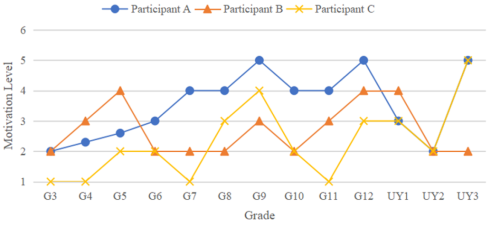
This study explores the dynamic changes in second language (L2) motivation and their underlying causes among underachieving English as a foreign language (EFL) learners in Chinese universities. Grounded in CDST, the research employs methodological triangulation—combining retrospective motivational trajectory graphs, semi-structured interviews, and written narratives—to investigate three non-English major underachievers from top-tier Chinese universities. The findings revealed that the motivational trajectories of these learners exhibited four core characteristics: non-linearity, complexity, dynamics, and self-organization. Furthermore, their motivation levels were significantly influenced by a continuous interplay of internal and external factors, primarily categorized into the L2 learning environment, attribution, and social and parental influence. The study highlights that underachievers often rely on external pressures (e.g., high-stakes exams) for temporary motivational boosts, but suffer from a lack of sustained intrinsic drive due to low self-confidence, ineffective learning strategies, and a critical lack of perceived value in English learning. Based on these insights, the study offers targeted pedagogical implications for students, teachers, parents, and institutions to collaboratively foster sustainable L2 motivation and improve English proficiency. This research broadens the understanding of L2 motivational dynamics among underrepresented learner groups and provides practical guidance for educational interventions.
| Published in | English Language, Literature & Culture (Volume 11, Issue 2) |
| DOI | 10.11648/j.ellc.20261102.14 |
| Page(s) | 45-56 |
| Creative Commons |
This is an Open Access article, distributed under the terms of the Creative Commons Attribution 4.0 International License (http://creativecommons.org/licenses/by/4.0/), which permits unrestricted use, distribution and reproduction in any medium or format, provided the original work is properly cited. |
| Copyright |
Copyright © The Author(s), 2026. Published by Science Publishing Group |
Motivation, Complex Dynamic Systems Theory, Underachieving Learners
Participants | Major | Year | Highest CET-4 scores |
|---|---|---|---|
A | Marine Chemistry | University year 3 | 411 |
B | Marketing | University year 3 | 376 |
C | Music Performance | University year 2 | 390 |
Major Category | Minor Category | Remotivation | Demotivation |
|---|---|---|---|
L2 Learning Environment | Instructor’s teaching method | 12 | 12 |
Instructor’s personality | 4 | 1 | |
Educational resources | 1 | 1 | |
Classmates | 1 | 6 | |
Other subjects | - | 6 | |
Content /Curriculum | 3 | 5 | |
Study method | 4 | 5 | |
Attribution | (Over-Lack of) Confidence | 1 | 4 |
Success/Failure experience | 1 | 6 | |
Strong/Weak willpower | 5 | 1 | |
Social & Parental Influence | Social pressure | 8 | 3 |
Parental influence | 1 | 2 |
L2 | Second Language |
EFL | English as a Foreign Language |
CDST | Complex Dynamic Systems Theory |
G | Grade |
UY | University Year |
AI | Artificial Intelligence |
| [1] | University Foreign Language Teaching Steering Committee of the Ministry of Education. College English Teaching Guide. Beijing: Higher Education Press; 2020. |
| [2] | Gardner, R. C., Lambert, W. E. Attitudes and motivation in second-language learning. Rowley, MA: Newbury House; 1972. |
| [3] | Gardner, R. C. Social psychology and second language learning: The role of attitudes and motivation. Edward Arnold; 1985. |
| [4] | Pintrich, P. R., Schunk, D. H. Motivation in education: Theory, research, and applications. London: Edward Arnold; 1996. |
| [5] | Ryan, R. M., Deci, E. L. Self-determination theory and the facilitation of intrinsic motivation, social development, and well-being. American Psychologist. 2000, 55(1), 68-78. |
| [6] | Dörnyei, Z., Ottó, I. Motivation in action: A process model of L2 motivation. Working Papers in Applied Linguistics. 1998, 4, 43-69. |
| [7] | Ushioda, E. Language learning at university: Exploring the role of motivational thinking. In Motivation and second language acquisition. University of Hawaii Press; 2001, pp. 93-125. |
| [8] | Wolters, C. A. Regulation of motivation: Evaluating an underemphasized aspect of self-regulated learning. Educational Psychologist. 2003, 38(4), 189-205. |
| [9] | Noels, K. A., Pelletier, L. G., Clément, R., Vallerand, R. J. Why are you learning a second language? Motivational orientations and self-determination theory. Language Learning. 2000, 50(1), 57-85. |
| [10] | Dörnyei, Z., Ushioda, E. Motivation, language identity and the L2 self. Bristol: Channel View Publications; 2009. |
| [11] | Ellis, N. C., Larsen-Freeman, D. Language emergence: Implications for applied linguistics—Introduction to the special issue. Applied Linguistics. 2006, 27(4), 558-589. |
| [12] | Morin, E. Seven complex lessons in education for the future. Unesco; 2001. |
| [13] | Larsen-Freeman, D. On the complementarity of chaos/ complexity theory and dynamic systems theory in understanding the second language acquisition process. Bilingualism: Language and Cognition. 2008, 10(1), 35-37. |
| [14] | Dörnyei, Z., MacIntyre, P., Henry, A. Motivational dynamics in language learning. Bristol: Multilingual Matters; 2014. |
| [15] | Larsen-Freeman, D., Cameron, L. Complex systems and applied linguistics. Oxford University Press; 2008. |
| [16] | Liang, A., Zhang, X. An overview of studies on second language dynamic development under complexity system theory. Ludong University Journal (Philosophy and Social Sciences Edition). 2017, 34(6), 30-36. |
| [17] | Hao, D. A Study on the Trajectories and Differences of Directed Motivational Currents in Junior High School Students' English Learning from the Perspective of Complex Dynamic Systems Theory. Master's Thesis, Qufu Normal University, Qufu, 2024. |
| [18] | Luo, S. The empirical evidence to the self-adaptive dynamic system of second language acquisition. Journal of Shaoguan University. 2018, 39(1), 101-104. |
| [19] | Busse, V., Walter, C. Foreign language learning motivation in higher education: A longitudinal study of motivational changes and their causes. The Modern Language Journal. 2013, 97(2), 435-456. |
| [20] | Waninge, F., Dörnyei, Z., De Bot, K. Motivational dynamics in language learning: Change, stability, and context. The Modern Language Journal. 2014, 98(3), 704-723. |
| [21] | Castro, E. Complex adaptive systems, language advising, and motivation: A longitudinal case study with a Brazilian student of English. System. 2018, 74, 138-148. |
| [22] | Trujillo, G., Tanner, K. D. Considering the role of affect in learning: monitoring students’ self-efficacy, sense of belonging, and science identity. CBE life sciences education. 2014, 13(1), 6-15. |
| [23] | Lu, X. C. The Influence of Students’ Learning Motivation and Achievement Attribution on English Scores and Countermeasures: A Case Study of a Middle School in Zhengzhou. Henan Education (Higher Education). 2018, (11), 110-113. |
| [24] | Hu, Y. C., Zhu, F., Kang, D. W. A Qualitative Study on the Influencing Mechanism of Learning Motivation of Outstanding Students in Higher Vocational Colleges: Based on Interview Analysis of Scholarship Winners in Guangxi L Vocational College. Vocational and Technical Education. 2025, 46(8), 42-47. |
| [25] | Tahmouresi, S., Papi, M. Future selves, enjoyment and anxiety as predictors of L2 writing achievement. Journal of Second Language Writing. 2021, 53, 100837. |
| [26] | Kwon, E. Ought-to L2 self and its influence on L2 motivation and demotivation: A case of college English majors. English Teaching. 2023, 78(4), 165-189. |
| [27] | Saito, K., Dewaele, J.-M., Abe, M., In’nami, Y. Motivation, emotion, learning experience, and second language comprehensibility development in classroom settings: A cross-sectional and longitudinal study. Language Learning. 2018, 68, 709-743. |
| [28] | Song, B., Kim, T. The dynamics of demotivation and remotivation among Korean high school EFL students. System. 2017, 65, 90-103. |
| [29] | Chang, P. Y., Zhang, J. A Micro-change Study of Directed Motivational Currents in College Students' English Listening. Modern Foreign Languages. 2020, 43(2), 200-212. |
| [30] | Dai, Y. C. A Retrospective and Tracking Study of Changes in L2 Learning Motivation. Beijing: Science Press; 2021. |
| [31] | Gentrup, S., Lorenz, G., Kristen, C., Kogan, I. Self-fulfilling prophecies in the classroom: Teacher expectations, teacher feedback and student achievement. Learning and Instruction. 2020, 66, 101296. |
| [32] | Huang, Y. S. A Heterogeneity Study on the Influence of Learning Motivation and Self-confidence on Academic Achievement of Urban and Rural Junior High School Students. Shanghai Educational Research. 2023, (2), 43-50. |
| [33] | Rezai, A., Ahmadi, R., Ashkani, P., Hosseini, G. H. Implementing active learning approach to promote motivation, reduce anxiety, and shape positive attitudes: A case study of EFL learners. Acta psychologica. 2025, 253, 104704. |
| [34] | Liu, M. An overview on the impact of the exam-oriented education in China. SHS Web of Conferences. 2023, 180. |
| [35] | Affuso, G., Zannone, A., Esposito, C., Pannone, M., Miranda, M. C., Angelis, G. D., Aquilar, S., Dragone, M., Bacchini, D. The effects of teacher support, parental monitoring, motivation and self-efficacy on academic performance over time. European Journal of Psychology of Education. 2023, 38, 1-23. |
| [36] | Dörnyei, Z. Motivational strategies in the language classroom. Cambridge University Press; 2001. |
| [37] | Chen, J., Warden, C., Chang, H. Motivators that do not motivate: The case of Chinese EFL learners and the influence of culture and motivation. TESOL Quarterly. 2005, 39(4), 609-633. |
| [38] | Dai, Y. C. A Retrospective Study of Motivational Changes in Excellent L2 Learners: Triangulation Based on Graph-drawing, Interviews and Narrative Inquiry. Foreign Language World. 2023, (2), 80-87. |
| [39] | Fu, H., Liu, H. A comparative study of learners’ conceptions of and approaches to learning English between high school students in urban and rural areas of China. Frontiers in Psychology. 2024, 15. |
| [40] | Gao, Y. H. College Students' English Learning Motivation and Self-identity Development: A Four-year Tracking Study in Five Universities. Beijing: Higher Education Press; 2013. |
| [41] | Li, W. Researching Chinese learners: skills, perceptions and intercultural adaptations. Language, Culture and Curriculum. 2012, 25(2), 211–214. |
| [42] | Gan, Z., Humphreys, G., Hamp-Lyons, L. Understanding Successful and Unsuccessful EFL Students in Chinese Universities. The Modern Language Journal. 2004, 88, 229-244. |
| [43] | Ma, L., Jiao, Y., Xiao, L., Liu, Q., Liu, J. Patterns of motivational beliefs among high-, medium-, and low-achieving English learners in China. International Review of Applied Linguistics in Language Teaching. 2024, 62(2), 747-773. |
| [44] | Dai, Y., Yu, H. A retrodictive study of second language motivational dynamics: A complex dynamic systems perspective. Modern Foreign Languages. 2022, 45(3), 357-368. |
| [45] | Chan, L., Dörnyei, Z., Henry, A. Learner archetypes and signature dynamics in the language classroom: A retrodictive qualitative modeling approach to studying L2 motivation. In Motivational Dynamics in Language Learning. Bristol: Multilingual Matters; 2014, pp. 238-259. |
| [46] | Jung, S. K. Demotivating and remotivating factors in learning English: A case of low level college students. English Teaching. 2011, 66(2), 47-72. |
| [47] | Barkhuizen, G., Benson, P., Chik, A. Narrative inquiry in language teaching and learning research. London: Routledge; 2014. |
| [48] | Kim, T. Y., Lee, Y. J. Constructs of Korean graduate students’ English learning motivation, demotivation, and remotivation through analyzing retrospective essays. The Sociolinguistic Journal of Korea. 2013, 21(1), 27-47. |
| [49] | Kim, T. Y., Lee, Y. J. Korean students’ English learning motivation and demotivation through autographic essays: Retrospective reconstruction. Korean Journal of Applied Linguistics. 2013, 29(1), 37-68. |
| [50] | Kim, T. Y., Kim, Y., Kim, J. Y. Structural relationship between L2 learning (de)motivation, resilience, and L2 proficiency among Korean college students. Asia-pacific Education Researcher. 2017, 26(6), 397-406. |
| [51] | Dörnyei, Z. Towards a better understanding of the L2 learning experience, the Cinderella of the L2 motivational self system. Studies in Second Language and Teaching. 2019, 9(1), 19-30. |
| [52] | Chang, P. Y. Research on Learner Individual Differences and L2 Listening Learning from the Perspective of Complex Dynamic Systems Theory. Beijing: Intellectual Property Publishing House; 2019. |
| [53] | Wei, L. Artificial intelligence in language instruction: Impact on English learning achievement, L2 motivation, and self-regulated learning. Frontiers in Psychology. 2023, 14. |
| [54] | Chen, X. Language motivated strategies, altruistic behavior and blended learning environment of Chinese EFL undergraduates. International Journal of Research Studies in Language Learning. 2024, 10(3), 75-89. |
| [55] | Ministry of Education of the People's Republic of China. English Curriculum Standards for Senior High Schools (2017 Edition, 2020 Revision). Beijing: People's Education Press; 2020. |
| [56] | Zhang, R., Zou, D. Types, features, and effectiveness of technologies in collaborative writing for second language learning. Computer Assisted Language Learning. 2021, 35(9), 2391-2422. |
| [57] | Xu, H., Yao, Y. Research on multimedia technology-assisted college English grammar teaching. Wireless Communications and Mobile Computing. 2022, (15), 1-10. |
| [58] | Hao, Y., Zhao, J., Liang, K. Comparative analysis of the effect of immersive English teaching. International Journal of Emerging Technologies in Learning. 2021, 16(23), 98-110. |
| [59] | Zhang, J., Liu, Z. The effects of parental emotional support, life and discipline involvement on adolescents’ intrinsic motivation in learning: The mediating role of goal concentration. Social Construction. 2024, 11(6), 142-160. |
| [60] | Liu, Y., Li, X., Ma, S., Li, M. A chain mediation model of entrepreneurial teachers’ experience and teaching competency-- evidence from China. International Journal of Management Education. 2024, 22(1). |
APA Style
Wang, H., Qi, S. (2026). Unravelling Motivational Trajectories: A Retrodictive Study of Underachieving EFL Learners in Chinese Universities. English Language, Literature & Culture, 11(2), 45-56. https://doi.org/10.11648/j.ellc.20261102.14
ACS Style
Wang, H.; Qi, S. Unravelling Motivational Trajectories: A Retrodictive Study of Underachieving EFL Learners in Chinese Universities. Engl. Lang. Lit. Cult. 2026, 11(2), 45-56. doi: 10.11648/j.ellc.20261102.14
@article{10.11648/j.ellc.20261102.14,
  author = {Helu Wang and Shiwei Qi},
  title = {Unravelling Motivational Trajectories: A Retrodictive Study of Underachieving EFL Learners in Chinese Universities},
  journal = {English Language, Literature & Culture},
  volume = {11},
  number = {2},
  pages = {45-56},
  doi = {10.11648/j.ellc.20261102.14},
  url = {https://doi.org/10.11648/j.ellc.20261102.14},
  eprint = {https://article.sciencepublishinggroup.com/pdf/10.11648.j.ellc.20261102.14},
  abstract = {This study explores the dynamic changes in second language (L2) motivation and their underlying causes among underachieving English as a foreign language (EFL) learners in Chinese universities. Grounded in CDST, the research employs methodological triangulation—combining retrospective motivational trajectory graphs, semi-structured interviews, and written narratives—to investigate three non-English major underachievers from top-tier Chinese universities. The findings revealed that the motivational trajectories of these learners exhibited four core characteristics: non-linearity, complexity, dynamics, and self-organization. Furthermore, their motivation levels were significantly influenced by a continuous interplay of internal and external factors, primarily categorized into the L2 learning environment, attribution, and social and parental influence. The study highlights that underachievers often rely on external pressures (e.g., high-stakes exams) for temporary motivational boosts, but suffer from a lack of sustained intrinsic drive due to low self-confidence, ineffective learning strategies, and a critical lack of perceived value in English learning. Based on these insights, the study offers targeted pedagogical implications for students, teachers, parents, and institutions to collaboratively foster sustainable L2 motivation and improve English proficiency. This research broadens the understanding of L2 motivational dynamics among underrepresented learner groups and provides practical guidance for educational interventions.},
 year = {2026}
}
TY  - JOUR
T1  - Unravelling Motivational Trajectories: A Retrodictive Study of Underachieving EFL Learners in Chinese Universities
AU  - Helu Wang
AU  - Shiwei Qi
Y1  - 2026/06/18
PY  - 2026
N1  - https://doi.org/10.11648/j.ellc.20261102.14
DO  - 10.11648/j.ellc.20261102.14
T2  - English Language, Literature & Culture
JF  - English Language, Literature & Culture
JO  - English Language, Literature & Culture
SP  - 45
EP  - 56
PB  - Science Publishing Group
SN  - 2575-2413
UR  - https://doi.org/10.11648/j.ellc.20261102.14
AB  - This study explores the dynamic changes in second language (L2) motivation and their underlying causes among underachieving English as a foreign language (EFL) learners in Chinese universities. Grounded in CDST, the research employs methodological triangulation—combining retrospective motivational trajectory graphs, semi-structured interviews, and written narratives—to investigate three non-English major underachievers from top-tier Chinese universities. The findings revealed that the motivational trajectories of these learners exhibited four core characteristics: non-linearity, complexity, dynamics, and self-organization. Furthermore, their motivation levels were significantly influenced by a continuous interplay of internal and external factors, primarily categorized into the L2 learning environment, attribution, and social and parental influence. The study highlights that underachievers often rely on external pressures (e.g., high-stakes exams) for temporary motivational boosts, but suffer from a lack of sustained intrinsic drive due to low self-confidence, ineffective learning strategies, and a critical lack of perceived value in English learning. Based on these insights, the study offers targeted pedagogical implications for students, teachers, parents, and institutions to collaboratively foster sustainable L2 motivation and improve English proficiency. This research broadens the understanding of L2 motivational dynamics among underrepresented learner groups and provides practical guidance for educational interventions.
VL  - 11
IS  - 2
ER  -
Shenyang No.126 Middle School, Shenyang, China
Faculty of Arts and Sciences, Beijing Normal University, Zhuhai, China

Information


 Share This Article
 Twitter
 Linked In
 Facebook
 Copy
Copy Download