Tripura is the third-smallest state in India, verifying its presence through diversified culture, natural talent and geomorphological conditions. Nurturing the youngsters in such an atmosphere and mixed socio-cultural fabric helps with dealing resilience. It helps to boost their psychological and health behaviour. These behavioural habits reflect in sports, academics and other areas. Specifically in sports, psychology plays a pivotal role and brings out better athletes’ performance and self-esteem, which is one of the ways to distinguish between the Tribal and Non-tribal groups in this region. The Rosenberg Self-Esteem Scale (1965) was used to measure self-esteem. A total of 200 (Tribal-100 and Non-tribal -100) male players were selected. The independent t-test was used to see the difference in self-esteem between two groups. The result showed that the tribal players scored 28.84±3.07, while the non-tribal players scored 28.9±3.54. Statistical analysis showed no significant difference (p-value of 0.449) between groups. The study also revealed that 41% of tribal and 37% of non-tribal players fall under high self-esteem, while 59% of tribal and 63% of non-tribal players fall under moderate self-esteem. None of the players fall under the low self-esteem category. Further, a game-wise comparison revealed that the tribal Volleyball players had significantly higher self-esteem as compared to non-tribal players. However, there were no significant differences found in Cricket, Football, Badminton, Judo and Athletics.
This is an Open Access article, distributed under the terms of the Creative Commons Attribution 4.0 International License (http://creativecommons.org/licenses/by/4.0/), which permits unrestricted use, distribution and reproduction in any medium or format, provided the original work is properly cited.
Athletic performance is a complicated pursuit which not only influence by physiological or biomechanical capabilities but also by the psychological factors (Rai & Pramanik., 2020; Galily, Y., et al., 2024)
[7]
Galily, Y., Samuel, R. D., & Tenenbaum, G. (2024). An overview of the psychological complexities in sports performance. AsianJournalofSportandExercisePsychology, 4(3), 73-74,
Rai, G., & Pramanik, T. N. (2020). Importance of psychological factors in sports. VidyabharatiInternationalInterdisciplinaryResearchJournal,11(2), 420-422.
[7, 11]
. Sports psychology has gaining major focus nowadays to understand the several psychological factors that affects sports performance (Ayranci, & Aydin., 2025)
[2]
Ayranci M, Aydin MK (2025) The complex interplay between psychological factors and sports performance: A systematic review and meta-analysis. PLoSOne, 20(8), e0330862,
. Self-esteem is an important factor of psychological well-being, which influences motivation, resilience, and a total mental health. Literature suggests that the self-esteem is closely associated with self-efficacy, emotional control and sports performance. The players involve with competitive games experience various psychological difficulties that helps to shape their self-perception, while the non-active individuals build self-esteem through different social, academic, or professional experiences (Cheikh, 2025)
[4]
Cheikh, s. (2025). Self-esteem, psychological factors, and sports participation: a comparative study among basketball players and non-active individuals. Internationaljournal, 7(2), 1-6.
[4]
.
Self-esteem refers to the individual self-worth that means how much one likes and appreciates ownself (Sagat, P., et al., 2021)
[14]
Sagat, P., Bartik, P., Lazić, A., Tohănean, D. I., Koronas, V., Turcu, I., Knjaz, D., Alexe, C.I., & Curițianu, I. M. (2021). Self-esteem, individual versus team sports. Internationaljournalofenvironmentalresearchandpublichealth, 18(24), 12915,
. According to Mullai, E. L. V. I. R. A., et al. (2017)
[10]
Mullai, E. L. V. I. R. A., Macaj, O. R. G. E. S. A., & Kotherja, O. R. T. E. N. C. A. (2017). Selfie-mania influence on adolescent self-esteem. InterdisciplinaryJournalofResearchandDevelopment, 4(2), 95-100.
[10]
, self-esteem is the self-pride, self-worth, self-respect, self-regard, and self-integrity. Moreover, self-esteem is an individually and socially constructed personality trait because it tends to be strong and stable (Sagat, P., et al., 2021; Nara, 2014)
[14]
Sagat, P., Bartik, P., Lazić, A., Tohănean, D. I., Koronas, V., Turcu, I., Knjaz, D., Alexe, C.I., & Curițianu, I. M. (2021). Self-esteem, individual versus team sports. Internationaljournalofenvironmentalresearchandpublichealth, 18(24), 12915,
Nara, K. (2017). Self-Esteem of sportspersons: A study of male and female sportspersons. InternationalJournalofPhysicalEducation,SportsandHealth,1(2), 34-36.
[14, 18]
. Rosenberg, M. (1979)
[13]
Rosenberg, M. (1979). Conceiving the Self. Basic Books: New York, NY, USA, 157-234.
[13]
defined self-esteem as a complicated cognitive and affective synthesis. As per literature, higher self-esteem is often connected with success in all aspects of life, and low self-esteem is linked with depression and anxiety (Sagat, P., et al., 2021)
[14]
Sagat, P., Bartik, P., Lazić, A., Tohănean, D. I., Koronas, V., Turcu, I., Knjaz, D., Alexe, C.I., & Curițianu, I. M. (2021). Self-esteem, individual versus team sports. Internationaljournalofenvironmentalresearchandpublichealth, 18(24), 12915,
Self-esteem has a vital role in achieving success, if one believes in their own abilities, they can perform well. On the other hand, one can never succeed in life if an individual does not have self-belief and have the feeling that the task is beyond their capabilities (Ahmed, D., et al., 2014)
[1]
Ahmed, D., Mladenovic, M., Ho, W. K. Y., Lee, K. C., & Khan, B. A. (2014). Exploring the perception of self-esteem among high school athletes. SportLogiaJournal, 10(2), 81-88,
. Individuals with higher self-esteem possess better coping mechanism from difficult situation (Baumeister, R. F., et al., 2003)
[3]
Baumeister, R. F., Campbell, J. D., Krueger, J. I., & Vohs, K. D. (2003). Does high self-esteem cause better performance, interpersonal success, happiness, or healthier lifestyles? Psychologicalscienceinthepublicinterest, 4(1), 1-44,
. Self-esteem may vary with individual to individual (Singh, J., & Battan, K. K., 2019)
[15]
Singh, J., & Battan, K. K. (2019). Study on self-esteem among individual sports, team sports and e-sports. International Journal of Physiology, Nutrition and Physical Education, 4(2), 430-432,
. Rosenberg state that “self-esteem is dynamic trait as it shaped with time continuously by social responses, experiences and cultural context (Rosenberg, F. et al., 1995)
[19]
Rosenberg, M., Schooler, C., Schoenbach, C., & Rosenberg, F. (1995). Global self-esteem and specific self-esteem: Different concepts, different outcomes. Americansociologicalreview, 141-156.
[19]
”. As per literature, athletes exhibit more self-esteem as compared to their non-athlete peers and thereby tend to have less anxiety and depression (Eime, R. M., et al., 2013)
[5]
Eime, R. M., Young, J. A., Harvey, J. T., Charity, M. J., & Payne, W. R. (2013). A systematic review of the psychological and social benefits of participation in sport for children and adolescents: informing development of a conceptual model of health through sport. Internationaljournalofbehavioralnutritionandphysicalactivity, 10(1), 98,
Despite of the fact that the self-esteem plays a pivotal role in sports performance, there is no evidence of self-esteem training intervention on the players of Tripura. More research work should be conducted by Indian researchers to fill the research gap in the area of self-esteem, as well as non-tribal players (Hossen, F., et al., 2026)
[20]
Hossen, F., Das, K. P., and Mitra, M. (2026). Bibliometric Analysis of Sports Mental Toughness and Sports Self-esteem. Inspiree:IndonesianSportInnovationReview, 7(1), 23-30,
. Hence, this study aimed to measure the level of self-esteem between the tribal and non-tribal players of Tripura to understand whether training intervention is necessary or not. This study also checked the difference in self-esteem between the tribal and non-tribal national level players of Tripura.
2. Materials and Methods
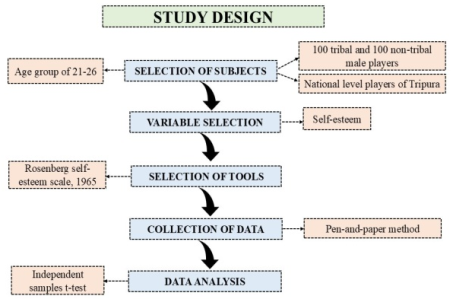
The current study was conducted at Tripura, North-East India during the period of 2024 to 2026. This study was conducted by using the following method:
2.1. Selection of Subjects
Two hundred (200) male players of Tripura (age range: 21-26 years) who has participated in national level sporting events in senior category during 2024-2026 session. The 200 players (N=200) were distributed as follows: 100 tribal players and 100 non-tribal players. A self-consent form was collected from the players. In order to ensure confidentiality, the responses were anonymous.
2.2. Variable Selection
The field of psychology is always unpredictable and uncertain as it deals with human behaviour. It is more complex in sports situations where every moment is challenging. Self-esteem is a very important psychological factor for sports performance. Therefore, self-esteem was selected as a variable in this particular study.
2.3. Selection of Tool
The Rosenberg Self-Esteem Scale (RSES) developed by Rosenberg in 1965
[12]
Rosenberg, M. (1965). Rosenberg self-esteem scale (RSE). Acceptanceandcommitmenttherapy.Measurespackage, 61(52), 18.
[12]
was used to assess self-esteem (Table 1). This questionnaire is widely used to measure self-esteem. The questionnaire consists of 10 items. Out of 10 questions, five questions (1, 3, 4, 7 and 10) were positive worded (e.g., “On the whole, I am satisfied with myself”), while five questions (2, 5, 6, 8 and 9) were negative worded (e.g., “At times I think I am not good at all”). It has a 4-point Likert scale with Strongly Agree, Agree, Disagree and Strongly Disagree. For positive items, the scoring was done as 4 for Strongly Agree, 3 for Agree, 2 for Disagree and 1 for Strongly Disagree as instructed by the questionnaire. The reverse scoring was applied for negative questions (1 for Strongly Agree, 2 for Agree, 3 for Disagree and 4 for Strongly Disagree). The questionnaire had minimum and maximum scores ranging from 10 to 40 scores. Higher score in RSES indicate higher self-esteem.
Table 1. Tools used to measure of self-esteem.
Parameters
Tools
Criterion Measures
Reliability/Validity
Developer
Self-Esteem
RSES
4-point Likert Scale
Reliability. 85 and. 88
Rosenberg in 1965
Scoring Range
The level of self-esteem was estimated by following the guidelines of RSES:
30-40 → High Self-Esteem: Indicates strong self-worth, confidence, and positive self-perceptions.
20-29 → Moderate Self-Esteem: Reflects average levels of self-esteem, with a balanced level of positive and negative self-views.
Below 20 → Low Self-Esteem: Suggests poor self-evaluation, feeling of inadequacy, and vulnerability to anxiety or negative emotions.
2.4. Data Collection
The data was collected from 200 (i.e., N=100 tribal and N=100 non-tribal) national level male players of Tripura by using the selected RSES questionnaire. To collect the data, the researcher visited the players training centres of Tripura as well as competition venues. The pen-and-paper method was applied to complete the data collection. The researcher covered all the sports (including Cricket, Football, Volleyball, Badminton, Judo, Athletics, Weightlifting and Yoga) where the Tripura team participated at national level in senior category during 2024-26 sessions.
2.5. Statistical Analysis
Collected data was subjected to descriptive statistics (mean, minimum score, maximum score, standard deviation, and percentage). The Microsoft office 2021 was used to analyse the data. The significant difference between tribal and non-tribal players of Tripura in terms of self-esteem was analysed through independent samples t-test. The statistical analysis was done at a significance level of 0.05.
Table 2. Question-wise self-esteem score of tribal and non-tribal players.
Q. N.
Mean tribal players
Mean non-tribal players
P-value
Q1
3.41±0.66
3.41±0.71
0.5
Q2
2.46±0.79
2.42±0.83
0.364
Q3
3.31±0.56
3.59±0.58
0.0003*
Q4
3.22±0.69
3.42±0.60
0.015*
Q5
2.56±0.71
2.62±0.80
0.288
Q6
2.64±0.79
2.52±0.79
0.109
Q7
3.07±0.67
2.87±0.84
0.018*
Q8
1.85±0.77
1.74±0.95
0.185
Q9
2.94±0.73
2.97±0.82
0.464
Q10
3.38±0.66
3.41±0.79
0.386
*At significance level of 0.05, Source: - National levels tribal and non-tribal male players of Tripura 2024-26.
The RSES consists of 10 items for measuring self-esteem, the question-wise score difference was analysed between the tribal and non-tribal players of Tripura. The result showed that the significant differences were found in three positive questions i.e., Q3, Q4, and Q7 with p-values of 0.0003*, 0.015* and 0.018* at 0.05 level. Further, the result stated that no significant differences were found between tribal and non-tribal players of Tripura in seven questions i.e., Q1, Q2, Q5, Q6, Q8, Q9 and Q10 with the p-values of 0.5, 0.364, 0.288, 0.109, 0.185, 0.464, and 0.386 respectively. Non-tribal players of Tripura scored significantly higher in Q3 (feeling of having good qualities) and Q4 (feeling good self-abilities) as compared to tribal players of Tripura, whereas they scored significantly lower in Q7 (feeling of self-worth) as compared to the tribal players of Tripura (Table 2).
The tribal players scored highest in Q1 (feeling of self-satisfaction) and lowest in Q8 (feeling of low self-respect). Whereas, the non-tribal players scored highest in Q4 (feeling good self-abilities) and lowest in Q8 (feeling of low self-respect). This co-existence of self-satisfaction and self-doubt reflects the self-esteem as multidimensional.
Table 3. Descriptive statistics of self-esteem.
Group
N
Minimum score
Maximum score
Mean score
SD
p-value
Tribal players
100
23.00
40.00
28.84
±3.07
0.449
Non-tribal players
100
21.00
40.00
28.9
±3.54
At significance level of 0.05.
Table 3 reveals that the non-tribal players of Tripura showed slightly higher self-esteem (28.9±3.54) as compared to tribal players (28.84±3.07). However, the difference was statistically not significant with a p-value of 0.449 (p>0.05). The minimum and maximum score of tribal players were 23.00 and 40.00, while the non-tribal players had 21.00 and 40.00 respectively.
Table 4. Levels of self-esteem among the tribal and non-tribal players.
Category
Score Range
Tribal players (%)
Non-tribal players (%)
High Self-esteem
30-40
41
37
Moderate Self-esteem
20-29
59
63
Low Self-esteem
0-19
0
0
Total
-
100
100
Source: - National levels Tribal male players of Tripura 2024-26
The above analysis showed (Table 4) that the considerable number (41%) of the tribal players fall under high self-esteem and a majority of tribal players (59%) fall under the range of moderate self-esteem, whereas none of the tribal players fall under low self-esteem category. On the other hand, 37% of the non-tribal players fall under high self-esteem and a large portion of tribal players 63% fall under moderate self-esteem, while none of the players fall under low self-esteem category. Hence, we can state that both the tribal and non-tribal players of Tripura have moderate to high self-esteem.
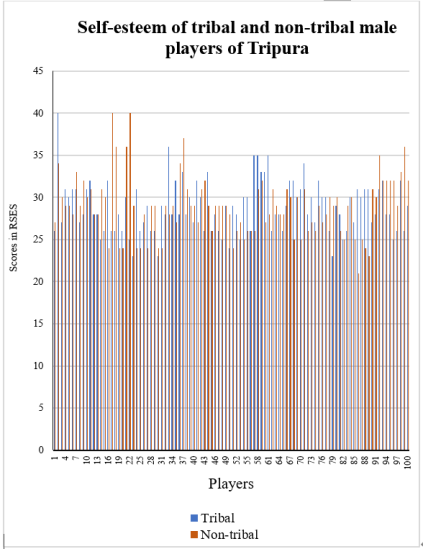
As shown in the Figure 2 that the majority of the tribal and non-tribal players scored more than 25 in RSES and none of the players scored less than 20 in this study.
Figure 2. Self-esteem scores of tribal (n=100) and non-tribal (n=100) players.
Table 5. Game-wise comparison of self-esteem between tribal and non-tribal players.
Games
Tribal (n)
Tribal Mean
Non-tribal (n)
Non-tribal Mean
p-value
Cricket
17
29.35 ± 3.60
43
29.56 ± 4.06
0.424
Football
25
28.28 ± 3.04
3
28 ± 1.73
0.411
Volleyball
28
29.21 ± 3.30
11
26.81 ± 1.72
0.0028*
Badminton
9
28.88± 3.29
12
29.16 ± 2.03
0.413
Judo
6
27.5 ± 1.87
4
27.25 ± 2.62
0.437
Athletics
14
29 ± 2.41
11
28.09 ± 1.81
0.147
*At 0.05 level of significance, Source: - National levels tribal and non-tribal male players of Tripura 2024-26.
[Game wise comparison did not performed where only one group of players participated in national level competition and these game groups are Weightlifting (01) player from tribal group, Weightlifting (7) and Yoga (9) players from non-tribal group].
Table 5 represents game-wise comparison of self-esteem between the two group which showed that the tribal volleyball players had significantly higher self-esteem in compare to non-tribal players (29.21 ± 3.30 and 26.81 ± 1.72, p = 0.0028*) whereas no significant difference were found between tribal and non-tribal players in cricket, football, badminton, judo, or athletics. The results suggest that nature of sports does not influence on self-esteem across the groups, except volleyball.
4. Discussion
This study evaluates and compares the level of self-esteem between tribal and non-tribal players of Tripura using a standard questionnaire developed by Rosenberg in 1965. The result showed that there was no significant difference (p=0.449) between the two group and showed moderate to high self-esteem level. This similarity of self-esteem in both the group indicates that despite of the differences in nurturing process, livelihood sustenance and sociocultural aspects. Their mental process, perception and cognitive behaviour are similar giving both the groups enough power to surpass the cultural variation. This absence of significant difference between tribal and non-tribal players of Tripura aligns with the agreement in sports psychology that sports participation buffers the social differences. Literature also suggests that sports participation serves as an excellent mechanism for self-efficacy and positive self-identity development (Fox, 2000; Sonstroem, R. J. and Morgan, W. P., 1989)
[6]
Fox, K. R. (2000). The effects of exercise on self-perceptions and self-esteem. PhysicalActivityandPsychologicalWell-being, 88-117.
[16]
Sonstroem, R. J. and Morgan, W. P. (1989). Exercise and self-esteem: Rationale and model. Medicine & Science in Sports & Exercise, 21(3), 329-337,
The possible reason of having higher score (Q3 and Q4) among the non-tribal players might be due to the availing advanced coaching, infrastructure facilities, and familial support that improved stronger self-perceptions and cognitive state. In respect to the Q7, the tribal players having higher score despite of limited sports facilities. The possible explanation is that the tribal players are characterised by collectivist social constructions lead to better cooperation in the sports field and reported to enhance deep intrinsic self-worth (Markus, H. R. and Kitayama, S., 1991)
[9]
Markus, H. R. and Kitayama, S. (1991). Culture and the self: Implications for cognition, emotion, and motivation. PsychologicalReview, 98(2), 224-253,
This study also revealed an interesting finding that the tribal players scored highest in Q1 (self-satisfaction), whereas the non-tribal players scored highest in Q4 (self-abilities). However, both the groups scored lowest in Q8 (feeling of low self-respect) which falls under agree to strongly agree as it was a negative question. This co-existence of self-satisfaction along with self-doubt emphasizes the multidimensional feature of sports self-esteem (Kernis, 2003)
[8]
Kernis, M. H. (2003). Target article: Toward a Conceptualization of Optimal Self-Esteem. PsychologicalInquiry, 14(1), 1-26.
[8]
. Literature also supports that high performance players often experience this dual state (Stoeber, J. and Otto, K., 2006)
[17]
Stoeber, J. and Otto, K. (2006). Positive conceptions of perfectionism: Approaches, evidence, issues. Personality and Social Psychology Review, 10(4), 295-319.
[17]
. The self-criticism signifies a psychological weakness that may causes by performance anxiety or burnout.
The game-wise comparison of self-esteem between tribal and non-tribal players of Tripura revealed that there were no significant differences in cricket, football, badminton, judo, and athletics with p>0.05. This result indicates that the sports participations uplift psychological wellness among the players irrespective of the games. However, the tribal volleyball players showed significant (p<0.05) difference in self-esteem when compared to non-tribal volleyball players. Volleyball is a commonly played game across the rural regions of Tripura and this game is also a part of their cultural celebration. This might be a possible reason that the tribal volleyball players showed better self-esteem in compare to non-tribal volleyball players.
5. Conclusion
Self-esteem is a crucial psychological factor for sports performance. This study examined the level of self-esteem among tribal and non-tribal national male players of Tripura. The result showed that both the groups exhibited moderate to high level of self-esteem and none of the players showed low self-esteem, which is a very good finding. The result also found that there was no significant difference between the two groups in terms of self-esteem. These findings suggest that both tribal and non-tribal players of Tripura have positive expectation in term of self-esteem. The training programs can be conducted in the future research to enhance the sports performance by shifting the moderate self-esteem to higher self-esteem.
Abbreviations
RSES
Rosenberg Self-esteem Scale
Q
Questions
n
Number of Samples
%
Percentage
Author Contributions
Farok Hossen: Formal Analysis, Investigation, Methodology, Data curtain, Writing–original draft
Mukesh Mitra: Conceptualization, Investigation, Methodology, Data curtain, Writing
4. I am able to do things as well as most other people.
Strongly Agree
Agree
Disagree
Strongly Disagree
5. I feel I do not have much to be proud of.
Strongly Agree
Agree
Disagree
Strongly Disagree
6. I certainly feel useless at times.
Strongly Agree
Agree
Disagree
Strongly Disagree
7. I feel that I'm a person of worth, at least on an equal plane with others.
Strongly Agree
Agree
Disagree
Strongly Disagree
8. I wish I could have more respect for myself.
Strongly Agree
Agree
Disagree
Strongly Disagree
9. All in all, I am inclined to feel that I am a failure.
Strongly Agree
Agree
Disagree
Strongly Disagree
10. I take a positive attitude toward myself.
Strongly Agree
Agree
Disagree
Strongly Disagree
References
[1]
Ahmed, D., Mladenovic, M., Ho, W. K. Y., Lee, K. C., & Khan, B. A. (2014). Exploring the perception of self-esteem among high school athletes. SportLogiaJournal, 10(2), 81-88,
Ayranci M, Aydin MK (2025) The complex interplay between psychological factors and sports performance: A systematic review and meta-analysis. PLoSOne, 20(8), e0330862,
Baumeister, R. F., Campbell, J. D., Krueger, J. I., & Vohs, K. D. (2003). Does high self-esteem cause better performance, interpersonal success, happiness, or healthier lifestyles? Psychologicalscienceinthepublicinterest, 4(1), 1-44,
Cheikh, s. (2025). Self-esteem, psychological factors, and sports participation: a comparative study among basketball players and non-active individuals. Internationaljournal, 7(2), 1-6.
[5]
Eime, R. M., Young, J. A., Harvey, J. T., Charity, M. J., & Payne, W. R. (2013). A systematic review of the psychological and social benefits of participation in sport for children and adolescents: informing development of a conceptual model of health through sport. Internationaljournalofbehavioralnutritionandphysicalactivity, 10(1), 98,
Fox, K. R. (2000). The effects of exercise on self-perceptions and self-esteem. PhysicalActivityandPsychologicalWell-being, 88-117.
[7]
Galily, Y., Samuel, R. D., & Tenenbaum, G. (2024). An overview of the psychological complexities in sports performance. AsianJournalofSportandExercisePsychology, 4(3), 73-74,
Mullai, E. L. V. I. R. A., Macaj, O. R. G. E. S. A., & Kotherja, O. R. T. E. N. C. A. (2017). Selfie-mania influence on adolescent self-esteem. InterdisciplinaryJournalofResearchandDevelopment, 4(2), 95-100.
[11]
Rai, G., & Pramanik, T. N. (2020). Importance of psychological factors in sports. VidyabharatiInternationalInterdisciplinaryResearchJournal,11(2), 420-422.
[12]
Rosenberg, M. (1965). Rosenberg self-esteem scale (RSE). Acceptanceandcommitmenttherapy.Measurespackage, 61(52), 18.
[13]
Rosenberg, M. (1979). Conceiving the Self. Basic Books: New York, NY, USA, 157-234.
[14]
Sagat, P., Bartik, P., Lazić, A., Tohănean, D. I., Koronas, V., Turcu, I., Knjaz, D., Alexe, C.I., & Curițianu, I. M. (2021). Self-esteem, individual versus team sports. Internationaljournalofenvironmentalresearchandpublichealth, 18(24), 12915,
Singh, J., & Battan, K. K. (2019). Study on self-esteem among individual sports, team sports and e-sports. International Journal of Physiology, Nutrition and Physical Education, 4(2), 430-432,
Stoeber, J. and Otto, K. (2006). Positive conceptions of perfectionism: Approaches, evidence, issues. Personality and Social Psychology Review, 10(4), 295-319.
[18]
Nara, K. (2017). Self-Esteem of sportspersons: A study of male and female sportspersons. InternationalJournalofPhysicalEducation,SportsandHealth,1(2), 34-36.
[19]
Rosenberg, M., Schooler, C., Schoenbach, C., & Rosenberg, F. (1995). Global self-esteem and specific self-esteem: Different concepts, different outcomes. Americansociologicalreview, 141-156.
[20]
Hossen, F., Das, K. P., and Mitra, M. (2026). Bibliometric Analysis of Sports Mental Toughness and Sports Self-esteem. Inspiree:IndonesianSportInnovationReview, 7(1), 23-30,
Hossen, F., Mitra, M., Das, P. K. (2026). Self-Esteem in Sports: A Study of Tribal and Non-tribal Players of Tripura, India. American Journal of Sports Science, 14(4), 55-62. https://doi.org/10.11648/j.ajss.20261404.11
Hossen, F.; Mitra, M.; Das, P. K. Self-Esteem in Sports: A Study of Tribal and Non-tribal Players of Tripura, India. Am. J. Sports Sci.2026, 14(4), 55-62. doi: 10.11648/j.ajss.20261404.11
Hossen F, Mitra M, Das PK. Self-Esteem in Sports: A Study of Tribal and Non-tribal Players of Tripura, India. Am J Sports Sci. 2026;14(4):55-62. doi: 10.11648/j.ajss.20261404.11
@article{10.11648/j.ajss.20261404.11,
  author = {Farok Hossen and Mukesh Mitra and Prasanta Kumar Das},
  title = {Self-Esteem in Sports: A Study of Tribal and Non-tribal Players of Tripura, India},
  journal = {American Journal of Sports Science},
  volume = {14},
  number = {4},
  pages = {55-62},
  doi = {10.11648/j.ajss.20261404.11},
  url = {https://doi.org/10.11648/j.ajss.20261404.11},
  eprint = {https://article.sciencepublishinggroup.com/pdf/10.11648.j.ajss.20261404.11},
  abstract = {Tripura is the third-smallest state in India, verifying its presence through diversified culture, natural talent and geomorphological conditions. Nurturing the youngsters in such an atmosphere and mixed socio-cultural fabric helps with dealing resilience. It helps to boost their psychological and health behaviour. These behavioural habits reflect in sports, academics and other areas. Specifically in sports, psychology plays a pivotal role and brings out better athletes’ performance and self-esteem, which is one of the ways to distinguish between the Tribal and Non-tribal groups in this region. The Rosenberg Self-Esteem Scale (1965) was used to measure self-esteem. A total of 200 (Tribal-100 and Non-tribal -100) male players were selected. The independent t-test was used to see the difference in self-esteem between two groups. The result showed that the tribal players scored 28.84±3.07, while the non-tribal players scored 28.9±3.54. Statistical analysis showed no significant difference (p-value of 0.449) between groups. The study also revealed that 41% of tribal and 37% of non-tribal players fall under high self-esteem, while 59% of tribal and 63% of non-tribal players fall under moderate self-esteem. None of the players fall under the low self-esteem category. Further, a game-wise comparison revealed that the tribal Volleyball players had significantly higher self-esteem as compared to non-tribal players. However, there were no significant differences found in Cricket, Football, Badminton, Judo and Athletics.},
 year = {2026}
}
TY  - JOUR
T1  - Self-Esteem in Sports: A Study of Tribal and Non-tribal Players of Tripura, India
AU  - Farok Hossen
AU  - Mukesh Mitra
AU  - Prasanta Kumar Das
Y1  - 2026/10/26
PY  - 2026
N1  - https://doi.org/10.11648/j.ajss.20261404.11
DO  - 10.11648/j.ajss.20261404.11
T2  - American Journal of Sports Science
JF  - American Journal of Sports Science
JO  - American Journal of Sports Science
SP  - 55
EP  - 62
PB  - Science Publishing Group
SN  - 2330-8540
UR  - https://doi.org/10.11648/j.ajss.20261404.11
AB  - Tripura is the third-smallest state in India, verifying its presence through diversified culture, natural talent and geomorphological conditions. Nurturing the youngsters in such an atmosphere and mixed socio-cultural fabric helps with dealing resilience. It helps to boost their psychological and health behaviour. These behavioural habits reflect in sports, academics and other areas. Specifically in sports, psychology plays a pivotal role and brings out better athletes’ performance and self-esteem, which is one of the ways to distinguish between the Tribal and Non-tribal groups in this region. The Rosenberg Self-Esteem Scale (1965) was used to measure self-esteem. A total of 200 (Tribal-100 and Non-tribal -100) male players were selected. The independent t-test was used to see the difference in self-esteem between two groups. The result showed that the tribal players scored 28.84±3.07, while the non-tribal players scored 28.9±3.54. Statistical analysis showed no significant difference (p-value of 0.449) between groups. The study also revealed that 41% of tribal and 37% of non-tribal players fall under high self-esteem, while 59% of tribal and 63% of non-tribal players fall under moderate self-esteem. None of the players fall under the low self-esteem category. Further, a game-wise comparison revealed that the tribal Volleyball players had significantly higher self-esteem as compared to non-tribal players. However, there were no significant differences found in Cricket, Football, Badminton, Judo and Athletics.
VL  - 14
IS  - 4
ER  -





 Share This Article
 Twitter
 Linked In
 Facebook

 Copy
 Download