Yak meat is rich in trace elements such as calcium and phosphorus, which can enhance human immunity and is highly favored by consumers. Some illegal elements, in order to obtain high profits, produce counterfeit and inferior beef products, disrupt market order, and harm public health. During the process of adapting to high-altitude environments, yaks have developed microstructures in their muscle cells that are distinct from those of other species. This is of great significance for identifying the species source of beef products. In this experiment, yellow cattle meat, buffalo meat, yak meat and their products were cut into 3mm ³ samples and soaked in 25%, 50%, and 75% defatting solutions for 15 minutes, 30 minutes, and 45 minutes respectively for gradient defatting. According to SEM observation, there are differences in muscle filament width, sarcomere length, and sarcomere spacing among yellow cattle meat, buffalo meat, and yak meat. Yak meat has thick muscle filaments and short muscle segment spacing, yellow cattle has slender muscle filaments with slightly longer muscle segment spacing, and buffalo meat has slender muscle filaments with larger muscle segment spacing. High concentration ethanol solution can affect the extensibility of muscle filament width and sarcomere spacing. The structural differences in muscle fibers provide a convenient operating method for species identification work and provide basic data support for public security organs to crack down on meat counterfeiting cases.
This is an Open Access article, distributed under the terms of the Creative Commons Attribution 4.0 International License (http://creativecommons.org/licenses/by/4.0/), which permits unrestricted use, distribution and reproduction in any medium or format, provided the original work is properly cited.
Scanning Electron Microscopy (SEM), Muscle Microstructure, Yak, Buffalo, Yellow Cattle
1. Introduction
Yaks (Bos mutus) are mainly distributed in the Qinghai Tibet Plateau and surrounding mountainous areas. Yaks have well-developed muscles, high blood oxygen content, and are rich in trace elements such as calcium and phosphorus, which help improve human metabolism and enhance immunity. Yak meat is the main food resource for nomadic peoples and is deeply loved by consumers. Some illegal elements, in order to obtain high profits, use yellow cattle meat and buffalo meat to impersonate yak meat, and use inferior beef to impersonate high priced beef products. The prevalence of synthetic beef not only disrupts market order and endangers public health, but also makes it more difficult to combat counterfeit and substandard food products and to conduct judicial appraisals. During police law enforcement operations, identifying the species of meat products aids in reconstructing the evidence formation process and ascertaining the value of the items in question. Currently, the identification of meat product species primarily depends on DNA molecular technology. However, this method is time-consuming, costly, and often cannot be completed promptly in urgent cases. In underdeveloped regions lacking DNA identification facilities, samples must be sent elsewhere for testing, posing numerous challenges to public security investigations and forensic identification work.
Thanks to their unique growth environment and physiological traits, yaks possess coarser muscle fibers, which make the yak jerky produced from them tough in texture and suitable for long-term storage. The thickness of muscle fibers in yellow cattle varies depending on factors such as breed and feeding method
[1]
Guo Dandan. Study on the relationship between microstructure marbling features and beef tenderness [D]. Nanjing: Nanjing Agricultural University, 2016.
[1]
. The cellular structure of muscles, including the arrangement of muscle cells and the integrity of cell membranes, can be observed through SEM. In the study of yak meat, it was found that there may be some structural characteristics of its muscle cells during the adaptation process to high-altitude environments, such as differences in cell gaps compared to yellow cattle meat, which may affect the microstructure of the muscles. In addition, the degree of muscle fiber contraction and pore structure of beef after drying are different, which is also of great significance for identifying the species source of beef jerky products.
SEM can clearly observe the microstructure of muscle fibers, adipose tissue, etc. By comparing the muscle filament width, sarcomere length, and sarcomere spacing of each beef sample, the source of meat can be distinguished, and a more scientific and efficient species identification method can be established based on this. The sarcomere is the basic functional unit of muscle contraction, and the longer the sarcomere, the greater the muscle contraction force
[2]
Pang Ailan, Yang Meifeng, Ye Pin, Yang Xinwang, Meng Buliang. Discussion on the definition of sarcomere [J]. Chinese Journal of Anatomy, 2023, 46(04): 356-357.
. Muscle filaments are filamentous structures that make up muscle segments and are the material basis for muscle contraction. The thicker the muscle filaments, the greater the muscle contraction force
. The main filling material between the two internodes is fat, and measuring the distance between the internodes can compare the fat content of different species of beef
[4]
Liu Chao, Wen Hongyuan, Zhang Jiayu, et al. Research on intelligent grading method of beef marbling based on small sample learning [J]. Journalof Chinese Agricultural Mechanization, 2025, 46 (12): 171-178.
. The observation results of SEM can also evaluate the impact of processing and techniques on beef quality.
This study selected yak meat, yellow cattle meat, buffalo meat and their products as samples, and observed the muscle fiber structure using SEM to distinguish the differences in microstructure between samples
[5]
YE Yun, YANG Yibin, YIN Tao, et al. Optimization Discussion of Sample Preparation Methods for Scanning ElectronMicroscope (SEM) [J]. Guangzhou Chemical Industry, 2025. 52(15): 82-86.
, providing basic data for the identification of beef products in the future.
2. Method
We purchase fresh yellow cattle meat, buffalo meat, yak meat and their products from legitimate markets as experimental materials to ensure that the meat undergoes strict inspection, quarantine and quality control.
Take 5g of each type of sample and cut it into 3mm ³ cubic samples. Prepare degreasing solutions with concentrations of 25%, 50%, and 75% by mixing 95% ethanol solution with pure water
[6]
ZHOU J X, LIN Y, LI Z J, DAI Y J, HU L, HOU A X. Quality comparison of beef thawed by differentmethods [J/OL]. Journal of Hunan Agricultural University (Natural Sciences), 2025, 51(5).
[6]
. Soak the samples in the prepared degreasing solution for 15 minutes, 30 minutes, and 45 minutes respectively, and perform gradient degreasing. After degreasing, rinse the sample with pure water, then use absorbent paper to remove excess moisture, and let it air dry until half dry for later use. Place the processed sample on the sample stage, use S-3400N Ⅱ scanning electron microscope to observe the microstructure of muscle fibers and take photos, while recording the values of muscle filament width, sarcomere length, and sarcomere spacing of muscle fibers
[7]
An Guoce. Identification of animal fiber by scanning electron microscope and infrared spectroscopy [J]. Wool Textile Journal, 2024, 52(09): 111-116.
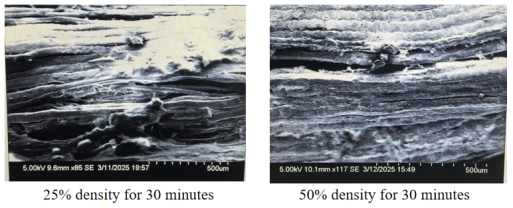
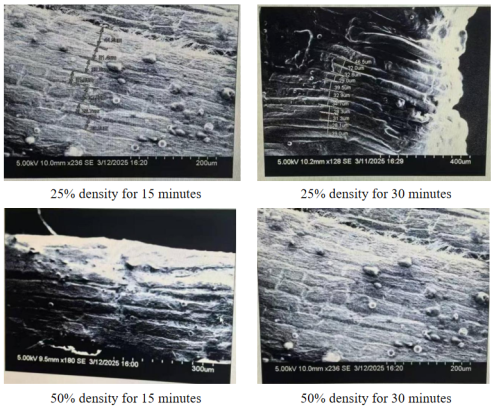
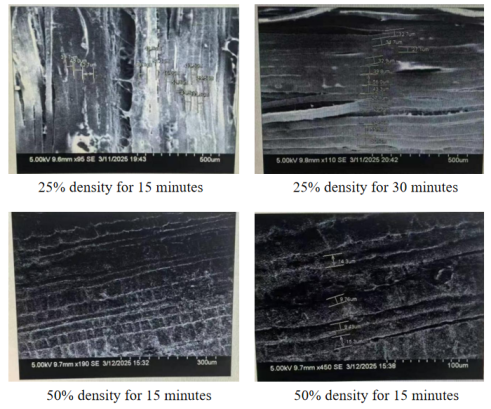
Through pre experimental observation, it was found that soaking the samples in ethanol solutions with concentrations of 25% and 50% for 15 minutes to 30 minutes resulted in better degreasing effects. Prolonged or high concentrations can affect the integrity of muscle fibers (Figures 1 to 3).
There are differences in muscle filament width, sarcomere length, and sarcomere spacing among yellow cattle meat, buffalo meat, and yak meat. The muscle fibers of yak meat are thicker, and the width of the muscle filaments is significantly larger than that of yellow cattle meat and buffalo meat. High concentration ethanol solution can affect the extensibility of muscle filament width. The sarcomere length of yellow cattle meat is significantly greater than that of buffalo meat, which has more connective tissue and well-developed muscles. The difference in sarcomere spacing results in buffalo > yellow cattle > yak, with a slight increase in sarcomere spacing with increasing ethanol concentration (Table 1).
No obvious sarcomere was observed in the SEM of yak meat, suggesting that the sarcomere length of yak meat may exceed 3mm, or the sampling point of the sample may not be located at the sarcomere. yellow cattle meat has finer muscle fibers, smaller diameter, and tighter arrangement with smaller gaps between fiber bundles, while buffalo meat has thicker muscle fibers, looser arrangement, and more connective tissue between fiber bundles.
Table 1. Muscle fiber measurement values of yellow cattle meat, buffalo meat, and yak meat.
soak time
sample
Muscle filament width (μm)
Sarcomere length (μm)
Intermuscular distance (μm)
The average value of 25% concentration
The average value of 50% concentration
The average value of 25% concentration
The average value of 50% concentration
The average value of 25% concentration
The average value of 50% concentration
15min
yellow cattle meat
32.76
34.00
354.8
354.6
9.67
10.37
Buffalo meat
45.73
33.71
32.06
32.06
12.35
12.35
Yak meat
41.26
42.68
/
/
5.74
6.24
30min
yellow cattle meat
32.76
34.00
354.8
354.6
9.67
10.37
Buffalo meat
44.57
33.71
32.06
32.06
12.35
12.35
Yak meat
41.26
42.68
/
/
5.74
6.24
3.2. Microstructure of Yellow Cattle Meat Products
After defatting in 25% and 50% ethanol solutions for 15 and 30 minutes, there was no significant difference in muscle filament width and sarcomere length between beef jerky and beef slices. However, there was no significant difference in muscle filament width and sarcomere length between beef jerky and beef slices after defatting at different concentrations. Due to the processing of beef jerky and beef slices, the distance between muscle segments is severely damaged, resulting in significant differences (Table 2).
Table 2. Measurement of muscle fibers in beef products.
soak time
sample
Muscle filament width (μm)
Sarcomere length (μm)
Intermuscular distance (μm)
Intermuscular distance (μm)
The average value of 25% concentration
The average value of 50% concentration
The average value of 25% concentration
The average value of 50% concentration
The average value of 25% concentration
The average value of 50% concentration
The average value of 25% concentration
The average value of 50% concentration
15min
beef jerky
30.06
30.81
351.60
351.00
31.50
27.31
9.434
9.434
sliced beef
31.63
31.53
354.10
354.50
3.52
3.59
/
/
4. Discussion
4.1. The Effect of Defatting Time and Concentration on Muscle Fibers
The concentration and soaking time of degreasing solution can affect the observation results of SEM. Designing gradient experiments to find the most suitable concentration and time nodes is of great significance for the accuracy of experimental results
[8]
Zong Shichao. Effects of Nacl and three Polyphenols on Thestructure and Gel Quality of Chicken [D]. Wu Han: Huazhong Agricultural University, 2023.
. Long term high concentration degreasing soaking can cause damage to the muscle fibers of the sample, resulting in the dissolution of some fat soluble substances. The loss of fat soluble substances weakens the connections and support between muscle fibers, making them more susceptible to damage and decomposition
[9]
Dong Wenxiu, Li Junsheng, Yan Liujuan, Huang Guoxia, Li Qiujie. Effect of Ethanol on the Structural and Functional Properties of Silk Fibroin [J]. Modern Food Science and Technology, 2015, 31(02): 106-112.
. (1) Ethanol can alter the spatial structure of protein molecules, transforming them from their natural folded state to an extended state. Long term soaking may cause denaturation of structural proteins such as myofibrillar proteins in beef, leading to a loose structure of muscle fibers that are easily broken down. (2) Ethanol can disrupt the phospholipid bilayer structure of the cell membrane, increasing cell permeability and making it easier for various hydrolytic enzymes inside the cell to be released outside. These enzymes break down proteins and other components in muscle fibers. (3) High concentration ethanol has strong water absorption, causing severe dehydration of cells, resulting in changes in ion concentration inside the cells, affecting enzyme activity and biochemical reactions inside the cells, making proteins and other substances in muscle fibers easier to decompose under the action of enzymes. Meanwhile, muscle fibers become fragile due to dehydration, making them more prone to breakage and breakdown.
4.2. Characteristics of Muscles
Yellow cattle, water buffaloes, and yaks belong to the cattle family, but due to differences in physiological functions and living environments, there are significant differences in the microstructure of their muscles. These differences directly affect the tenderness and water retention of the meat, which in turn affects people's preference for different varieties of beef
[10]
LI Ruizhe, MA Zhijie, LI Wenhao, SUN Yonggang, HAN Yincang, CHEN Shengmei. Analysis of Transcriptome Profiles in Different Adipose Tissues of Yaks [J]. Journal of Sichuan Agricultural University, 2025.43(5): 1279-1287.
[10]
.
According to the differences in diameter and function, muscle fibers can be divided into two types: coarse muscle fibers and fine muscle fibers. The two are arranged and combined according to specific rules in the sarcomere, sliding against each other to produce muscle contraction
[11]
BAI Xueyuan. Effect of slaughter age on the quality characteristics of yak beef and its mechanisms [D]. Zhengzhou: Henan Agricultural University, 2022.
. Yaks have thicker muscle filaments and the most developed muscles, which is the result of adapting to high-altitude and low-pressure living environments
[12]
Song Xiaoyue, Peng Yingqiao, Liao Qiuhong, et al. Effects of High-Pressure Processing on the Tenderness and Shelf Life of Preconditioned Yak Meat [J/OL]. Science and Technology of Food Industry, 2025-10-17.
REN Haijia, WU Haiyue, HU Rong, et al. Analysis of Color and Quality of Yak Meat in Different Parts Based onProteomics [J/OL]. Modern Food Science and Technology, 2025-10-14.
. As agricultural animals, water buffaloes require better muscle contraction and endurance for long-term labor. Yellow cattle, on the other hand, are a more adaptable species with muscle fibers that tend to be more flexible, hence yellow cattle meat has the smallest muscle filament width.
The length of the sarcomere can affect the tenderness of the meat, and the sarcomere of yellow cattle meat shrinks significantly, resulting in a tighter texture; Water buffalo meat has loose and rough muscle segments. Therefore, most people enjoy eating yellow cattle meat, which leads to the price of yellow cattle meat being much higher than that of buffalo meat. As a result, there have been many cases of using buffalo meat to impersonate yellow cattle meat in the market
[14]
Wu Bin. Comparative Studies on the Interaction Effects between Genetic Basis and Nutrition under Different Cross Combinations of Beef Cattle [D]. Chang Chun: Jilin Agricultural University, 2011.
[14]
.
The gaps between sarcomere intervals and filaments are mainly filled by fat, sarcoplasmic reticulum, and capillaries. A larger sarcoplasmic space can accommodate more mitochondria, which produce a large amount of ATP through aerobic respiration, which is very helpful for long-term low-intensity exercise in water buffaloes. During muscle movement, larger muscle spacing can also effectively reduce muscle contraction resistance
[15]
Yang Chengjian, Huang Jiaxiang, Fang Wenyuan, Li Ling, Liang Xin, Mo Naiguo. Comparative analysis on meat quality oflocal water buffalo and cattle in Guangxi region [J]. Science and Technology of Food Industry, 2017, 38(19): 36-39+44.
Beef jerky is processed by air drying technology, with a large distance between muscle segments; Beef slices, on the other hand, are processed using compression techniques, resulting in severe muscle damage and a significant reduction in the distance between muscle segments. The processing method of yellow cattle meat products does not affect the characteristic values of muscle filament width and sarcomere length, but it does affect the sarcomere spacing of muscle fibers.
5. Conclusion and Recommendation
The structural differences in muscle fibers are not only a microscopic reflection of the genetic characteristics of breeds, but also provide data explanations for the differences in meat quality among yellow cattle, water buffaloes, and yaks. The structural differences observed in muscle fibers under SEM provide a convenient operational method for judicial appraisal work and key data support for public security organs to crack down on meat counterfeiting cases.
Yaks are a species adapted to high-altitude survival, mainly distributed in the Qinghai Tibet Plateau of China, and there are also breeding populations in Xinjiang and Inner Mongolia. We believe that yaks have developed physiological characteristics adapted to low altitude survival, including cardiovascular, respiratory, muscle, and skeletal adaptations. But what we are most concerned about is which lineage the yak population adapted to low altitude comes from. Our team will uncover the secrets between the low altitude adaptive evolution and genetic lineage inheritance of yaks in the future.
Xiaoming Xue: Data curation, Formal Analysis, Methodology
Ping Lin: Funding acquisition, Methodology
Guanheng Wang: Data curation, Formal Analysis, Methodology, Software, Writing – original draft
Yuxin Chen: Data curation, Formal Analysis, Methodology, Software, Writing – original draft
Funding
This work was supported by the Special Funds for Basic Scientific Research Services of Central Universities (No. LGYB202505), and National key R&D Projects (No. 2023YFC3304000), and Research Project of Higher Education Reform in Jiangsu Province (No. 2025JGYB386).
Conflicts of Interest
The authors declare no conflicts of interest.
References
[1]
Guo Dandan. Study on the relationship between microstructure marbling features and beef tenderness [D]. Nanjing: Nanjing Agricultural University, 2016.
[2]
Pang Ailan, Yang Meifeng, Ye Pin, Yang Xinwang, Meng Buliang. Discussion on the definition of sarcomere [J]. Chinese Journal of Anatomy, 2023, 46(04): 356-357.
Liu Chao, Wen Hongyuan, Zhang Jiayu, et al. Research on intelligent grading method of beef marbling based on small sample learning [J]. Journalof Chinese Agricultural Mechanization, 2025, 46 (12): 171-178.
YE Yun, YANG Yibin, YIN Tao, et al. Optimization Discussion of Sample Preparation Methods for Scanning ElectronMicroscope (SEM) [J]. Guangzhou Chemical Industry, 2025. 52(15): 82-86.
ZHOU J X, LIN Y, LI Z J, DAI Y J, HU L, HOU A X. Quality comparison of beef thawed by differentmethods [J/OL]. Journal of Hunan Agricultural University (Natural Sciences), 2025, 51(5).
[7]
An Guoce. Identification of animal fiber by scanning electron microscope and infrared spectroscopy [J]. Wool Textile Journal, 2024, 52(09): 111-116.
Dong Wenxiu, Li Junsheng, Yan Liujuan, Huang Guoxia, Li Qiujie. Effect of Ethanol on the Structural and Functional Properties of Silk Fibroin [J]. Modern Food Science and Technology, 2015, 31(02): 106-112.
LI Ruizhe, MA Zhijie, LI Wenhao, SUN Yonggang, HAN Yincang, CHEN Shengmei. Analysis of Transcriptome Profiles in Different Adipose Tissues of Yaks [J]. Journal of Sichuan Agricultural University, 2025.43(5): 1279-1287.
[11]
BAI Xueyuan. Effect of slaughter age on the quality characteristics of yak beef and its mechanisms [D]. Zhengzhou: Henan Agricultural University, 2022.
Song Xiaoyue, Peng Yingqiao, Liao Qiuhong, et al. Effects of High-Pressure Processing on the Tenderness and Shelf Life of Preconditioned Yak Meat [J/OL]. Science and Technology of Food Industry, 2025-10-17.
REN Haijia, WU Haiyue, HU Rong, et al. Analysis of Color and Quality of Yak Meat in Different Parts Based onProteomics [J/OL]. Modern Food Science and Technology, 2025-10-14.
Wu Bin. Comparative Studies on the Interaction Effects between Genetic Basis and Nutrition under Different Cross Combinations of Beef Cattle [D]. Chang Chun: Jilin Agricultural University, 2011.
[15]
Yang Chengjian, Huang Jiaxiang, Fang Wenyuan, Li Ling, Liang Xin, Mo Naiguo. Comparative analysis on meat quality oflocal water buffalo and cattle in Guangxi region [J]. Science and Technology of Food Industry, 2017, 38(19): 36-39+44.
Li, Y., Xue, X., Lin, P., Wang, G., Chen, Y. (2025). Research on the Differences in Muscle Microstructure of Yak, Buffalo and Yellow Cattle. Animal and Veterinary Sciences, 13(6), 186-191. https://doi.org/10.11648/j.avs.20251306.13
Li, Y.; Xue, X.; Lin, P.; Wang, G.; Chen, Y. Research on the Differences in Muscle Microstructure of Yak, Buffalo and Yellow Cattle. Anim. Vet. Sci.2025, 13(6), 186-191. doi: 10.11648/j.avs.20251306.13
Li Y, Xue X, Lin P, Wang G, Chen Y. Research on the Differences in Muscle Microstructure of Yak, Buffalo and Yellow Cattle. Anim Vet Sci. 2025;13(6):186-191. doi: 10.11648/j.avs.20251306.13
@article{10.11648/j.avs.20251306.13,
  author = {Yilin Li and Xiaoming Xue and Ping Lin and Guanheng Wang and Yuxin Chen},
  title = {Research on the Differences in Muscle Microstructure of Yak, Buffalo and Yellow Cattle
},
  journal = {Animal and Veterinary Sciences},
  volume = {13},
  number = {6},
  pages = {186-191},
  doi = {10.11648/j.avs.20251306.13},
  url = {https://doi.org/10.11648/j.avs.20251306.13},
  eprint = {https://article.sciencepublishinggroup.com/pdf/10.11648.j.avs.20251306.13},
  abstract = {Yak meat is rich in trace elements such as calcium and phosphorus, which can enhance human immunity and is highly favored by consumers. Some illegal elements, in order to obtain high profits, produce counterfeit and inferior beef products, disrupt market order, and harm public health. During the process of adapting to high-altitude environments, yaks have developed microstructures in their muscle cells that are distinct from those of other species. This is of great significance for identifying the species source of beef products. In this experiment, yellow cattle meat, buffalo meat, yak meat and their products were cut into 3mm ³ samples and soaked in 25%, 50%, and 75% defatting solutions for 15 minutes, 30 minutes, and 45 minutes respectively for gradient defatting. According to SEM observation, there are differences in muscle filament width, sarcomere length, and sarcomere spacing among yellow cattle meat, buffalo meat, and yak meat. Yak meat has thick muscle filaments and short muscle segment spacing, yellow cattle has slender muscle filaments with slightly longer muscle segment spacing, and buffalo meat has slender muscle filaments with larger muscle segment spacing. High concentration ethanol solution can affect the extensibility of muscle filament width and sarcomere spacing. The structural differences in muscle fibers provide a convenient operating method for species identification work and provide basic data support for public security organs to crack down on meat counterfeiting cases.
},
 year = {2025}
}
TY  - JOUR
T1  - Research on the Differences in Muscle Microstructure of Yak, Buffalo and Yellow Cattle

AU  - Yilin Li
AU  - Xiaoming Xue
AU  - Ping Lin
AU  - Guanheng Wang
AU  - Yuxin Chen
Y1  - 2025/12/06
PY  - 2025
N1  - https://doi.org/10.11648/j.avs.20251306.13
DO  - 10.11648/j.avs.20251306.13
T2  - Animal and Veterinary Sciences
JF  - Animal and Veterinary Sciences
JO  - Animal and Veterinary Sciences
SP  - 186
EP  - 191
PB  - Science Publishing Group
SN  - 2328-5850
UR  - https://doi.org/10.11648/j.avs.20251306.13
AB  - Yak meat is rich in trace elements such as calcium and phosphorus, which can enhance human immunity and is highly favored by consumers. Some illegal elements, in order to obtain high profits, produce counterfeit and inferior beef products, disrupt market order, and harm public health. During the process of adapting to high-altitude environments, yaks have developed microstructures in their muscle cells that are distinct from those of other species. This is of great significance for identifying the species source of beef products. In this experiment, yellow cattle meat, buffalo meat, yak meat and their products were cut into 3mm ³ samples and soaked in 25%, 50%, and 75% defatting solutions for 15 minutes, 30 minutes, and 45 minutes respectively for gradient defatting. According to SEM observation, there are differences in muscle filament width, sarcomere length, and sarcomere spacing among yellow cattle meat, buffalo meat, and yak meat. Yak meat has thick muscle filaments and short muscle segment spacing, yellow cattle has slender muscle filaments with slightly longer muscle segment spacing, and buffalo meat has slender muscle filaments with larger muscle segment spacing. High concentration ethanol solution can affect the extensibility of muscle filament width and sarcomere spacing. The structural differences in muscle fibers provide a convenient operating method for species identification work and provide basic data support for public security organs to crack down on meat counterfeiting cases.

VL  - 13
IS  - 6
ER  -
Li, Y., Xue, X., Lin, P., Wang, G., Chen, Y. (2025). Research on the Differences in Muscle Microstructure of Yak, Buffalo and Yellow Cattle. Animal and Veterinary Sciences, 13(6), 186-191. https://doi.org/10.11648/j.avs.20251306.13
Li, Y.; Xue, X.; Lin, P.; Wang, G.; Chen, Y. Research on the Differences in Muscle Microstructure of Yak, Buffalo and Yellow Cattle. Anim. Vet. Sci.2025, 13(6), 186-191. doi: 10.11648/j.avs.20251306.13
Li Y, Xue X, Lin P, Wang G, Chen Y. Research on the Differences in Muscle Microstructure of Yak, Buffalo and Yellow Cattle. Anim Vet Sci. 2025;13(6):186-191. doi: 10.11648/j.avs.20251306.13
@article{10.11648/j.avs.20251306.13,
  author = {Yilin Li and Xiaoming Xue and Ping Lin and Guanheng Wang and Yuxin Chen},
  title = {Research on the Differences in Muscle Microstructure of Yak, Buffalo and Yellow Cattle
},
  journal = {Animal and Veterinary Sciences},
  volume = {13},
  number = {6},
  pages = {186-191},
  doi = {10.11648/j.avs.20251306.13},
  url = {https://doi.org/10.11648/j.avs.20251306.13},
  eprint = {https://article.sciencepublishinggroup.com/pdf/10.11648.j.avs.20251306.13},
  abstract = {Yak meat is rich in trace elements such as calcium and phosphorus, which can enhance human immunity and is highly favored by consumers. Some illegal elements, in order to obtain high profits, produce counterfeit and inferior beef products, disrupt market order, and harm public health. During the process of adapting to high-altitude environments, yaks have developed microstructures in their muscle cells that are distinct from those of other species. This is of great significance for identifying the species source of beef products. In this experiment, yellow cattle meat, buffalo meat, yak meat and their products were cut into 3mm ³ samples and soaked in 25%, 50%, and 75% defatting solutions for 15 minutes, 30 minutes, and 45 minutes respectively for gradient defatting. According to SEM observation, there are differences in muscle filament width, sarcomere length, and sarcomere spacing among yellow cattle meat, buffalo meat, and yak meat. Yak meat has thick muscle filaments and short muscle segment spacing, yellow cattle has slender muscle filaments with slightly longer muscle segment spacing, and buffalo meat has slender muscle filaments with larger muscle segment spacing. High concentration ethanol solution can affect the extensibility of muscle filament width and sarcomere spacing. The structural differences in muscle fibers provide a convenient operating method for species identification work and provide basic data support for public security organs to crack down on meat counterfeiting cases.
},
 year = {2025}
}
TY  - JOUR
T1  - Research on the Differences in Muscle Microstructure of Yak, Buffalo and Yellow Cattle

AU  - Yilin Li
AU  - Xiaoming Xue
AU  - Ping Lin
AU  - Guanheng Wang
AU  - Yuxin Chen
Y1  - 2025/12/06
PY  - 2025
N1  - https://doi.org/10.11648/j.avs.20251306.13
DO  - 10.11648/j.avs.20251306.13
T2  - Animal and Veterinary Sciences
JF  - Animal and Veterinary Sciences
JO  - Animal and Veterinary Sciences
SP  - 186
EP  - 191
PB  - Science Publishing Group
SN  - 2328-5850
UR  - https://doi.org/10.11648/j.avs.20251306.13
AB  - Yak meat is rich in trace elements such as calcium and phosphorus, which can enhance human immunity and is highly favored by consumers. Some illegal elements, in order to obtain high profits, produce counterfeit and inferior beef products, disrupt market order, and harm public health. During the process of adapting to high-altitude environments, yaks have developed microstructures in their muscle cells that are distinct from those of other species. This is of great significance for identifying the species source of beef products. In this experiment, yellow cattle meat, buffalo meat, yak meat and their products were cut into 3mm ³ samples and soaked in 25%, 50%, and 75% defatting solutions for 15 minutes, 30 minutes, and 45 minutes respectively for gradient defatting. According to SEM observation, there are differences in muscle filament width, sarcomere length, and sarcomere spacing among yellow cattle meat, buffalo meat, and yak meat. Yak meat has thick muscle filaments and short muscle segment spacing, yellow cattle has slender muscle filaments with slightly longer muscle segment spacing, and buffalo meat has slender muscle filaments with larger muscle segment spacing. High concentration ethanol solution can affect the extensibility of muscle filament width and sarcomere spacing. The structural differences in muscle fibers provide a convenient operating method for species identification work and provide basic data support for public security organs to crack down on meat counterfeiting cases.

VL  - 13
IS  - 6
ER  -





 Share This Article
 Twitter
 Linked In
 Facebook
 Copy
Copy Download