Research Article | | Peer-Reviewed

Excess Molar Volume and Deviations in Viscosity of the Binary Liquid Mixtures Containing 1,3-Dioxolane + Alkanols at T = 298.15k

Received: 21 August 2024     Accepted: 18 September 2024     Published: 29 September 2024
Views:       Downloads:
Abstract

Thermodynamic and transport properties of liquid and liquid mixtures have been used to understand the intermolecular interactions between the components of the mixture. The sound velocity, density and viscosity of binary liquid mixtures are important from practical and theoretical point of view to understand the liquid theory. In the present study sound velocity, density and viscosity have been measured of binary mixtures of 1, 3-dioxolane with pentanol, hexanol, heptanol, octanol, nonanol and decanol over the entire range of mole fraction at 298.15K, and atmospheric pressure. From these experimental measurements the excess molar volume (VmE), excess viscosity (ηE), acoustic impedance (ZE) and excess adiabatic compressibility (βadE), have been calculated. The excess molar volume (VmE), excess viscosity (ηE), acoustic impedance (ZE) and excess adiabatic compressibility (βadE), have been analyzed in terms of interactions arising due to structural effect, charge-transfer complexes and dipole-dipole interaction between unlike molecules. These deviations have been correlated by a polynomial Redlich-Kister equation. The excess properties are found to be eighter negative or positive depending on the molecular interactions and nature of the liquid mixtures. Excess properties provide important information in understanding the solute-solvent interaction in a solution. The excess molar volume (VmE), excess viscosity (ηE), acoustic impedance (ZE) and excess adiabatic compressibility (βadE), values have been interpreted to terms of the nature of intermolecular interactions between constituent molecules of mixtures.

Published in American Journal of Heterocyclic Chemistry (Volume 10, Issue 1)
DOI 10.11648/j.ajhc.20241001.12
Page(s) 13-25
Creative Commons

This is an Open Access article, distributed under the terms of the Creative Commons Attribution 4.0 International License (http://creativecommons.org/licenses/by/4.0/), which permits unrestricted use, distribution and reproduction in any medium or format, provided the original work is properly cited.

Copyright

Copyright © The Author(s), 2024. Published by Science Publishing Group

Keywords

1, 3-dioxolane, Mole Fraction, Excess Viscosity, Adiabatic Compressibility, Density, Sound Velocity, Molecular Interaction

1. Introduction
The sound velocity (u), density (ρ) and viscosity (η) of binary liquid mixtures are used experimentally to understand molecular interaction between the components of the mixtures and find applications in several industries and cosmetics . The variation of sound velocity and other ultrasonic parameters of binary liquid mixtures have been studied by many researchers and thy have shed height upon structural changes associated with liquid mixtures of weakly and strongly components . Ultrasound is a useful tool in nearly every case where a liquid and a solid must react. Furthermore, since ultrasound can radiate through large volumes of liquid, it is well suited for industrial applications. For these reasons future applications of ultrasound in chemical reactions will be in diverse. In the synthesis of pharmaceuticals, ultrasound will improve chemical yields over conventional methods .
Objects of the present research find wide application in large scale operation of chemical production process. Ethers have wide use as commercial solvents and extractant foe esters, gum, hydrocarbons, alkaloids, oils, plastics, lacquers and paints. They are used as dewaxing extractants for lubricating oils. The physical properties of binary mixtures are studied for many reasons, the most important of which is to provide information about molecular interactions present in the liquid state. Experimental data of physical properties such of densities, viscosities, or refractive indices are required for a full understanding of the thermodynamic properties of liquid mixtures, as well as for practical chemical engineering work. The studied of excess thermodynamic properties are of considerable interest in understanding the intermolecular interactions in binary liquid mixtures. Knowledge of these properties is very important in many practical problems concerning mass transport and fluid flow. Physical properties of binary organic mixtures have been extensively studied in the literature of solution chemistry in view of the importance of such data in many areas of science and engineering. The ultrasonic investigations of pure liquids and liquid mixtures consisting polar & non-polar components are considerable importance in analyzing intermolecular interaction between component molecules. These studies find several applications in industries. Such studies as variations in concentration and temperature are use fulin giving insight in to structure and various bonding of associated molecular complexes and other related molecular processes. Ultrasonic velocity and related thermodynamic parameters helps us for characterizing thermodynamic and physico-chemical aspects of binary liquid mixtures such as molecular association and dissociation. Thermodynamic studies of binary liquid mixtures have attracted much attention of scientists. These physico-chemical analyses are used to handle the mixtures of hydrocarbons, alcohols, aldehydes, ketones etc. The measurement of ultrasonic speed enables us to the accurate measurement of some useful acoustic and thermodynamic parameters and their excess values. These excess values of ultrasonic velocity, adiabatic compressibility, molar volume and viscosity in binary liquid mixture are useful in understanding the solute-solvent interactions.
The present paper is a part of our ongoing research program in the measurement of thermodynamic and transport properties of binary liquid mixtures. The liquids were chosen in the present investigation on the basis of their industrial impotence.1,3-dioxolane (cyclic diether) have played a major role in the pharmaceutical chemistry. Therefore, the applications of these compounds attract us to study their behavior in alcohols. Alcohols are used as hydraulic fluids in pharmaceutical and cosmetics, in medications for animals, in manufacturing of perfumes, paint removers, flavors and dyestuffs, as defrosting and as an antiseptic agent. The experimental results have been used to discuss the nature of interaction between unlike molecules in terms of hydrogen bonding, dipole-dipole interactions and dispersive forces. It is well known that ethers interact with alcohols by dipole-dipole interaction, formation of new hydrogen bonds or hetro-associations and dispersion forces.
In the present paper several parameters such as adiabatic compressibility (βad), molar volume (Vm) and acoustic impedance (Z) of a binary system 1,3-dioxolane with pentanol, hexanol, heptanol, octanol, nonanol and decanol have been reported using the experimental values of sound velocity (u), density (ρ) and viscosity (η) of the binary liquid mixtures at temperature 298.15K. These results have been fitted to the Redlich-Kister polynomial equation.
2. Experimental Procedure
2.1. Chemicals
The source and purity of the chemical compound are shown in table 1. The substances density, viscosity and ultrasonic velocity is compared with the literature data (Table 2) to ascertain the purity, and a good agreement between the experimental data and literature data was observed.
2.2. Apparatus and Procedure
All six binary liquid mixtures were prepared by weighing appropriate amounts of pure liquids on a digital electronic balance (Citizen Scale (I) PVT. LTD. Mumbai, India.) with a precision ± 0.1. The experimental uncertainty in mole fractions did not exceed ± 0.0005. All the solutions were prepared by mass ratios and stored in the air-tight stopper measuring flasks. Experimentally measured densities, sound velocity and viscosities of the pure compounds compared well with their respective literature values shown in table 2 .
Table 1. CAS Registry Number, Mass Fraction Purity of the chemicals.

Component

Formula

CAS Reg. No.

Supplier

Mass Fraction Purity (%)

Method Purity analysis method

1,3-Dioxolane

C3H6O2

646-06-0

CDH Delhi

99.7

Chromatography by the supplier

Pentanol

C5H12O

71-41-0

CDH Delhi

99.7

Chromatography by the supplier

Hexanol

C6H14O

111-27-3

CDH Delhi

99.5

Chromatography by the supplier

Heptanol

C7H16O

111-70-6

CDH Delhi

99

Chromatography by the supplier

Octanol

C8H18O

111-87-5

CDH Delhi

99.7

Chromatography by the supplier

Nonanol

C9H20O

143-08-8

CDH Delhi

99

Chromatography by the supplier

Decanol

C10H22O

112-30-1

CDH Delhi

99

Chromatography by the supplier

Table 2. Comparison of Experimental and Literature density (ρ), sound velocity (u) and viscosity (η) of pure Components with Available Literature Values at T = 298.15K and atmospheric pressure.

Compound

ρ (g.cm-3)

u (m.s-1)

η (mPa s)

This work

Literature

This work

Literature

This work

Literature

1,3-Dioxolane

1.0616

1.057717

1340

133817

0.5885

0.587817

1.058617

133818

0.587317

Pentanol

0.8124

0.810813

1198

119716

3.3978

3.541113

0.810713

126822

3.542413

Hexanol

0.8176

0.818713

1306

130415

4.6091

4.592413

0.815215

130315

4.593213

Heptanol

0.8196

0.818713

1325

132715

5.9066

5.944313

0.819719

1327.3724

5.9443224

Octanol

0.8236

0.821613

1350

134814

7.1508

7.660513

0.821813

134722

7.598113

Nonanol

0.8248

0.824415

1366

136515

8.9258

9.023021

0.82422415

136424

9.020024

Decanol

0.8292

0.826715

1378

138015

11.8027

11.82515

0.826419

137924

11.82915

2.3. Measurements
Density:
Densities of pure liquids and their binary mixtures were determined by using a 25-ml specific gravity bottle by relative measurement method with an accuracy of ± 0.01 kg.m-3, is used to measure the densities (ρ) of pure liquids and binary mixtures. The specific gravity bottle filled with air bubbles free liquids is kept in a thermostate water bath controlled (MSI Goyal Scientific, Meerut.) with a thermal stability of ±0.01 K for over 30 minute to attain thermal equilibrium. The precision of the density measurements was estimated to be ±0.0002 g cm-3.
The mixtures were prepared by mixing known volumes of the pure liquids in air-tight stoppered bottles. The weights were taken on a digital electronic balance (Citizen Scale (I) PVT. LTD. Mumbai, India) with a precision ± 0.1.
Sound velocity:
Ultrasonic velocity of the sample were measured at 298.15 K and atmospheric pressure using F-80D multifrequency ultrasonic interferometer (M/s Mittal Enterprises, New Delhi) at a constant frequency of 3 MHz. The sample were kept in the cell of interferometer and closed by rotating clock wise upper part of the cell having micrometer with least constant ±1.0×10⁻⁵ m. The minimum amount of the liquid needed was about 1.2×10⁻² litre. The micrometer was slowly moved upward and first reading was taken when the current meter shows a maximum. The micrometer is further moved upward till 20 such maxima were passed on and the two reading gives total distance, d to be used in eq. (u = d. 103 ms-1) for the evaluation of sound velocity. The temperature of the experimental solutions was maintained about 298.15 K and atmospheric pressure by circulating water around the cell with the help of a pump from a thermostate regulated at required temperature to better than ±0.03K. The average of the two measurement of ultrasound velocity for each sample was taken which were accurate to ±0.03%. The measured values of ultrasonic velocities of pure1,3-dioxolane with pentanol. Hexanol, heptanol, octanol, nonanol and decanol compare well with the corresponding literature values.
Viscosity:
The viscosity of pure liquids and their binary mixture were measured using a Ostawald’s viscometer having a capacity of about 25 ml and the capillary having a length of about 90 mm and 0.5 mm internal diameter has been used to measure the flow time of pure liquids and liquid mixtures and is was calibrated with triply distilled water, methanol and benzene at 298.15 K. The efflux time was measured with an electronic stop watch (Racer) with a time resolution (±0.015), and an average of at least four flow time readings was taken. Glass stopper was placed at the opening of the viscometer to prevent the loss due to evaporation during measurements. The two bulbs reservoir, one at the top and other at the bottom of the viscometer linked to each other by U type facilitate the free full of liquid at atmospheric pressure. Viscosity values (η) of pure liquids and their binary mixtures are calculated using the solution. The accuracy in viscosity data was ± 0.0005 mPa.s. The flow time of pure liquids and liquid mixtures were repeated for five times. The efflux Time was measured with an electronic stopwatch (Racer) with a time resolution (± 0.015), and an average of at least five flow time readings was taken.
The measured values of viscosities of pure 1,3-dioxolane with Pentanol, Hexanol, Heptanol, Octanol, Nonanol and Decanol compare well with the corresponding literature values.
3. Theoretical
The experimentally measured ultrasonic velocity (u), density (ρ) and viscosity (η) are used to evaluate derived parameters like molar volume (Vm), adiabatic compressibility (βad), and acoustic impedance (Z) using well established relations.
The deviation in viscosities (Δη) can be computed using the relationship.
Δη=η-i=1iXiηi(1)
where η is the dynamic viscosities of the mixture and xi, ηi are the mole fraction and viscosity of ith component in the mixture, respectively. The estimated uncertainty for viscosity deviation (Δη) is ±0.004mPa.s.
The molar volume (Vm) of binary liquid mixtures were calculated by using a following equation:
Vm=X1M1+ X2M2ρ (2)
The adiabatic compressibility(βad) has been calculated from the ultrasonic velocity (u) and density (ρ) of the medium using the equation as
βad =1u2ρ(3)
The excess adiabatic compressibility (βadE) values were obtained by subtracting the ideal values from the experimental values.
βadEadexp.–X1βad(1)+X2βad(2)
where  βad is the adiabatic compressibility of the mixture and X1, X2, βad (1), βad (2) are the mole fraction and adiabatic compressibility of component 1 and 2 in the mixture, respectively.
The acoustic impedance is the parameter related to elastic properties of the medium and calculated by using the expression.
Z=ρ.U(4)
where ρ is the density and u is the sound velocity.
The excess acoustic impedance (ZE) values were obtained by subtracting the ideal values from the experimental values.
ZE=Zexp..–X1Z(1)+X2Z(2)
where Z is the acoustic impedance of the mixture and X1, X2, Z1, Z2 are the mole fraction and acoustic impedance of component 1 and 2 in the mixture, respectively.
The excess value of ultrasonic related parameters has been calculated by using the following relation
AE = Aexp. – (X1 A1+ X2A2)(5)
Where A represents the parameter such as intermolecular free length, molar volume, isentropic compressibility, viscosity and internal pressure and X1 andX2 is the mole fractions of components whose parameters.
4. Result and Discussion
The experimentally determined values of density (ρ), sound velocity (u) and viscosity (η) and derived parameters adiabatic compressibility(βad), molar volume (Vm) and acoustic impedance (Z) at 298.15K and atmospheric pressure for the binary liquid system 1,3-Dioxolane with Pentanol, Hexanol, Heptanol, Octanol, Nonanol and Decanol are listed in table 3. The same excess values for the binary liquid mixtures 1,3-Dioxolane with Pentanol, Hexanol, Heptanol, Octanol, Nonanol and Decanol are presented in table 4. The data related to excess adiabatic compressibility, excess viscosity and excess acoustic impedance for the binary liquid system 1,3-Dioxolane with Pentanol, Hexanol, Heptanol, Octanol, Nonanol and Decanol were graphically represented in figures 1 to 3 at 298.15K respectively. Alcohols are good solvent that can dissolve both the polar and non-polar components. The hydrophilic –OH group of alcohols can dissolve the polar whereas the short hydrophobic hydrocarbon group can dissolve the non-polar.
Alcohols are strongly self-associated liquids with a three dimensional network of hydrogen bonds and can be associated with any other group having some degree of polar attraction. The associative alcohols molecule act as proton donar enabling hydrogen bonding with 1,3- dioxolane molecule. In the system studied, the complex formation is likely to occur between Hδ + of alcohol and Oδ- of ether group of 1,4-dioxane. Hence in the present study there is existence of solute-solvent interactions.
From the table 3, it was observed that the density and ultrasonic velocity increase with increasing mole fraction of 1,3-Dioxolane while the viscosity decrease. This may be due to association of a very strong dipole- induced dipole interaction between the component molecules.
Table 3. Experimental Values of density (ρ), sound velocity (u) and viscosity (η), derived parameters adiabatic compressibility (βad), molar volume (Vm) and acoustic impedance (Z) for the binary mixtures of 1,3-Dioxolane(1) + Alkanols (2) at 298.15K and atmospheric pressure.

Mole fraction 1,3-Dioxolane (x1)

Density (ρ) g.cm-3

Sound velocity (u) ms-1

Viscosity (η) mPa.s

adiabatic compressibility(βad) × 10-7Pa-1

molar volume (Vm) × 10-3 cm3.mole-1

acoustic impedance (Z) × 10-4 g.cm.s-1

1,3-Dioxolane + Pentanol

0

0.8124

1198

3.3978

8.5770

0.1085

0.0973

0.0939

0.8276

1284

2.3973

7.3290

0.1049

0.1062

0.1942

0.8436

1290

1.8970

7.1233

0.1012

0.1088

0.2941

0.8640

1296

1.4437

6.8909

0.0972

0.1119

0.3942

0.8836

1300

1.1866

6.6966

0.0934

0.1148

0.4787

0.9068

1304

1.0904

6.4853

0.0897

0.1182

0.5999

0.9316

1310

0.9311

6.2551

0.0855

0.1220

0.6972

0.9596

1318

0.7717

5.9991

0.0816

0.1264

0.7928

0.9876

1324

0.7171

5.7762

0.0779

0.1307

0.9035

1.0260

1332

0.6489

5.4934

0.0735

0.1366

1.0000

1.0616

1340

0.5885

5.246

0.0697

0.1422

1,3-Dioxolane + Hexanol

0

0.8176

1306

4.6091

7.1709

0.1249

0.1067

0.0912

0.8252

1317

3.3826

6.9867

0.1207

0.1086

0.1955

0.8432

1320

2.3306

6.8065

0.1146

0.1113

0.2923

0.8584

1322

1.9839

6.6657

0.1094

0.1134

0.3982

0.8792

1325

1.5720

6.4786

0.1034

0.1164

0.4942

0.8992

1327

1.3059

6.3154

0.0981

0.1193

0.6059

0.9264

1330

1.0343

6.1024

0.0919

0.1232

0.6976

0.9508

1332

0.9131

5.9279

0.0868

0.1266

0.8018

0.9836

1335

0.7680

5.7045

0.0809

0.1313

0.8914

1.0168

1337

0.7304

5.5018

0.0758

0.1359

1.0000

1.0616

1340

0.5885

5.2460

0.0697

0.1422

1,3-Dioxolane + Heptanol

0

0.8196

1325

5.9066

6.9497

0.1417

0.1085

0.0928

0.8304

1334

4.3181

6.7671

0.1352

0.1107

0.1905

0.8412

1334

3.2577

6.6802

0.1286

0.1122

0.2939

0.8592

1335

2.5895

6.5304

0.1208

0.1147

0.3894

0.8740

1335

1.9926

6.4199

0.1141

0.1166

0.4818

0.8916

1336

1.5315

6.2837

0.1075

0.1191

0.6021

0.9184

1337

1.2190

6.0912

0.0989

0.1227

0.6952

0.9420

1337

1.0959

5.9387

0.0922

0.1259

0.7892

0.9756

1338

0.9903

5.7255

0.0850

0.1305

0.9006

1.0156

1339

0.7057

5.4918

0.0770

0.1359

1.0000

1.0616

1340

0.5885

5.2460

0.0697

0.1422

1,3-Dioxolane + Octanol

0

0.8296

1350

7.1508

6.6622

0.1581

0.1111

0.0885

0.8296

1350

5.6095

6.6139

0.1509

0.1119

0.1967

0.8464

1349

3.9321

6.4923

0.1408

0.1141

0.2998

0.8560

1348

3.2616

6.4291

0.1324

0.1153

0.3902

0.8712

1348

2.4284

6.3168

0.1243

0.1174

0.4963

0.8876

1348

1.9058

6.2002

0.1153

0.1196

0.6008

0.9140

1347

1.3631

6.0301

0.1055

0.1231

0.6925

0.9340

1348

1.1376

5.8921

0.0978

0.1259

0.7975

0.9676

1348

0.9141

5.6875

0.0883

0.1304

0.8940

1.0104

1348

0.7652

5.4466

0.0792

0.1362

1.0000

1.0616

1340

0.5885

5.2460

0.0697

0.1422

1,3-Dioxolane + Nonanol

0

0.8248

1366

8.9258

6.4976

0.1749

0.1126

0.0876

0.8336

1366

6.8601

6.4289

0.1656

0.1138

0.1913

0.8404

1363

5.8531

6.4051

0.1556

0.1145

0.2942

0.8504

1359

4.4022

6.3671

0.1453

0.1155

0.3963

0.8692

1355

3.1558

6.2662

0.1339

0.1177

0.4959

0.8844

1352

2.3340

6.1859

0.1237

0.1195

0.6050

0.9092

1349

1.7321

6.0439

0.1119

0.1226

0.6947

0.9332

1346

1.3334

5.9145

0.1023

0.1256

0.7993

0.9648

1343

0.9642

5.7466

0.0913

0.1295

0.9013

1.0084

1340

0.8031

5.5228

0.0803

0.1351

1

1.0616

1340

0.5885

5.2460

0.0697

0.1422

1,3-Dioxolane + Decanol

0

0.8292

1378

11.8027

6.4976

0.1908

0.1142

0.0881

0.8364

1374

8.5615

6.4289

0.1803

0.1149

0.191

0.8396

1370

7.8207

6.4051

0.1693

0.1150

0.2921

0.8560

1366

5.5340

6.3671

0.1561

0.1169

0.3937

0.8672

1362

4.2319

6.2662

0.1442

0.1181

0.4956

0.8824

1358

3.4173

6.1859

0.1320

0.1198

0.604

0.9076

1353

2.5370

6.0439

0.1183

0.1227

0.7129

0.9308

1348

1.5262

5.9145

0.1055

0.1254

0.7983

0.9616

1344

1.1637

5.7466

0.0946

0.1292

0.8971

1.0040

1340

0.8623

5.5228

0.0824

0.1345

1

1.0616

1340

0.5885

5.246

0.0697

0.1422

Table 4. Excess adiabatic compressibility (βadE), excess viscosity (ηE), excess molar volume (VmE) and excess acoustic impedance (ZE) for the binary mixtures of 1,3-Dioxolane (1) + Alkanols (2) at 298.15K and atmospheric pressure.

Mole fraction 1,3-Dioxolane (x1)

Excess adiabatic compressibility (βadE) × 10-7Pa-1

excess viscosity (ηE) mPa.s

Excess molar volume (VmE) × 10-3 cm3.mole-1

Excess acoustic impedance (ZE) × 10-4 g.cm.s-1

1,3-Dioxolane + Pentanol

0

-

-

-

-

0.0939

-93.514

-0.7367

0.0469

47.19498

0.1942

-80.677

-0.9552

0.2682

27.73692

0.2941

-70.644

-1.1280

0.1192

14.35296

0.3942

-56.727

-1.1038

0.2446

-1.68484

0.4787

-49.711

-0.9627

0.1860

-5.86255

0.5999

-32.372

-0.7815

0.2867

-22.3876

0.6972

-25.563

-0.6675

0.1314

-21.7466

0.7928

-15.997

-0.4535

0.1568

-21.869

0.9035

-7.400

-0.2108

0.0076

-12.5556

1.0000

-

-

-

-

1,3-Dioxolane + Hexanol

0

-

-

-

-

0.0912

-12.864

-0.8597

0.7779

-13.3654

0.1955

-11.193

-1.4925

0.4810

-24.1169

0.2923

-93.762

-1.4500

0.6245

-36.6767

0.3982

-77.201

-1.4361

0.4952

-44.1104

0.4942

-61.541

-1.3162

0.4919

-49.8688

0.6059

-45.638

-1.1387

0.3860

-50.6217

0.6976

-32.537

-0.8912

0.3783

-48.7995

0.8018

-20.169

-0.6174

0.2564

-39.1249

0.8914

-1.060

-0.2947

0.0816

-24.5556

1.0000

-

-

-

-

1,3-Dioxolane + Heptanol

0

-

-

-

-

0.0928

2.457

-1.0951

0.1293

-9.44037

0.1905

5.504

-1.6358

0.5357

-27.9265

0.2939

8.146

-1.7541

0.2168

-37.8571

0.3894

13.359

-1.8431

0.4437

-50.2419

0.4818

15.486

-1.8128

0.4770

-56.9538

0.6021

16.733

-1.4856

0.4818

-60.7204

0.6952

17.334

-1.1136

0.5437

-60.5022

0.7892

12.039

-0.7193

0.0752

-46.2414

0.9006

7.647

-0.4114

0.1264

-29.2001

1.0000

-

-

-

-

1,3-Dioxolane + Octanol

0

-

-

-

-

0.0885

7.713

-1.0951

0.6846

-19.3955

0.1967

10.869

-1.6358

0.0682

-31.1779

0.2998

19.142

-1.7541

0.8340

-51.1151

0.3902

20.728

-1.8431

0.6824

-58.7113

0.4963

24.082

-1.8128

1.0462

-69.5677

0.6008

21.867

-1.4856

0.5270

-67.3609

0.6925

21.066

-1.1136

0.8545

-67.9767

0.7975

15.476

-0.7193

0.6410

-55.3057

0.8940

5.051

-0.4114

0.0624

-27.5923

1.0000

-

-

-

-

1,3-Dioxolane + Nonanol

0

-

-

-

0.0876

4.101

-1.3354

-0.0127

-13.8972

0.1913

14.688

-1.4778

0.8880

-37.811

0.2942

23.767

-2.0708

1.3824

-58.0273

0.3963

26.458

-2.4659

0.7277

-66.163

0.4959

30.889

-2.4573

0.9917

-77.6885

0.6050

30.351

-2.1496

0.6632

-79.1657

0.6947

28.662

-1.8005

0.4673

-76.1285

0.7993

24.941

-1.2976

0.5023

-67.4371

0.9013

15.325

-0.6083

0.1749

-42.0859

1

-

-

-

1,3-Dioxolane + Decanol

0

-

-

-

0.0881

7.94

-2.2532

0.2115

-18.0838

0.191

20.585

-1.8401

1.6598

-45.848

0.2921

23.249

-2.9930

0.7076

-55.1023

0.3937

30.026

-3.1558

1.1236

-71.7103

0.4956

34.182

-2.8276

1.2487

-83.06

0.604

33.522

-2.4923

0.6457

-83.7183

0.7129

34.915

-2.2819

1.0260

-87.4645

0.7983

28.826

-1.6867

0.5040

-73.6965

0.8971

18.727

-0.8801

0.1778

-48.3816

1

-

-

-

-

Excess Molar Volume (VmE)
The excess molar volume (VmE) data of all the binary mixtures of 1,3-Dioxolane with Pentanol, Hexanol, Heptanol, Octanol, Nonanol and Decanol are presented in table 4 at 298.15K and atmospheric pressure.
Excess molar volumes can be used for understanding some of the molecular interactions (such as dispersion forces, hydrogen bonding interactions) in the binary mixtures. The excess molar volume data is a helpful parameter in the design of technological processes of a reaction, and can be used to predict vapour liquid equilibria using appropriate equation of state models. The measurement of molar volume in binary liquid mixture provides same reliable information in the study of molecular interaction.
A perusal of table 4 indicates that the values of excess molar volume (VmE) data for the binary mixtures of 1,3-Dioxolane with Pentanol, Hexanol, Heptanol, Octanol, Nonanol and Decanol are positive.
The excess molar volume (VmE) of the binary mixtures investigated in the study were all positive over the entire range of solvent composition at 298.15 K. These are shown in Table 4. The positive excess molar volume (VmE) are attributable mainly to the association between the1,3-Dioxolane and alkanol through inter molecular hydrogen bonding between the –OH groups in alkanol and the oxygen atoms in the1,3-Dioxolane molecule. The magnitudes of the positive excess molar volumes were in the order Pentanol < Hexanol < Heptanol < Octanol < Nonanol < Decanol for the binary mixtures with the1,3-Dioxolane. The strength of the associations arising from the interactions between the unlike molecules was stronger than the strength of the association between like molecule. Large positive excess molar volume (VmE) for binary mixture of1,3-Dioxolane with alcohols have also been reported by other workers. It has been suggested that the large positive values are due to hetero association of unlike molecules which give rise to formation of cross complexes where O-H---O bonds of the mixtures are stronger than O---H-O bonds of the single component solvents. It is generally increases with chain length. This suggest that the oxygen atom in the alkanols in electron enriched to different degrees depending upon the chain length and degree of the alkyl group attached to the oxygen atom in the alkanols.
The positive values of excess molar volume (VmE) indicate that there is a volume expansion. This signifies that the mixtures are less compressible than the corresponding ideal mixtures. Further, it is observed the magnitude of positive excess molar volume (VmE) values decrease with increase in composition of 1,3-Dioxolane. According to Marcus , the molecules of alkanols are associated through hydrogen bonding in pure state. Mixing these alcohol molecules with polar molecule like 1,3-Dioxolane would induce mutual dissociation of the hydrogen-bonded structure present in pure alcohols with subsequent formation of inter molecular hydrogen bonds (O-----OH) between the oxygen atom of ether group of 1,3-Dioxolane molecule and hydrogen atom of hydroxyl group of alcohols. The positive excess molar volume (VmE) values suggest that the higher alcohols less proton donating ability than the lower alcohols. Hence hetro association affects decrees in the binary liquid mixtures with an increase of chain length of linear alcohols. The algebraic values of excess molar volume (VmE) for the mixtures of 1,3-Dioxolane with Pentanol, Hexanol, Heptanol, Octanol, Nonanol and Decanol fall in the order,
Pentanol<Hexanol<Heptanol<Octanol<Nonanol<Decanol
Excess adiabatic compressibility (βadE)
The values of excess adiabatic compressibility (βadE), may be interpreted in terms of two opposing effects viz. (i) loss of mutual dipolar association and difference in size and shape of unlike components molecules, and (ii) dipole-induced dipole and dipole- dipole interactions. The former effect contributes to an increase in free lengths of component mixtures described by Jacobson. This leads to negative deviation in sound velocity and positive deviation in isentropic compressibility. The latter effect, on the other hand contributes to positive deviation in sound speed and negative deviation in isentropic compressibility. The sign and magnitude of the actual deviation depend on the relative strength or the two opposing effects.
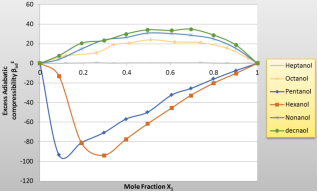
The excess adiabatic compressibility (βadE) data of all the binary mixtures of 1,3-Dioxolane with Pentanol, Hexanol, Heptanol, Octanol, Nonanol and Decanol are graphically presented Figure 1 at 298.15 K and atmospheric pressure. An examination of curves in Figure 1 shows that the values of excess adiabatic compressibility (βadE) data for 1,3-Dioxolane with Pentanol, Hexanol, are negative and for the remaining binary mixtures excess adiabatic compressibility (βadE) is positive over the entire composition range at 298.15 K. It is evident that the excess adiabatic compressibility (βadE) values are negative for lower monoalcohols, but the magnitude of the negative values diminishes and the positive values increase with increasing chain length of the alcohols. The order it is follows is:
Pentanol<Hexanol<Heptanol<Octanol<Nonanol<Decanol
The excess adiabatic compressibility (βadE) values were ascribed according to Sri Devi et al the negative excess values have been due to the closely packed molecules which account for existence of strong molecular interaction where as positive excess values are due to prevailing of dispersion forces between unlike molecules.
Figure 1. Curves of adiabatic compressibility (βadE) against the mole fraction of 1,3-dioxolane x1, for the binary mixture (1,4-dioxane (1) + Alkanols (2)) at 298.15K and atmospheric pressure. The solid lines represent the values calculated from the Redlich−Kister equation.
A perusal of curves in Figure 1 shows that the excess adiabatic compressibility (βadE) negative value decreases may be attributed to hetero association complexes decrease with increasing chain length, probably due to less proton-donating ability of higher alcohols. Experimental results suggest that the negative values of excess adiabatic compressibility (βadE) and deviation in intermolecular free length (ΔLf) for binary mixtures attributed to the dipole-dipole interactions through formation of complexes between the molecules of mixing components and the positive values of excess adiabatic compressibility (βadE) and deviation in intermolecular free length (ΔLf) for binary mixtures may be due to the domination ofdispersion forces over formation of complexes between unlike molecules.
The excess adiabatic compressibility (βadE) values of 1,3-Dioxolane with alcohols fall in the order:
Decanol<Nonanol<Octanol<Heptanol<Hexanol<Pentanol
Excess Viscosity (ηE)
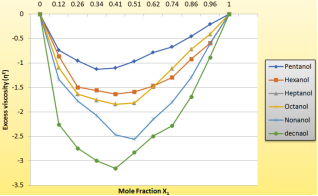
The excess viscosity (ηE) data of all the binary mixtures of 1,3-Dioxolane with Pentanol, Hexanol, Heptanol, Octanol, Nonanol and Decanol are graphically presented Figure 2 at 298.15 K and atmospheric pressure. An examination of curves in Figure 2 shows that the values of excess viscosity (ηE) data for 1,3-Dioxolane with Pentanol, Hexanol, Heptanol, Octanol, Nonanol and Decanol are negative over the entire composition range at 298.15 K.
Figure 2. Curves of excess viscosity (ηE) against the mole fraction of 1,3-dioxolane x1, for the binary mixture (1,4-dioxane (1) + Alkanols (2)) at 298.15K and atmospheric pressure. The solid lines represent the values calculated from the Redlich−Kister equation.
The measurement of viscosity in binary liquid mixture provides some reliable information in the study of molecular interaction. Table 3 shows that the viscosity decrease with increase in concentration of 1,3-Dioxolane molecule. More insight about molecular interaction can be obtained by excess viscosity (ηE) values.
According to Fort and Moore, the excess viscosity gives the strength of the molecular interaction between the interacting molecules. The excess value of viscosity at the six binary mixtures 1,3-Dioxolane + Pentanol, 1,3-Dioxolane + Hexanol, 1,3-Dioxolane + Heptanol, 1,3-Dioxolane + Octanol, 1,3-Dioxolane + Nonanol and 1,3-Dioxolane + Decanol at the 298.15 K are reported in Table 4. The Figure 2 represents the variation of excess viscosity (ηE) is found to be negative for all six binary liquid mixtures over the entire composition range at the 298.15 K. Which suggest the presence of weak intermolecular interactions. For systems where dispersion, induction and dipolar forces are operating, the values of excess viscosity are found to be negative, whereas the existence of specific interaction leading to the formation of complexes in mixtures tends to make positive. The excess viscosity is negative through the whole range of concentration in all the studied systems. The large negative values of excess viscosity for all systems can be attributed to the presence of dispersion, induction and dipolar forces between the components.
The negative excess viscosity (ηE) for all the six binary liquid mixtures (1,3-Dioxolane + Pentanol, 1,3-Dioxolane + Hexanol, 1,3-Dioxolane + Heptanol, 1,3-Dioxolane + Octanol, 1,3-Dioxolane + Nonanol and 1,3-Dioxolane + Decanol) studied are indicative of the predominance of dispersion forces and further their magnitudes increase from pentanol to decanol (C5-C10), hence suggesting an increase in dispersion forces in the same order. Alcohols are good solvent that can dissolve both the polar and non-polar components. The hydrophilic –OH group of alcohols can dissolve the polar whereas the short hydrophobic hydrocarbon group can dissolve the non-polar. Alcohols are strongly self-associated liquids with a three dimensional network of hydrogen bonds and can be associated with any other group having some degree of polar attraction. The associative alcohols molecule act as proton donor enabling hydrogen bonding with 1,3-Dioxolane molecule. In the system studied, the complex formation is likely to occur between Hδ+ of alcohol and Oδ- of ether group of 1,3-Dioxolane. Hence in the present study there is existence of solute-solvent interactions. The algebraic values of excess viscosity for binary mixtures of 1,3-Dioxolane with Pentanol, Hexanol, Heptanol, Octanol, Nonanol and Decanol fall in the order:
Decanol<Nonanol<Octanol<Heptanol<Hexanol<Pentanol
In the alkanol mixture, the 1,3-Dioxolane is completely dissolved and so no changes of hydrogen bond raptures and only the interaction with the 1,3-Dioxolane ring and the active group of alkanols, which are mostly dispersive in nature. The increase in mole fraction of 1,3-Dioxolane increase the net dispersive interaction and hence the velocity continuously increases as observed. As the mole fraction of 1,3-Dioxolane increases, the hydrogen bond repture of the boat form is of considerable extent and they leads to additional dipole type interaction. 1,3-Dioxolane being non-polar the predominant dispersive type interactions with temporary dipolar type are existing as a net result of intermolecular forces in all systems.
Acoustic impedance (Z)
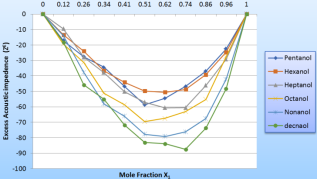
The excess acoustic impedance (ZE) data of all the binary mixtures of 1,3-Dioxolane with Pentanol, Hexanol, Heptanol, Octanol, Nonanol and Decanol are graphically presented Figure 3 at 298.15 K and atmospheric pressure. An examination of curves in Figure 3 shows that the values of excess acoustic impedance (ZE) data for 1,3-Dioxolane with Pentanol, Hexanol, Heptanol, Octanol, Nonanol and Decanol are negative over the entire composition range at 298.15 K.
Figure 3. Curves of excess acoustic impedance (ZE) against the mole fraction of 1,3-dioxolane x1, for the binary mixture (1,4-dioxane (1) + Alkanols (2)) at 298.15K and atmospheric pressure. The solid lines represent the values calculated from the Redlich−Kister equation.

The variation of excess acoustic impedance (ZE) with mole fraction of 1,3-Dioxolane at 298.15K are shown in figure 3. It is observed the excess acoustic impedance (ZE) data for 1,3-Dioxolane with Pentanol, Hexanol, Heptanol, Octanol, Nonanol and Decanol are negative over the entire composition range at 298.15 K. This is in agreement with requirement as both ultrasonic velocity and density increase with increase in concentration of the solute and also effective due to solute – solvent interaction.
5. Conclusions
From experimental results, negative excess molar volume (VmE) and excess adiabatic compressibility (βadE) values can be attributed to the dipole –dipole interactionsbetween unlike molecules through hydrogen bonding and positive values indicate that the effect due to breaking up of self-associated structures of the components of the mixtures is dominant over the effect of H-bonding and dipole-dipole interaction between unlike molecules The positive values of Excess molar volume (VmE) and excess adiabatic compressibility (βadE) may be attributed to the formation of hydrogen bonding (O-H….O) resulting in the formation of complexes between the component molecules and negatives values suggesting breaking of the self-associated alcohols and weak interactions between unlike molecules. From these data, several thermodynamic excess functions have been calculated and correlated using the Redlich – Kister type polynomial equation. The sign and magnitude of these quantities have been discussed in terms of hydrogen bond, electron-transfer complexes and dipole-dipole interactions between the component molecules.
Abbreviations

ρ

Density of Liquid

u

Sound Velocity

𝑢𝐸

Excess Sound Velocity

η

Viscosity

ηE

Excess Viscosity

βad

Adiabatic Compressibility

βadE

Excess Adiabatic Compressibility

Vm

Molar Volume

VmE

Excess Molar Volume

Z

Acoustic Impedance

ZE

Excess Acoustic Impedance

X1

Mole Fraction of 1,3-Dioxolane

𝑌𝐸

Thermodynamic Excess Function

Acknowledgments
The authors thank the Bundelkhand University authorities for providing the necessary facilities to carry out the work.
Author Contributions
Ravi Kant Mishra: Data curation, Investigation
Dhirendra Kumar Sharma: Methodology, Supervision, Writing – original draft
Chandra Pal Prajapati: Formal Analysis, Software
Funding
The author(s) reported there is no funding associated with the work featured in this article.
Data Availability Statement
All data generated or analyzed during this study are included in this published article.
Conflicts of Interest
The authors declare no conflicts of interest.
References
[1] V. Armugam, R. Sanjeevi, D. Raghunadha Rao, B. Shameem, Clssical areas of Pheno-menology (Including applications)- Ultrasonic studies on edible oils, Indian Journal of Pure and Applied Physics, 36, 578-583 (1998);
[2] A. Ali, S. Hyder, A. K. Nain, Studies on molecular interactions in binary liquid mixtures by viscosity and ultrasonic velocity measurements at 303.15K, Journal of Molecular Liquids, 79, 89-99 (1999);
[3] S. C. Bhatt, H. K. Semwal, V. Lingwal, B. S. Semwal, Acoustical parameters of some molecular liquids, J. Acous. Soc. India., 28, 293-296 (2000).
[4] A. Ali, S. Hyder, A. K. Nain, Study of intermolecular interaction in binary liquid mixtures through ultrasonic speed measurement, Journal of Pure and AppliedUltrasonics, 23, 73-79 (2001);
[5] A. Ali, A. Yasmin A. K. Nain, Study of intermolecular interactions in binary liquid mixtures through ultrasonic speed measurements, Indian Journal of Pure and Applied Physics, 40, 315-322 (2002);
[6] S. Anuradha, S. Prema, K. Rajagopal, Ultrasonic studies on molecular interactions in binary mixtures of acetonitrile with carbonyl molecules, Journal of Pure and Applied Ultrasonics, 27, 49-54 (2005);
[7] J. A. Al-Kandary, A. S. Al-Jimaz, A. H. M. Abdul-Latif, Viscosities, densities and speeds of sound of binary mixtures of toluene, o-xylene, m-xylene, p-xylene and mesitylene with anisole at 288.15K, 293.15K AND 303.15K, Journal of Chemical and Engineering Data, 51, 2074-2082 (2006);
[8] L. Palaniappan, R. Thiyagarajan, Effect of aniline in methanol + benzene mixture - An ultrasonic study, Ind. J. Chem., 47B, 1906-1909 (2008);
[9] A. Tadkalkar, P. Pawar, G. K. Bichile, Studies of acoustic and thermodynamic properties of citric acid in double distilled water at different temperatures, J. Chem. Pharm. Res., 3(3), 165-168 (2011);
[10] J. N. Ramteke, Ultrasonic study of molecular interaction in binary liquid mixture containing α-picolin in ethanol at 301.15K and 305.15K, Advances in Applied Science Research, 3(3), 1832-1835 (2012);
[11] C. Yang, H. Lal, P. Ma, Density and viscosity of binary mixtures diethyl carbonate with alcohols at 293.15 to 363.15 K and predictive results by unifacvisco group contribution method, Journal of Chemical and Engineering Data, 51, 1345-1358 (2006);
[12] S. C. Bhatia, R. Bhatia, G. P. Dubey, Thermo-physical and sono chemical behavior of binary mixtures of hehxan-1-ol with halo hydrocarbons at 303.15K, Journal of Molecular Liquids, 152, 39-52 (2010);
[13] A. H. Zainab, Al-Dulaimy, T. A. Dhafir, Al-Heetimi, Husam Saleem Khalaf, Ahmed Mohammed Abbas, Excess molar quantities of binary mixture of dipropyl amine with aliphatic alcohols at 298.15 K. Oriential Journal of Chemistry, 34(4), 2074-2082 (2018);
[14] G. P. Dubey, Monika Sharma, Excess volumes, densities, speed of sound and viscosities for the binary systems of 1-Octanol with hexadecane and squalane at (298.15, 303.15 and 308.15) K. Int. J Thermo phys 24, 1361-1375 (2008);
[15] J. A. Al-Kandary, A. S. Al-Jimaz, A. H. M. Abdul-Latif, Densities, viscosities, speeds of sound and refractive indices of binary mixtures of tetra hydro furan with 1-hexanol, 1-heptanol, 1-octanol, 1-nonanol, 1-decanol at 298.15, 303.15, and 313.15 K. Physics and Chemistry of Liquids, 47(2), 210-224 (2009);
[16] M. Indumati, G. Meenakshi, V. J. Priyadharshini, R. Kayalvizhi, S. Thiyagaraj, Theoretical evaluation of ultrasonic velocity and excess parameters in binary liquid mixtures of bromobenzene with alkanols. Research Journal of Pharmaceutical, Biological and Chemical Science 4(2), 1332-1384 (2013);
[17] Riju Chanda, A. Banerjee, R. N. Mahendra, Studies of viscous antagonism, excess molar volumes, viscosity deviation and isentropic compressibility of ternary mixtures containing N,N-di methyl formamide, benzene and some ethers at 298.15 K. Journal of Serbian Chemical Society, 75(12), 1721-1732 (2010);
[18] I. Giner, M. Haro, I. Gascon, C. Lafuente, Thermodynamic properties of binary mixtures formed by cyclic ethers and chloro alkanes. Journal of Thermal Analysis and Calorimetry, 2, 587-595 (2007);
[19] Anil kumar, C. Srinivasu, Speeds of Sound and Excess molar volume for binary mixture of 1,4-Dioxane with 1-Heptanol at five Temperatures. Advance in Chemistry, 2014, 1-7 (2014);
[20] C. Bhatia Subhash, R. Rani, J. Sangwan, R. Bhatia, Densities, viscosities, speed of sound, refractive indices of binary mixtures of 1-Decanol with Isomeric Chloro toluene. Int J Thermo phys, 32, 1163-1174 (2011);
[21] P. K. Banipal, V. Singh, N. Kaur, R. Sharma, S. Thakur, M. Kaur, T. S. Banipal, Physico-Chemical studies on binary mixtures of 1,4-Dioxane and Alkan-1-ols at 298.15K, Acad. Sci. India. Sec. A Phys. Sci. 88(4), 479-490 (2017);
[22] V, Venkatalakshmi, M. Gowrisankar, P. Venkateswarlu, K. S. Reddy, Density, Ultrasonic velocity and their excess parameters of the binary mixtures of 2-Methyl-aniline with 1-Alkanols (C3-C8) at different temperatures, International Journal of Physics and Research, Vol. 3 Issue 5, 33-44 (2013);
[23] G, Douhéret, M. L. Davis, J. C. R. Reis, M. J. Blandamer, Isentropic compressibility- experimental origin and the quest for their rigorous estimation in thermodynamically ideal liquid mixtures. Chem. Phys. Chem. 2, 148−161, (2001);
[24] P. J. Victor, D, Das, D. K. Hazra, Excess molar volumes, viscosity deviations and isentropic compressibility changes in binary mixtures of N,N-dimethylacetamide with 2-methoxy ethanol and water in the temperature range 298.15 to 318.15 K. J. Indian Chem. Soc. 81, 1045−1050 (2004);
[25] Y. Marcus, Introduction of liquid state Chemistry, Wiley Interscience, New York, (1977).
[26] U. Sri Devi, K. Samatha, A. Visvanantasarma, J. Pure & Appl. Ultrason., 26, 1-11 (2004);
[27] R. J. Fort, & W. R. Moore, Trans Faraday Soc. 61, 2102-2111 (1965);
Cite This Article
  • APA Style

    Mishra, R. K., Sharma, D. K., Prajapati, C. P. (2024). Excess Molar Volume and Deviations in Viscosity of the Binary Liquid Mixtures Containing 1,3-Dioxolane + Alkanols at T = 298.15k. American Journal of Heterocyclic Chemistry, 10(1), 13-25. https://doi.org/10.11648/j.ajhc.20241001.12

    Copy | Download

    ACS Style

    Mishra, R. K.; Sharma, D. K.; Prajapati, C. P. Excess Molar Volume and Deviations in Viscosity of the Binary Liquid Mixtures Containing 1,3-Dioxolane + Alkanols at T = 298.15k. Am. J. Heterocycl. Chem. 2024, 10(1), 13-25. doi: 10.11648/j.ajhc.20241001.12

    Copy | Download

    AMA Style

    Mishra RK, Sharma DK, Prajapati CP. Excess Molar Volume and Deviations in Viscosity of the Binary Liquid Mixtures Containing 1,3-Dioxolane + Alkanols at T = 298.15k. Am J Heterocycl Chem. 2024;10(1):13-25. doi: 10.11648/j.ajhc.20241001.12

    Copy | Download

  • @article{10.11648/j.ajhc.20241001.12,
      author = {Ravi Kant Mishra and Dhirendra Kumar Sharma and Chandra Pal Prajapati},
      title = {Excess Molar Volume and Deviations in Viscosity of the Binary Liquid Mixtures Containing 1,3-Dioxolane + Alkanols at T = 298.15k
    },
      journal = {American Journal of Heterocyclic Chemistry},
      volume = {10},
      number = {1},
      pages = {13-25},
      doi = {10.11648/j.ajhc.20241001.12},
      url = {https://doi.org/10.11648/j.ajhc.20241001.12},
      eprint = {https://article.sciencepublishinggroup.com/pdf/10.11648.j.ajhc.20241001.12},
      abstract = {Thermodynamic and transport properties of liquid and liquid mixtures have been used to understand the intermolecular interactions between the components of the mixture. The sound velocity, density and viscosity of binary liquid mixtures are important from practical and theoretical point of view to understand the liquid theory. In the present study sound velocity, density and viscosity have been measured of binary mixtures of 1, 3-dioxolane with pentanol, hexanol, heptanol, octanol, nonanol and decanol over the entire range of mole fraction at 298.15K, and atmospheric pressure. From these experimental measurements the excess molar volume (VmE), excess viscosity (ηE), acoustic impedance (ZE) and excess adiabatic compressibility (βadE), have been calculated. The excess molar volume (VmE), excess viscosity (ηE), acoustic impedance (ZE) and excess adiabatic compressibility (βadE), have been analyzed in terms of interactions arising due to structural effect, charge-transfer complexes and dipole-dipole interaction between unlike molecules. These deviations have been correlated by a polynomial Redlich-Kister equation. The excess properties are found to be eighter negative or positive depending on the molecular interactions and nature of the liquid mixtures. Excess properties provide important information in understanding the solute-solvent interaction in a solution. The excess molar volume (VmE), excess viscosity (ηE), acoustic impedance (ZE) and excess adiabatic compressibility (βadE), values have been interpreted to terms of the nature of intermolecular interactions between constituent molecules of mixtures.
    },
     year = {2024}
    }
    

    Copy | Download

  • TY  - JOUR
    T1  - Excess Molar Volume and Deviations in Viscosity of the Binary Liquid Mixtures Containing 1,3-Dioxolane + Alkanols at T = 298.15k
    
    AU  - Ravi Kant Mishra
    AU  - Dhirendra Kumar Sharma
    AU  - Chandra Pal Prajapati
    Y1  - 2024/09/29
    PY  - 2024
    N1  - https://doi.org/10.11648/j.ajhc.20241001.12
    DO  - 10.11648/j.ajhc.20241001.12
    T2  - American Journal of Heterocyclic Chemistry
    JF  - American Journal of Heterocyclic Chemistry
    JO  - American Journal of Heterocyclic Chemistry
    SP  - 13
    EP  - 25
    PB  - Science Publishing Group
    SN  - 2575-5722
    UR  - https://doi.org/10.11648/j.ajhc.20241001.12
    AB  - Thermodynamic and transport properties of liquid and liquid mixtures have been used to understand the intermolecular interactions between the components of the mixture. The sound velocity, density and viscosity of binary liquid mixtures are important from practical and theoretical point of view to understand the liquid theory. In the present study sound velocity, density and viscosity have been measured of binary mixtures of 1, 3-dioxolane with pentanol, hexanol, heptanol, octanol, nonanol and decanol over the entire range of mole fraction at 298.15K, and atmospheric pressure. From these experimental measurements the excess molar volume (VmE), excess viscosity (ηE), acoustic impedance (ZE) and excess adiabatic compressibility (βadE), have been calculated. The excess molar volume (VmE), excess viscosity (ηE), acoustic impedance (ZE) and excess adiabatic compressibility (βadE), have been analyzed in terms of interactions arising due to structural effect, charge-transfer complexes and dipole-dipole interaction between unlike molecules. These deviations have been correlated by a polynomial Redlich-Kister equation. The excess properties are found to be eighter negative or positive depending on the molecular interactions and nature of the liquid mixtures. Excess properties provide important information in understanding the solute-solvent interaction in a solution. The excess molar volume (VmE), excess viscosity (ηE), acoustic impedance (ZE) and excess adiabatic compressibility (βadE), values have been interpreted to terms of the nature of intermolecular interactions between constituent molecules of mixtures.
    
    VL  - 10
    IS  - 1
    ER  - 

    Copy | Download

Author Information